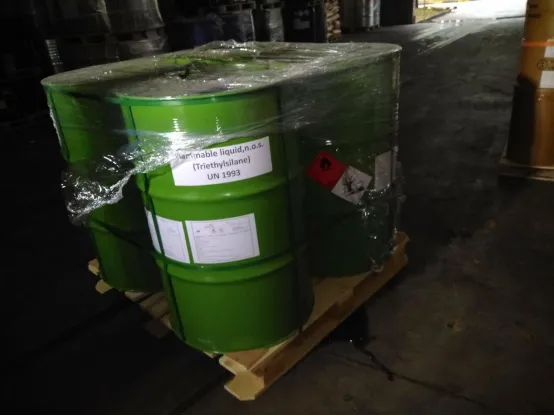

Tri ethylsilane Basic information
|
Product Name:
|
Tri ethylsilane
|
|
Synonyms:
|
Triethylsilyl; Silane, triethyl;Triethylsilicon; Triethylsilyl hydride
|
|
CAS:
|
617-86-7
|
|
MF:
|
C6H16Si
|
|
MW:
|
116.28
|
|
EINECS:
|
210-535-3
|
Tri ethylsilane Chemical Properties
|
Melting point
|
-157°C
|
|
Boiling point
|
107-108 °C(lit.)
|
|
density
|
0.728 g/mL at 25 °C(lit.)
|
|
vapor pressure
|
>1 hPa (20 °C)
|
|
refractive index
|
n20/D 1.412(lit.)
|
|
Fp
|
25 °F
|
|
storage temp.
|
2-8°C
|
|
form
|
liquid
|
|
color
|
colorless
|
|
Specific Gravity
|
0.728
|
|
Water Solubility
|
Miscible with water.
|
|
Sensitive
|
Moisture Sensitive
|
|
BRN
|
1098278
|
|
Stability:
|
Stable, but moisture sensitive. Highly flammable. Generates highly flammable gas (hydrogen) in contact with water, acids and bases.
|
Tri ethylsilane Usage And Synthesis
|
Reference
|
Triethylsilane is a useful versatile reductant since it has a active hydride. It can be used for mediated the palladium-catalyzed dehalogenation reaction of alkyl or aryl halides, the reduction of primary, secondary, and tertiary chlorides, bromides, and iodides catalyzed by iridium, as well as efficient reduction of multiple bonds, azides, imines, and nitro groups, as well as benzyl group and allyl group deprotection. It is also specifically for the hydrosilation of olefins to give alkyl silanes. It is also the catalyst for synthesis of a spiro-oxindole blocker of Nav1.7 for the treatment of pain, redox initiated cationic polymerization and Beckmann rearrangement of cyclododecanone oxime as well as regioselective reductive coupling of enones and allenes.
|
|
Chemical Properties
|
Clear liquid
|
|
Uses
|
Triethylsilane is a trialkylsilicon hydride used in the synthesis of alkylsilanes via hydrosilation of olefins. Triethylsilane is also used as an effective reducing agent.
|
|
Uses
|
Triethylsilane is used as a reducing agent inmany organic synthetic reactions.
|
|
Fire Hazard
|
Highly flammable; flash point -4°C (25°F) (Aldrich 1996).
It does not ignite spontaneously in air, but it can explode on heating. The ease of oxidation of this compound is relatively lower than mono- and dialkylsilanes. Reaction with oxidizing substances, however, can be violent. Reaction with boron trichloride could be explosive at room temperature. Even at 78°C ( 108°F), mixing these reagents caused pressure buildup and combustion (Matteson 1990). |
Hot Tags: CAS NO.617-86-7-Tri Ethyl Silane, China, manufacturers, suppliers, factory, custom, wholesale, Anti Hyperlipidemia Drugs