Recently, a research team led by Zhong Chao from the Shenzhen Institute of Advanced Technology of the Chinese Academy of Sciences, in collaboration with a team led by Liu Yan from the Ruijin Hospital affiliated with Shanghai Jiao Tong University School of Medicine, published a significant research finding in the top-tier international journal *Advanced Materials* - they successfully developed an integrated dressing named T-BC, offering a breakthrough solution for burn wound care.
The "tough nut to crack" in burn treatment: the dual dilemma of hemostasis and healing
In clinical burn treatment, early debridement is a critical step in removing necrotic tissue, but the procedure often involves severe bleeding. If hemostasis is not achieved promptly, it not only increases the risk of infection but also delays wound healing, causing patients to endure additional suffering.
However, existing treatment methods each have their limitations:
Electrocoagulation hemostasis is fast but may cause "thermal damage" to surrounding healthy tissue;
Traditional hemostatic agents either cause rebleeding during dressing changes or have poor adhesion and insufficient strength, making them ineffective for complex wounds.
More challenging is the difficulty in balancing hemostasis and promoting healing. Is there a material that can both quickly stop bleeding and provide "boosting power" for wound repair?
From nature to innovation: The "birth secret" of T-BC dressings
The research team turned their attention to two "natural tools":
Biocellulose (BC): A natural membrane material formed by bacteria on the surface of culture medium, featuring a nanoscale mesh structure, excellent breathability, high mechanical strength, and the ability to maintain a moist wound environment, making it an ideal dressing substrate. However, it lacks hemostatic functionality.
Thrombin: The "key enzyme" in blood clotting, it rapidly catalyzes the formation of blood clots from fibrinogen. However, natural thrombin is easily degraded by bodily fluids and cannot be retained at the wound site.
How can the two be effectively combined? The team devised a clever method: using a cellulose-binding domain (CBD) as a "molecular adhesive" to anchor human thrombin to the BC membrane surface.
This fusion protein requires no complex chemical modifications; it can stably bind to BC with simple immersion. The resulting T-BC dressing retains BC's natural advantages while imparting sustained hemostatic activity-the entire process is environmentally friendly, safe, and scalable for mass production.
Proven efficacy: Impressive performance from laboratory to animal models
How does the T-BC dressing perform in real-world applications? Experimental data provides the answer:
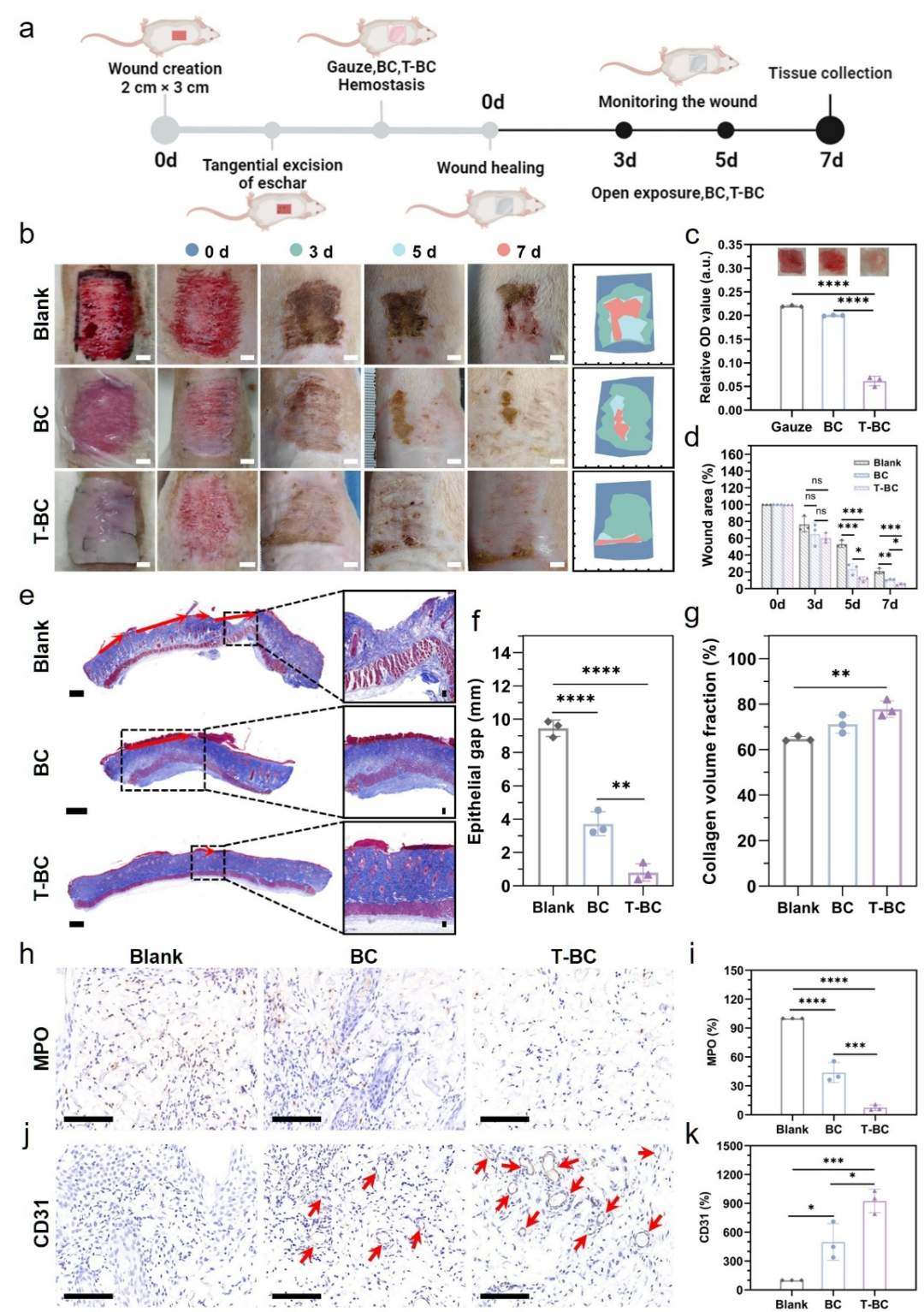
Rapid hemostasis: In a rat liver incision model, the T-BC dressing achieved effective hemostasis within 1 minute, significantly outperforming traditional materials in reaction speed.
Accelerated healing: In a rat model simulating deep second-degree burns, wounds treated with T-BC exhibited a significantly higher closure rate by day 5 compared to the untreated group, while also regulating key repair pathways such as angiogenesis and inflammation resolution.
Safe and reliable: Multiple tests, including cytotoxicity and hemolytic activity, demonstrate that the T-BC dressing has excellent biocompatibility and does not cause additional tissue damage.
Beyond "hemostasis": Opening new avenues for wound repair
The significance of this T-BC dressing extends far beyond addressing the "hemostasis challenge." It has achieved the integration of "immediate hemostasis" and "long-term wound healing" for the first time, filling a technical gap in burn wound care.
More importantly, its "modular design" concept provides a new direction for future wound material research and development-by precisely regulating protein function and material properties, customized treatment solutions for more complex wounds such as diabetic foot ulcers and chronic ulcers may be developed.
Currently, this research has received support from multiple projects, including the National Key Research and Development Program, and the team is advancing clinical translation efforts. In the future, we may see this "dual-effect dressing" in hospitals, offering burn patients faster and safer recovery experiences.