The phage genome contains the nucleobase chemical diversity that is widely present in all life forms. Certain DNA viruses that infect the host (such as cyanobacteria, proteobacteria, and actinomycetes) have the phenomenon that amino adenine completely replaces adenine, thereby forming three hydrogen bonds with thymine, which violates the Watson-Crick pairing rule. Amino adenine encoding DNA polymerase homologous to the bacterial DNA polymerase I Klenow fragment containing 3-exonuclease but lacking 5-exonuclease activity was found in deoxynucleoside triphosphates with thymine as the template During the incorporation process, amino adenine is preferentially used instead of adenine.
The polymerase gene occurs at the same time as the gene of the biosynthetic enzyme, which produces amino adenine deoxynucleotides in various bacteriophages of Schizospora virus. The phylogenetic clustering of polymerases and biosynthetic enzymes indicated that aminoadenine and adenine have accompanied DNA replication since the ancient evolutionary stage.
Related paper information:
Https://doi.org/10.1126/science.abe6542
Source:ChemNet
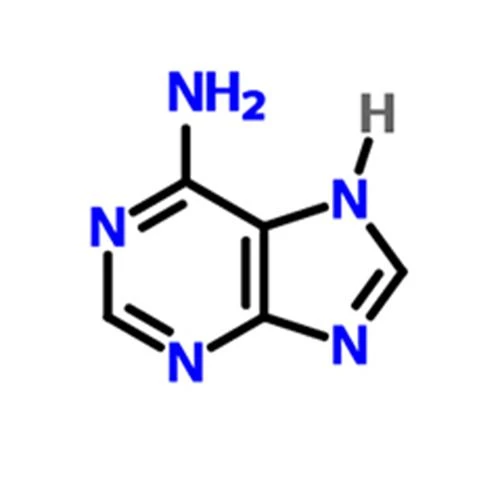
Adenine CAS NO.73-24-5
adenine is one of the purine nitrogenous bases that composes DNA and RNA
composed of two carbon–nitrogen rings. Adenine bonds with thymine in DNA and with uracil in RNA (see base pairing rule)
it is also a major component of other molecules such as adenosine triphosphate.