Nerve injury can cause permanent neurological dysfunction due to limited axonal regeneration, and injury-dependent and non-independent mechanisms can provide important insights into neuronal regeneration. However, commonalities that support neural regeneration remain elusive, and comparative analyses of transcriptomic datasets related to the regenerative capacity of neurons reveal that circadian rhythms may be the most significantly enriched pathway. In a recent study published in the international journal Cell Metabolism entitled "The circadian clock time tunes axonal regeneration," scientists from the University of Geneva and other institutions in Switzerland found that The circadian clock may regulate axonal regeneration and repair.
In the article, the researchers found that in a mouse model of sciatic nerve injury, dorsal root ganglia (DRG) sensory neurons have an endogenous molecular clock that may optimize axonal regeneration; in addition, they also elucidated that the use of time-active drugs such as lithium, which are currently used in clinical practice for the treatment of human neurological disorders, may be able to promote axonal regeneration. The results of the study may provide scientists with the opportunity to optimize the regeneration of axons. The findings may pave the way for scientists to utilize clock-related therapies and timed neurorehabilitation strategies to treat patients with peripheral nervous system (PNS, Peripheral Nervous System) injuries.
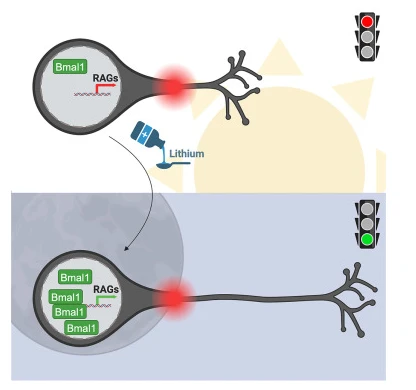
The biological clock may regulate the body's axonal regeneration and repair damage.
Image credit: Cell Metabolism (2023). DOI:10.1016/j.cmet.2023.10.012
Our findings suggest that the biological clock may regulate axonal regeneration, and that we can tap into this mechanism by redirecting the use of lithium (a time-active drug used to treat neurological disorders) to promote axonal regeneration; what's more, the findings also suggest the use of chronotherapy and neurorehabilitation to improve the concept of neural repair in the body.
Taken together, the results of this paper suggest that the molecular clock may be able to fine-tune the regenerative capacity of sensory neurons, and the researchers also propose that compounds affecting the clock pathway may serve as a new approach to treating and promoting the repair of neurological injuries in the body.