The nucleolar scaffolding protein NPM1 is a multifunctional regulator of cellular homeostasis, genome integrity, and stress response, and mutations in NPM1 may promote its aberrant cytoplasmic localization, which is also the most common genetic alteration in acute myeloid leukemia (AML), a cellular feature of AML that is dependent on elevated autophagic flux. Recently, a study published in the international journal Cell Reports entitled "An atypical GABARAP binding module drives the pro-autophagic potential of the AML-associated NPM1c In the study entitled "An atypical GABARAP binding module drives the pro-autophagic potential of the AML-associated NPM1c variant", published in the international journal Cell Reports, scientists from Goethe University and other institutions have investigated the pathogenesis of AML, a disease that occurs predominantly in adulthood and is often fatal in older patients. gene, which contains instructions for the production of the NPM1 protein.
Now that researchers have known that NPM1 mutants (NPM1c) are an important factor in the development of leukemia, they have discovered a new way of mutating the NPM1c gene; based on this, altered cellular proteins may be able to intervene in the process of autophagy, which is an important cellular process that encompasses the metabolic pathways by which cells recycle their own structures, and, on the one hand, this self-digestion helps to remove defective molecules On the one hand, this self-digestion helps to remove defective molecules; on the other hand, it also encourages the cell to meet the demand for important basic components, including in the presence of nutrient deficiencies or increased levels of cellular proliferation, which is a key characteristic of cancer cells.
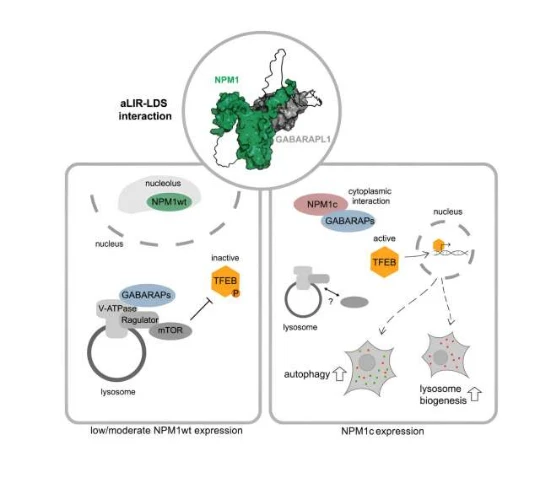
Leukemia cells may be able to activate the cellular recycling program.
Image from: Cell Reports (2023). DOI:10.1016/j.celrep.2023.113484
During autophagy, the cell initially produces a type of waste bag, the autophagosome, into which cellular components are loaded and broken down and recycled when necessary; this waste bag is then transported to the cell's recycling center, the lysosome, where its contents are broken down with the help of acids and enzymes; from there, the cell is recycled to the lysosome, which is the recycling center of the cell. and enzymes; from here, the basic components are released into the cell and reused, and today the researchers have found that NPM1c promotes the production of autophagosomes and lysosomes.
In addition, the researchers have explained why NPM1c produces these affective effects by binding to and activating a central regulator of the autophagosome-lysosome system called GABARAP. Through computational simulations, the researchers have demonstrated that the binding of NPM1c to GABARAP may have an atypical structure; and the experimental structural biology data support the simulations, on which the researchers may hope to develop new technologies that can be used in the production of autophagosomes and lysosomes. Based on these results, researchers may be able to develop active substances to specifically affect the binding of NPM1c to GABARAP to effectively combat leukemia growth.
Taken together, the results of this paper suggest that researchers have reported an atypical binding pattern of GABARAP family members that may be able to drive the pro-autophagic potential of NPM1c, thereby potentially facilitating the development of therapeutics.