Dementia, a global health problem with a high economic and social burden. There are about 57.4 million cases of dementia worldwide, with about 10 million new cases each year. In China, there are tens of millions of patients, ranking first in the world. Despite much effort from the scientific community, there is still no very effective treatment program to prevent or cure it.
Colorful vegetables and fruits are very beneficial to health. These foods are usually rich in various vitamins, minerals and antioxidants, which play an important role in the proper functioning of the body and in the prevention of diseases.
In general, red vegetables and fruits (e.g. tomatoes, strawberries) are rich in lycopene and vitamin C, which help to boost the immune system, maintain heart health and antioxidants. Orange vegetables and fruits (e.g. carrots, citrus) are rich in beta-carotene and vitamin A, which help maintain good vision, promote skin health and strengthen the immune system. Yellow vegetables and fruits (e.g., bananas, pineapples) are rich in vitamin C and fiber, which help improve digestive function and boost the immune system.
Recently, researchers from the Virginia Tech Carilion School of Medicine published an article in the Journal of Alzheimer's Disease entitled " Low Xanthophylls, Retinol, Lycopene, and Tocopherols in Grey and White Matter of Brains with Alzheimer's Disease".
The study showed that levels of dietary lutein, zeaxanthin, lycopene, and vitamin E were halved in the brains of people with Alzheimer's disease compared to normal brains, suggesting that people whose diets are rich in lutein, zeaxanthin, lycopene, and vitamin E, which are associated with better cognitive functioning, are at a significantly lower risk of developing Alzheimer's disease.
In the study, the researchers analyzed Alzheimer's disease (AD) brains and healthy elderly (HE) brains, analyzing a total of 15 brain samples, and extracted the levels of lutein, zeaxanthin, and lycopene in the brain samples through a series of processes to compare the differences in micronutrients between AD brains and HE brains.
The analyses found significantly lower concentrations of lutein, zeaxanthin, lycopene, retinol, and alpha-tocopherol in the brains of AD patients, with lycopene and zeaxanthin being the two most deficient antioxidants, and significantly higher levels of a yet-to-be-identified lutein (XMiAD).
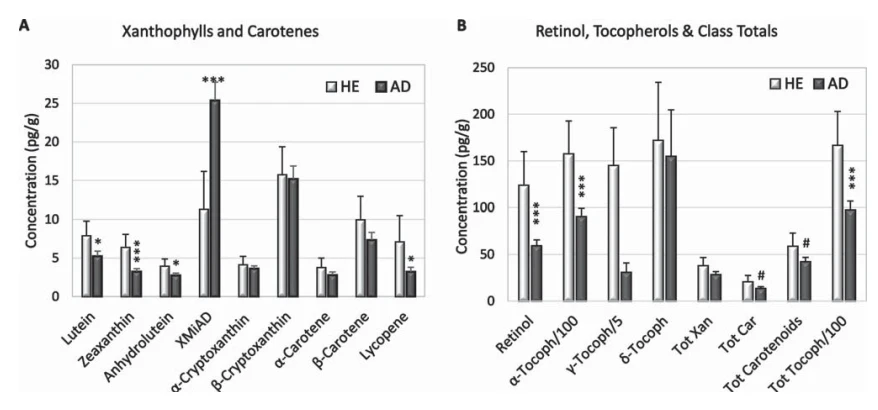
HE and AD micronutrients in the brain
Analysis of lutein and zeaxanthin revealed that analyte concentrations in gray matter were higher than those in white matter, with lutein concentrations in gray matter of HE and AD brains being 1.8 and 2.0 times higher than those in white matter, and 1.7 and 1.8 times higher than those in zeaxanthin.
In addition, zeaxanthin in both white and gray matter was lower in AD brains than in HE brains, and healthy brains had 1.5 times more lutein and 2 times more zeaxanthin than AD brains, suggesting the presence of lutein and zeaxanthin deficiencies in AD brains.
Finally, the researchers also analyzed the extent of deficiencies in various micronutrients and found that the greatest deficiency in AD brains was lycopene, with AD brains having only 38.8% of the HE brain's lycopene, followed by retinol (46.5% of the HE brain's), zeaxanthin (48.9% of the HE brain's), alpha tocopherol (53.7% of the HE brain's), dehydrated lutein, and lutein (HE 62% of the brain).
Importantly, the lack of zeaxanthin and retinol in AD gray matter was striking, with only 6% of the samples reaching the average concentrations found in HE brains.
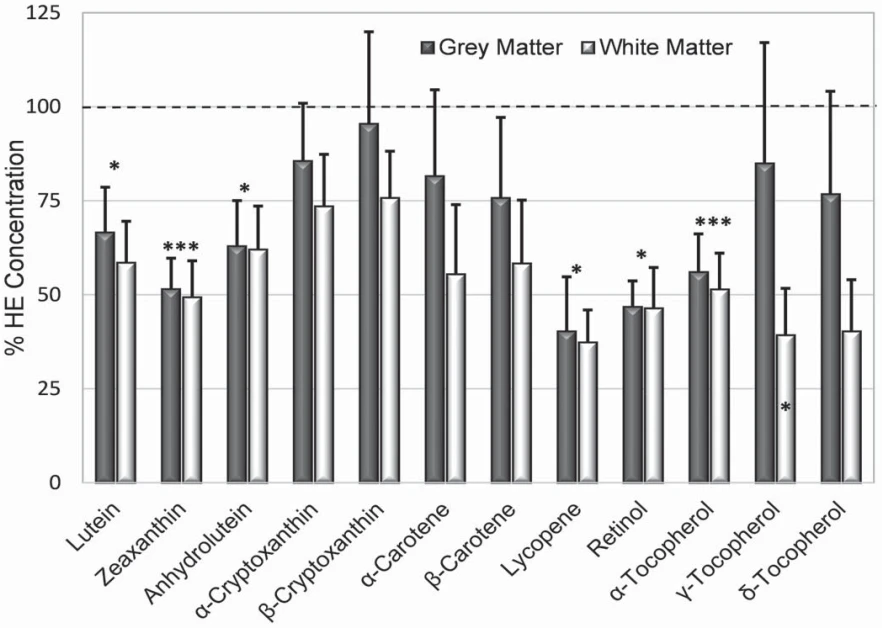
Levels of micronutrient deficiencies in the AD brain
This is the first report to compare retinol, carotenoid, and tocopherol levels in the brains of patients with established AD neuropathology with those of healthy older adults, and the deficiencies of lutein, zeaxanthin, and lycopene in AD brains are consistent with previous findings, the researchers said.
In summary, the study showed significantly lower concentrations of lycopene, retinol, zeaxanthin, and lutein in AD brains compared to HE brains, suggesting that people with diets rich in lutein, zeaxanthin, lycopene, and vitamin E have a significantly lower risk of developing Alzheimer's disease.
It is worth mentioning that as early as July 28, 2021, Harvard University scholars, Professor Yuan Changzheng of Zhejiang University and others published a research paper in the journal " Neurology" entitled " Long-term Dietary Flavonoid Intake and Subjective Cognitive Decline in US Men and Women".
Researchers analyzed over 70,000 people in the US for up to 20 years and found that daily consumption of colorful fruits and vegetables was associated with a 20% lower risk of subjective cognitive decline. This suggests that a simple change in diet can help prevent cognitive decline and thus Alzheimer's disease.