Renal cell carcinoma (RCC) is a common malignant tumor with a significant increase in incidence over the past two decades. Clear cell renal cell carcinoma (ccRCC) is the most common histologic subtype, accounting for approximately 75% of all RCC cases. Even with improved methods of early detection, approximately 30% of patients diagnosed with RCC already exhibit distant metastases, while another 30% of patients with locally or locally advanced RCC progress to metastatic RCC after surgical intervention.
Unfortunately, even with targeted therapy and immunotherapy, the 5-year survival rate for patients with metastatic RCC is less than 10%. Therefore, an in-depth understanding of the molecular mechanisms driving RCC metastasis is critical to finding new therapeutic targets and improving the overall prognosis of patients.
Recently, researchers from Southern Medical University published an article entitled "CircPPAP2B controls metastasis of clear cell renal cell carcinoma via HNRNPC-dependent alternative splicing and targeting the miR-182-5p/CYP1B1 axis" in Molecular Cancer. alternative splicing and targeting the miR-182-5p/CYP1B1 axis" in Molecular Cancer, which reveals that CircPPAP2B controls metastasis of clear cell renal cell carcinoma via HNRNPC-dependent alternative splicing and targeting the miR-182-5p/CYP1B1 axis. cell renal cell carcinoma metastasis.
Renal cell carcinoma is one of the most common malignant tumors worldwide. Metastasis is the leading cause of renal cancer-related death. Circular rna (circRNAs) are a class of non-coding rna that have emerged as important regulators of cancer metastasis. However, the functional roles and regulatory mechanisms of circRNAs in RCC metastasis remain largely unknown.
Investigators used high-throughput RNA sequencing to analyze the expression profiles of circRNAs and mrna in highly invasive and less invasive clear cell renal cell carcinoma (ccRCC) cell lines. Functional experiments were performed to reveal the regulatory role of circPPAP2B in the proliferation and metastatic ability of ccRCC cells. The molecular mechanisms by which circPPAP2B promotes ccRCC metastasis were elucidated by RNA pull-down, mass spectrometry, RNA methylation immunoprecipitation (MeRIP), RNA immunoprecipitation (RIP), co-immunoprecipitation (CoIP), next-generation RNA sequencing, and dual luciferase assays.
In this study, the investigators describe a newly identified circular RNA circPPAP2B, which is overexpressed in highly invasive ccRCC cells, as determined by advanced high-throughput RNA sequencing. In addition, the investigators observed that circPPAP2B was elevated in ccRCC tissues, especially in metastatic ccRCC tissues, and found that it was associated with poor prognosis. Functional experiments showed that circPPAP2B positively stimulated the proliferation and metastatic ability of ccRCC cells.
Mechanistically, circPPAP2B interacts with HNRNPC in an m6a-dependent manner and promotes HNRNPC nuclear translocation. The subcellular relocalization is dependent on the nondegradable ubiquitination of HNRNPC and the stabilization of the HNRNPC/Vimentin/Importin α7 ternary complex. In addition, the investigators found that circPPAP2B regulates the interaction of HNRNPC with splicing factors, PTBP1 and HNPNPK, and regulates pre-mRNA-selective splicing. Finally, this study demonstrated that circPPAP2B acted as a miRNA sponge to directly bind miR-182-5p and increase the expression of CYP1B1 in ccRCC.
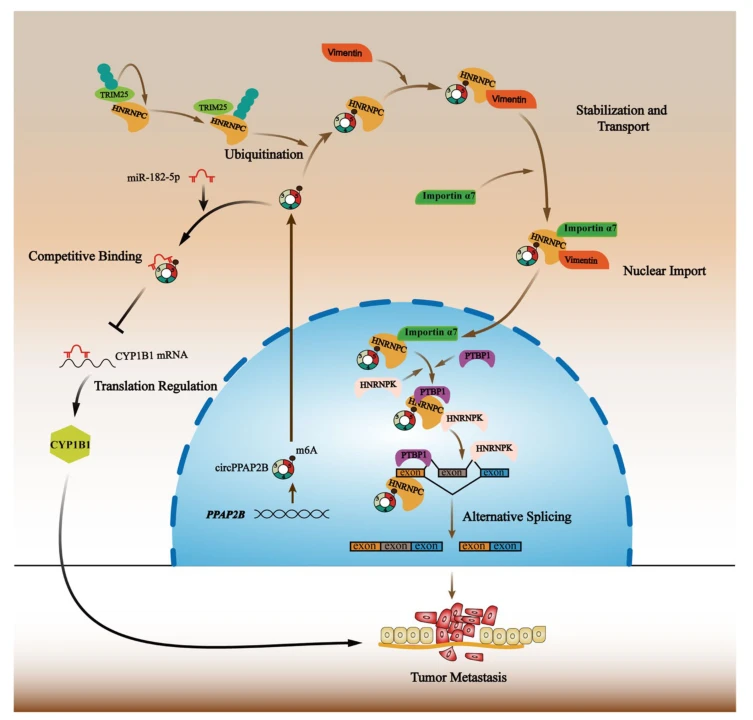
Mechanism Summary Chart
Image from: https://doi.org/10.1186/s12943-023-01912-w
Taken together, this study demonstrates that circPPAP2B plays an important role in ccRCC metastasis. upregulation of circPPAP2B expression levels drives metastasis through multiple pathways. First, circPPAP2B directly interacts with HNRNPC in an m6a-dependent manner. This interaction promotes nuclear translocation of HNRNPC by coordinating the nondegradable ubiquitination of HNRNPC and enhancing the stability of the HNRNPC/Vimentin/ Importin α7 ternary complex.
In addition, circPPAP2B recruits splicing factors PTBP1 and HNPNPK to oversee the regulation of pre-mRNA-selective splicing. Second, circPPAP2B acts as a miRNA sponge, forming a direct binding to miR-182-5p and regulating CYP1B1 expression in ccRCC. The findings of this study provide a comprehensive understanding of the complex mechanistic pathways orchestrated by circPPAP2B, including hnrnpc-dependent alternative splicing and the miR-182-5p/ CYP1B1 axis. These findings emphasize the potential of circPPAP2B as a promising therapeutic target for controlling ccRCC metastasis.