Nowadays, a major pharmacological hypothesis proposed by scientists is that reducing the levels of proteins that promote disease development is often considered beneficial. For example, inhibiting the metastatic activator BACH1 is believed to reduce cancer metastasis, and testing such hypotheses requires methods to accurately adjust the protein levels that promote disease while determining disease phenotype. Recently, in a research report published in the international journal Nature Chemical Biology titled "Non monone invasion landscape by noise aware control of metastasis activator levels", scientists from institutions such as Shixi University proposed a new approach through research that may help them increase or decrease the levels of specific metastatic protein suppressor BACH1 in cells, This may provide a new approach for cancer research, thereby helping to reassess the effectiveness of protein inhibitors in treating diseases. In the article, researchers used a genetic circuit to adjust the level of BACH1, which is a special genetic circuit placed in human breast metastatic cells.
Biomedical medicine relies on the use of protein inhibitors, based on the assumption that reducing the level or activity of disease promoting proteins is usually considered beneficial in the treatment of cancer. Researchers believe that when it comes to oncogenes that produce cancer promoting proteins, manipulating them within cancer cells through "elimination only" (the most common method) may not necessarily be the best way to develop anticancer therapies. Researchers found that BACH1, which is highly expressed in many forms of metastatic cancer, such as lung cancer and breast cancer, may also act as an activator or inhibitor of invasion of triple negative breast cancer cancer cells in culture.
To this end, researchers developed a two-step technology called "pipeline" to generate a "landing pad", where BACH1 or other genes can be safely introduced into any human cell line, like a door that can be opened with the correct key. Subsequently, researchers used various methods, including CRISPR technology, to genetically manipulate cells and generate the "landing pad" that completes the first step; The second step mainly involves developing synthetic genetic circuits to control protein levels, which can prompt them to use a "dimmer switch" to control the level or proportion of BACH1 placed in cancer cells.
Biomedical medicine relies on the use of protein inhibitors, based on the assumption that reducing the level or activity of disease promoting proteins is usually considered beneficial in the treatment of cancer. Researchers believe that when it comes to oncogenes that produce cancer promoting proteins, manipulating them within cancer cells through "elimination only" (the most common method) may not necessarily be the best way to develop anticancer therapies. Researchers found that BACH1, which is highly expressed in many forms of metastatic cancer, such as lung cancer and breast cancer, may also act as an activator or inhibitor of invasion of triple negative breast cancer cancer cells in culture.
To this end, researchers developed a two-step technology called "pipeline" to generate a "landing pad", where BACH1 or other genes can be safely introduced into any human cell line, like a door that can be opened with the correct key. Subsequently, researchers used various methods, including CRISPR technology, to genetically manipulate cells and generate the "landing pad" that completes the first step; The second step mainly involves developing synthetic genetic circuits to control protein levels, which can prompt them to use a "dimmer switch" to control the level or proportion of BACH1 placed in cancer cells.
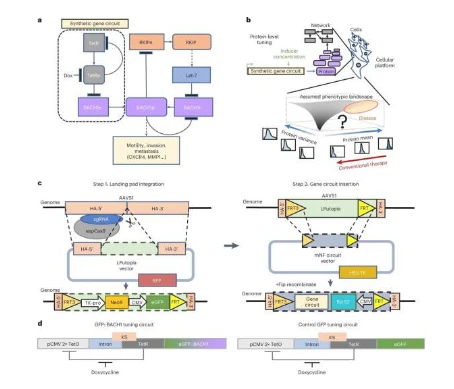
Scientists are expected to rethink and utilize protein inhibitor methods as new cancer therapies.
Researcher Balazsi said that we can imagine this work as a lighting switch, but this switch does not only work in "on" or "off" situations, but also has complex dimming capabilities; Although most research methods involving BACH1 or other cancer promoting proteins turn on (activate) or off (suppress) the light switch, we have a tunable dimmer that allows us to adjust the level of metastatic activators to the middle percentage by logging into the platform. What surprised researchers when detecting BACH1 in cancer cell invasion models was that lowering the level of this protein did not always lead to the metastasis process of cancer cells, and increasing the level of this protein did not always increase the invasion of cancer cells.
The researchers wrote in the article that, unexpectedly, as they increased the level of BACH1, the engineered MDA-MB-231 human breast cancer metastasis cells would become more, and then less and more invasive, which is unrelated to the original BACH1. The expression of BACH1 undergoes transformation in invasive cells, and the expression of BACH1 transcription targets also confirms the non monotonic phenotype and regulatory effects of BACH1. Therefore, chemical inhibition of BACH1 may have unnecessary effects on the invasion of cancer cells. The researchers also found that adjusting the BACH1 section to an intermediate level (i.e. the middle position of the dimmer) actually inhibits the invasion process of cancer cells, just like colleagues pushing the dimmer knob, where the light does not become so bright.
Researchers believe that when it comes to metastasis and proteins that seem to drive cancer progression, our research findings seem to provide a cautionary tale, that is, we need to carefully study these proteins and genes and their exact roles in cancer development; It is highly likely that in some cases, researchers need to suppress it in order to treat cancer; But in some cases, based on their original level, researchers seem to need to increase their level, or even both. However, researchers may need to conduct more investigations to help determine any conclusive things.
To sum up, the research results in this paper show that the application of a BACH1 degrading agent may reduce or unnecessarily increase the invasion of breast cancer cells that rely on the original level of BACH1. Relevant research results emphasize the importance of describing the characteristics of gene disease effects by regulating the protein level.
The researchers wrote in the article that, unexpectedly, as they increased the level of BACH1, the engineered MDA-MB-231 human breast cancer metastasis cells would become more, and then less and more invasive, which is unrelated to the original BACH1. The expression of BACH1 undergoes transformation in invasive cells, and the expression of BACH1 transcription targets also confirms the non monotonic phenotype and regulatory effects of BACH1. Therefore, chemical inhibition of BACH1 may have unnecessary effects on the invasion of cancer cells. The researchers also found that adjusting the BACH1 section to an intermediate level (i.e. the middle position of the dimmer) actually inhibits the invasion process of cancer cells, just like colleagues pushing the dimmer knob, where the light does not become so bright.
Researchers believe that when it comes to metastasis and proteins that seem to drive cancer progression, our research findings seem to provide a cautionary tale, that is, we need to carefully study these proteins and genes and their exact roles in cancer development; It is highly likely that in some cases, researchers need to suppress it in order to treat cancer; But in some cases, based on their original level, researchers seem to need to increase their level, or even both. However, researchers may need to conduct more investigations to help determine any conclusive things.
To sum up, the research results in this paper show that the application of a BACH1 degrading agent may reduce or unnecessarily increase the invasion of breast cancer cells that rely on the original level of BACH1. Relevant research results emphasize the importance of describing the characteristics of gene disease effects by regulating the protein level.