The gastric body, the main component of the spleen and stomach, consists of wall cells, principal cells, crypt cells and neck cells, each of these specialized epithelial cells plays an important role in the digestive process of the body and can be constantly replenished by new cells formed by differentiation of stem cells. Defects in this process often lead to the development of gastric diseases such as intestinal metaplasia and gastric cancer, yet the molecular mechanisms behind stem cell renewal and differentiation, as well as those behind the maintenance of gastric homeostasis, are currently unknown to researchers.
To bridge this gap, a paper published in the international journal Nature Communications, entitled "Single-cell transcriptomics uncovers EGFR signaling-mediated gastric progenitor In a recent study published in the international journal Nature Communications, entitled "Single-cell transcriptomics uncovers EGFR signaling-mediated gastric progenitor cell differentiation in stomach homeostasis," scientists from the Nara Institute of Science and Technology in Japan and other institutions have identified two specific signaling pathways that may play a key role in the regulation of stem cell differentiation.
To address this issue, we used the most accurate single-cell RNA sequencing technology, called Quartz-Seq2, developed by the Japan Research Institute of Physical and Chemical Sciences, as well as in vitro gastric assays on cells isolated from gastric glands and in vivo tests using a mouse model," said researcher Takada. By performing in vivo experiments, this combinatorial approach enabled the researchers to map the dynamic changes in gene expression in the differentiation of stem cells into crypt cells, neck cells and mural cell lineages, and to identify the specific signaling pathways that regulate the differentiation of crypt cells.
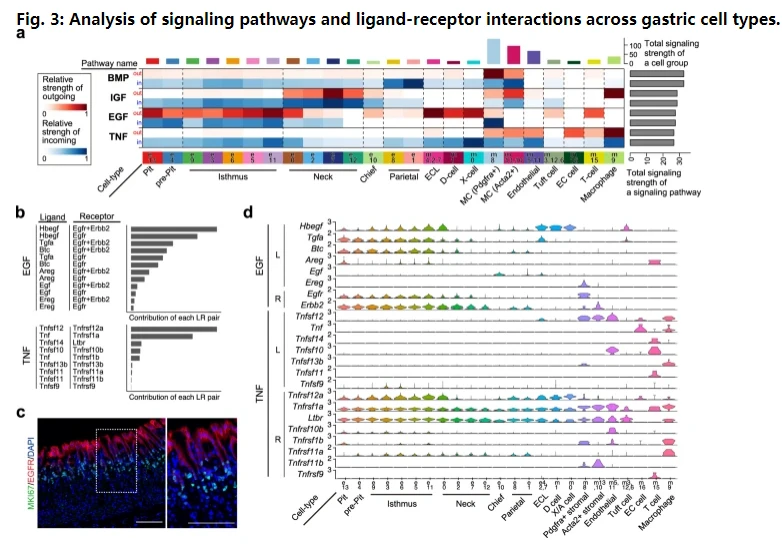
Image from: Nature Communications (2023). DOI:10.1038/s41467-023-39113-0
Using pseudo time-dependent genetic analysis, which provides information about gene expression at different stages of cell differentiation, as well as in vivo and in vitro experiments, the researchers then identified that the transforming growth factor alpha-epidermal growth factor receptor-extracellular signal-regulated kinase (TGFɑ-EGFR-ERK) signaling pathway is perhaps primarily responsible for the differentiation of stem cells into mucus-secreting crypt cells. The researchers also noted that when EGFR was pharmacologically inhibited, fewer crypt cells were produced, suggesting that this pathway may be necessary for the differentiation of gastric stem cells into crypt cells in the mouse organism; in addition, the researchers identified members of the tumor necrosis factor ligand superfamily: the nuclear factor 12 kappa light chain enhancer of activated leukocytes (TNFSF12- NF-κB) signaling pathway, and noted that it may help maintain gastric epithelial cells in their undifferentiated state.
The researchers knew that EGFR signaling is often intricately associated with gastric carcinogenesis and that multiple EGF receptors tend to be overexpressed in multiple cancers, however, to the researchers' surprise, by performing single-cell analysis they found that EGFR signaling has a pro-differentiation role in healthy gastric homeostasis and not a mitogenic role. This study is the first step in scientists' research to understand the mechanisms behind the maintenance of cellular homeostasis in the healthy stomach. The researchers are encouraged by the fact that they have now demonstrated that TGFα-EGFR-ERK and NFSF12-NF-κB form a micro-regulatory framework for epithelial homeostasis in the healthy stomach, which may provide a basis for studying the molecular mechanisms underlying the development of other human gastric diseases.
In summary, although activation of EGFR signaling in gastric progenitor cells is thought to act as a major inducer of gastric carcinogenesis, EGFR signaling may also perform a pro-differentiation function in normal gastric homeostasis, rather than a mitogenic function.