In a new study, more than 100 researchers from around the world have fully sequenced the chromosome associated with male development - the Y chromosome - the last enigmatic part of the human genome. Their findings complete the Y chromosome's genetic code and reveal key details about bacteria that may provide a clearer understanding of the chromosome's role in male-specific development, fertility, and genetically-triggered diseases such as cancer. The findings were published online August 23, 2023, in the journal Nature in a paper titled "Assembly of 43 human Y chromosomes reveals extensive complexity and variation" The paper is titled "Assembly of 43 human Y chromosomes reveals extensive complexity and variation.
These authors say that given the availability of a 100% complete sequence of the human Y chromosome today, they can identify and explore numerous genetic variations that may affect human traits and diseases in a way that was not previously possible.
The DNA sequences that make up chromosomes encode the genes and genetic circuits that direct the development and function of all cells within an organism. Decoding the Y chromosome is particularly challenging because of its repetitive molecular patterns, but new sequencing technologies and bioinformatics algorithms have allowed these authors to parse these DNA sequences. They revealed the structure of a family of sperm-regulating genes and identified 41 additional genes in the Y chromosome. They also revealed the structures of genes thought to play an important role in the growth and function of the male reproductive system.
These authors say that they have completed a wiring diagram of all of these genetic switches activated through the Y chromosome, many of which are critical to the genetic contribution to male development; they are at the stage where scientists can begin to use this wiring diagram; and that people were previously ignorant of the different parts of the Y chromosome DNA and the different mutations that are present, but now they can see the entire Y chromosome DNA, which may add new insights into the genetics of many different diseases.
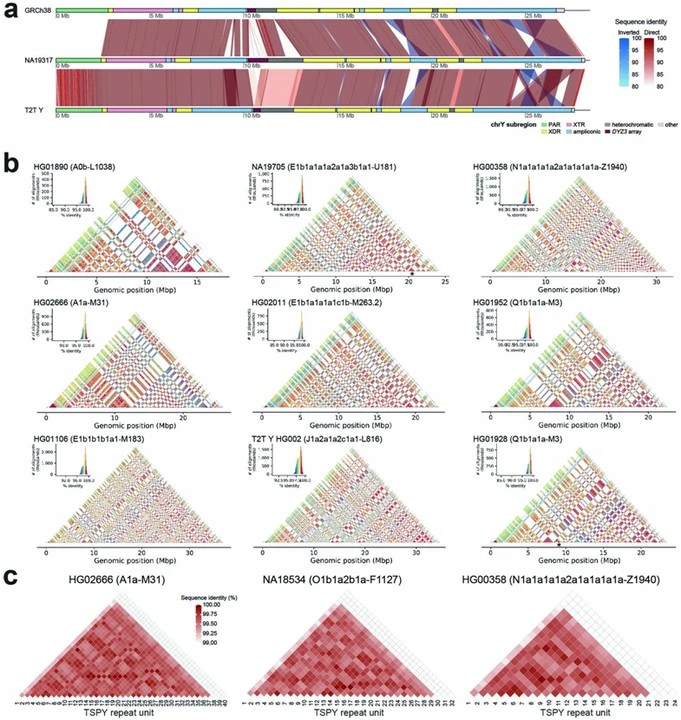
Image from Nature, 2023, doi:10.1038/s41586-023-06425-6.
The Y and X chromosomes are often discussed for their role in sexual development. Although these two chromosomes play a central role, the factors involved in human sexual development are spread throughout the genome and are highly complex, giving rise to a wide range of human sexual characteristics in males, females and intersexuals. In addition, recent research has shown that genes on the Y chromosome have an impact on other aspects of human biology, such as cancer risk and severity.
The new study was led by the National Human Genome Research Institute, which is part of the Telomere-to-Telomere consortium, a 2022 initiative that aims to establish an intersex community with a strong focus on the Y chromosome. The Institute is led by the National Human Genome Research Institute, part of the Telomere-to-Telomere consortium, which in 2022 will publish the complete sequence of the human genome, promising a new frontier of molecular and genetic discovery (see BioValley News story: Highlights from the April 2022 issue of Science). However, this was done with two X chromosomes.
Now, in this new study, these authors have constructed a complete blueprint of the Y chromosome and each element of its DNA using a donor with both X and Y chromosomes. These new findings lay the groundwork for high-quality genome assembly - including personalized genomes - that did not exist before.
The human genome, these authors say, is a very personal thing that contains the basic instructions for human development and for making humans human; they knew that what they had before was incomplete, but now for the first time they can look at the complete Y chromosome DNA from start to finish.
These authors compared this new Y chromosome sequence with genetic data from thousands of people around the world. Their analysis uncovered errors in previous human reference genomes and demonstrated how the new Y chromosome sequence will improve future human DNA research.
They are incorporating these new insights into studies of primates to provide a deeper analysis of the evolution of the Y chromosome and to analyze clinically relevant genes that may influence personalized treatments for pancreatic cancer and other diseases.