In eukaryotic cells, serine/threonine protein kinases (StpKs) play important roles in restricting viral infections.StpKs are usually activated during infection and inhibit the expression of genes at the center of viral replication.
On August 10, 2023, He Zhengguo's team at Guangxi University (with Li Xiaohui as the first author) published an online article entitled "Mycobacterial phage TM4 requires an eukaryotic-like Ser/Thr protein kinase to silence and escape anti-phage immunity", which reported that a eukaryotic-like StpK7 encoded by MSMEG_1200 is required for Mycobacterium pubescens TM4 to escape bacterial defense in Mycobacterium pubescens.
StpK7 is located in the gene island MSMEG_1191MSMEG_1200 and contains multiple phage resistance genes similar to the BREX (phage rejection) phage resistance system. stpK7 negatively regulates the expression of this gene island. Upon phage TM4 infection, StpK7 is induced to directly phosphorylate the transcriptional regulator MSMEG_1198 and inhibit its positive regulatory activity, thereby reducing the expression of several downstream genes in the BREX-like gene island. Further analysis showed that the genes within this anti-phage island play a key regulatory role in Mycobacterium lipid hemostasis and phage adsorption. Overall, this work characterizes a regulatory network driven by StpK7 that is exploited by phage TM4 to evade host defenses against Mycobacterium.
Mycobacteria belong to a large group of Gram-positive actinomycetes, the best known of which are slow-growing human pathogens, including Mycobacterium tuberculosis, which causes human tuberculosis, and Mycobacterium leprae, which causes leprosy. It also includes Mycobacterium pubescens, a relatively fast-growing, non-toxic putrefactive bacterium.The CRISPR-CAS system has been characterized in Mycobacterium species and has shown resistance to transformation by foreign plasmids In addition, the Mycobacterium genome encodes a number of innate immune systems, such as restriction modification systems and toxin-antitoxin systems. However, the defense function of these innate immune systems against phages has not been described. Interestingly, in Mycobacterium pubescens, the synthesis and localization of glycolipids and phospholipids can alter phage adsorption capacity, and mutations in related genes can affect bacterial resistance to phages. In Mycobacterium abscessus, strains with smooth colony morphology caused by mutations in the genes showed stronger phage resistance. Thus, the regulation of glycolipid metabolism in Mycobacterium is closely related to its phage resistance. However, the specific pathways and mechanisms remain poorly understood.
Recently, some eukaryotic-like proteins found in bacteria have been reported to have a defense function against phage infection, such as Toll - interleukin receptor structural domain proteins that mediate intracellular NAD+ depletion in bacterial cells and lead to cell death, as well as StpK, which represses viral transcription through the production of modified ribonucleotides, are present in eukaryotes and most bacteria, and usually act as antivirals. In eukaryotes, some StpKs may be activated by viral signaling and further inhibit viral infection by blocking viral protein synthesis. In bacteria, StpKs have many physiological functions, such as regulating cell wall synthesis, cell division, and dormancy. However, the study of StpK regulation of phage-host interactions has only been reported in a few bacteria. This results in the phosphorylation of some proteins associated with translation, DNA repair and central metabolism, leading to cell death and thus protecting neighboring cells from phage infection In Streptomyces, StpK is involved in defense against phages as a component of the Pgl and BREX defense system, but its exact role is unknown.
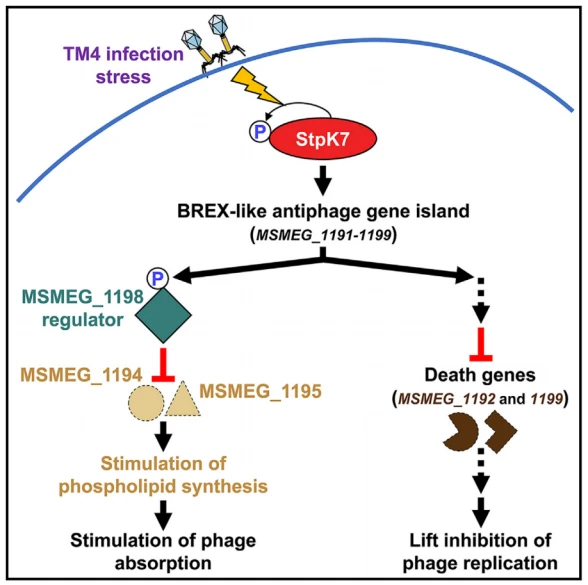
Mechanism model diagram (image from Cell Host & Microbe)
Remarkably, the Mycobacterium tuberculosis genome encodes 11 StpKs, of which PknA and PknB belong to the same manipulator essential for mycobacterial growth. Although these StpKs have been found to play important roles in cell wall synthesis, cell morphology and division, lipopolysaccharide transport, osmotic pressure resistance, virulence, and many other aspects of bacterial physiology, their roles in mycobacterial-phage interactions have not been reported. Whether these eukaryotic-like StpKs are involved and how they regulate the phage infection process remains unknown.
TM4 is a double-stranded DNA phage with a genome size of 52,797 base pairs (bp) It infects fast-growing Mycobacterium pubescens and slow-growing Mycobacterium tuberculosis TM4 phage replicates 20 min after infection of the host bacterium, and lyses the host cell 4 hr after infection of the host cell It is currently widely used for the genetic manipulation of mycobacteria. However, little is known about the interaction of TM4 phage with host bacteria and the host defense mechanisms against TM4 phage.
This study systematically evaluated all 13 non-essential StpK genes encoded by the Mycobacterium pubescens genome and found that knockdown of stpK7 significantly enhanced Mycobacterium resistance to TM4 phage. This study reports that the unique StpK7 gene is essential for TM4 phage infection in Mycobacterium pubescens. Of particular importance, stpK7 is located in a previously undefined BREX-like gene island and can silence host defenses by directly phosphorylating transcription factors on the island, thereby maintaining TM4 phage adsorption capacity and inhibiting Mycobacterium cell death. In conclusion, this study successfully unraveled a eukaryotic-like StpK7-driven regulatory network that is exploited by phage TM4 to evade the host defense of BREX-like phage-resistant gene islands in Mycobacterium. This work greatly enriches the understanding of the host defense evasion mechanism of Mycobacterium phage.