Coffee, a life-saving tool for contemporary people, is the most popular beverage in the world, with 80% of adults drinking at least one caffeinated beverage every day. It is estimated that 3 billion cups of coffee are consumed globally every day. Due to its high content of caffeine, it is often consumed by people to wake up and improve work efficiency. Previous studies have shown that regular coffee consumption can bring multiple health benefits.
Cardiovascular disease (CVD) is the world's leading cause of death and also the leading cause of death in China. According to statistics from the World Health Organization, nearly 18 million people die from cardiovascular diseases every year, accounting for over 30% of the total global deaths. The high mortality and incidence rate of cardiovascular disease is a major global public health problem that needs to be solved urgently.
Recently, researchers from the University of Bologna in Italy published a research paper titled "Self Reported Coffee Consumption and Central and Peripheral Blood Pressure in the Cohort of the Bristol Heart Study" in the journal "Nutrients".
This study shows that compared to people who do not drink coffee, those who drink 2-3 cups of coffee a day have lower blood pressure, including peripheral arterial pressure and aortic pressure, as well as arterial pressure closest to the heart, indicating the positive role of coffee in reducing the risk of cardiovascular disease.
In this study, researchers analyzed 1503 participants, including 720 males and 783 females, in the Brisighella Heart Study in Italy. Clinical evaluations were conducted every four years, including physical examination, lifestyle, dietary habits, blood pressure, etc. By analyzing the amount of coffee consumed, the participants' central and peripheral blood pressure values were analyzed.
Participants were divided into 5 groups based on their coffee intake: no coffee, 1 cup per day, 2 cups per day, 3 cups per day, and more than 3 cups per day.
Among all participants, 14.6% did not drink coffee regularly, 27% drank one cup per day, 48.3% drank two cups per day, 6.6% drank three cups per day, and 3.5% drank more than three cups per day.
Research has found that compared to people who do not drink coffee, those who drink 2 cups a day have an average decrease in systolic blood pressure of 5.2 mmHg, while those who drink 3 cups a day have an average decrease in systolic blood pressure of 9.7 mmHg.
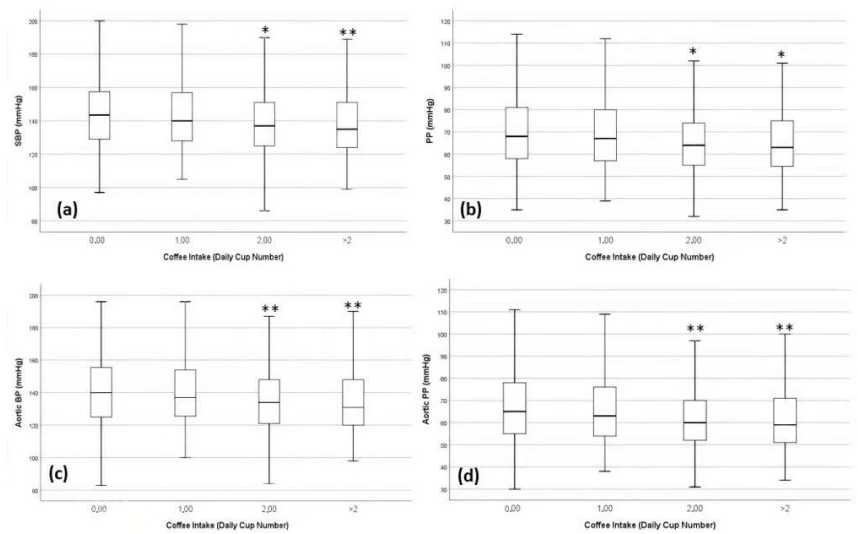
The relationship between coffee consumption and blood pressure
In addition, similar trends were observed in peripheral pulse pressure, aortic BP, and aortic PP. Compared to people who do not drink coffee, those who drink one cup of coffee a day have an average decrease in blood pressure of 4.7, 4.9, and 4.6, respectively. The number of people who drink three cups of coffee per day decreased by 6.9, 9.5, and 6.9, respectively.
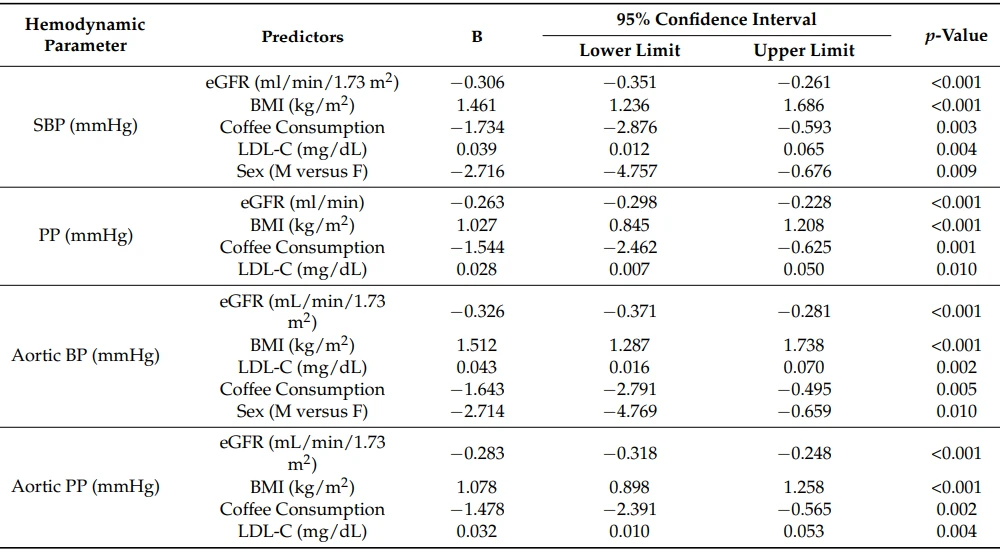
Further analysis revealed that negative predictive factors for systolic blood pressure, peripheral pulse pressure, aortic BP, and aortic PP were glomerular filtration rate, female, and coffee intake. Positive predictive factors include BMI and low-density lipoprotein cholesterol.
Researchers stated that this is the first study to observe this association in the Italian population, and the data confirms the positive impact of coffee consumption on cardiovascular risk. It can also be confirmed that coffee has an effect on aortic pressure, which is almost the same phenomenon observed near the heart.
Researchers have stated that we know caffeine can increase blood pressure, but other bioactive components in coffee seem to counteract this effect, ultimately having a positive impact on blood pressure levels.
To sum up, the results show that compared with people who don't drink coffee, people who drink 2-3 cups of coffee a day have significantly lower peripheral blood pressure and aortic blood pressure, which supports the overall positive impact of coffee drinking on the cardiovascular risk status of the general population.