A genome-wide genetic screen uncovers determinants of human pigmentation," published online in Science by Joanna Wysocka's team at Stanford University. The study utilizes the light scattering properties of melanin to perform a genome-wide screen for regulators of melanin formation. The study identified 169 functionally diverse genes clustered around melanosome biogenesis, endosomal transport, and gene regulation, 135 of which were associated with pigmentation, which was previously unknown.
This study further reveals the function of KLF6 as a transcription factor regulating melanosome maturation and pigmentation in vivo, as well as the function of the endosomal transport protein COMMD3 in regulating melanosome pH. This study reveals a large number of melanin-promoting genes with broad implications for human variation, cell biology and medicine.
Skin and hair color are genetically derived traits that are highly variable between and within populations and are determined by the amount, type, and distribution of melanin. Melanocyte development originates from embryonic neural crest cells located in the epidermis and synthesizes melanin in subcellular lysosome-associated organelles called melanosomes. During melanin synthesis, melanosomes undergo typical stages of maturation, where stage I melanosomes contain intraluminal vesicles, stage II melanosomes deposit PMEL protofibrils on which melanogenesis occurs, and stage III and stage IV melanosomes represent partially and fully melanized melanosomes, respectively. Mature melanosomes are transported extracellularly to surrounding epidermal keratin-forming cells, leading to skin and hair hyperpigmentation.
Key insights into human pigmentation have come from the localization of genes associated with under- and over-pigmentation disorders, as well as candidate genes and genome-wide association studies (GWASs) of human normal-range skin and hair color variants. In addition, studies of model organisms, particularly mouse fur color, have revealed genes and pathways associated with hyperpigmentation, many of which focus on the melanin synthesis pathway. Nonetheless, GWASs estimate the cumulative contribution of the major skin color genetic variants found in a given population and can explain only a relatively small fraction of the skin color variation in the populations analyzed (23 - 35%). Similarly, using an approach based on GWAS summary statistics, the authors estimated that only 15.2% of the skin color variation in White British individuals from UK Biobank (UKBB) could be explained by the set of genomic regions matched to genome-wide significant skin color GWAS in this population. Taken together, these observations suggest that although key loci controlling human pigmentation have been identified, other contributing loci remain to be discovered.
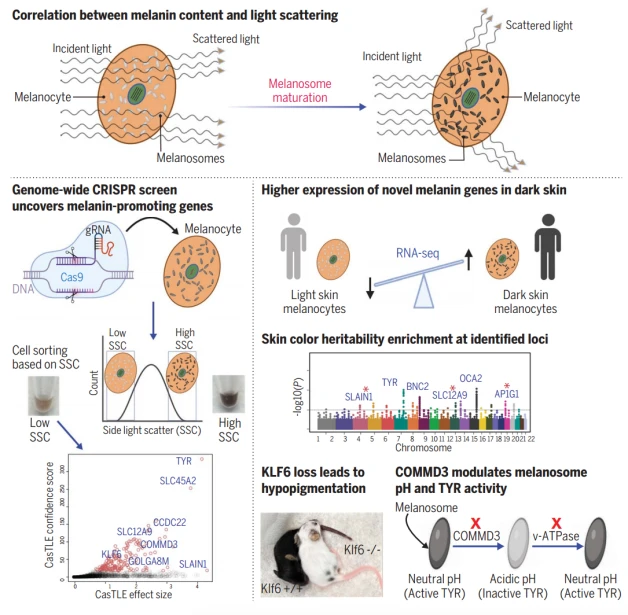
Genetic screen identifies previously unidentified locus for melanin formation in humans (image from Science )
Melanin is a heterogeneous and structurally ambiguous biopolymer consisting of two forms, the black or brown true melanin and the red or yellow phenomenal melanin. The amount and type of melanin produced determines its physicochemical properties, such as a high refractive index, which form the basis of melanin's characteristic light-absorbing and scattering properties. These are thought to be key to protecting the skin from damage associated with sun exposure.
This study demonstrates that cellular melanin concentration indeed determines the light scattering properties of pigment cells. Exploiting this feature and using SSCs as a proxy for melanin levels, a CRISPR-Cas9-based genetic screen was performed to identify regulators of human pigmentation, leading to the identification of 169 candidate genes with pre-melanogenic functions. The study validated a subset of the screen hits, confirming their transcriptional up-regulation in primary melanocytes from dark-skinned individuals and their involvement in different stages of melanosome biogenesis. Furthermore, through subsequent functional studies, this study identified a role for the transcription factor KLF6 in melanosome maturation and pigmentation in vivo, as well as a role for the endosomal transport protein COMMD3 in regulating melanosome pH. Thus, this study will provide a rich resource for further research on the genetic architecture of human skin color diversity.