It is becoming increasingly clear that chronic inflammation increases the risk of developing cancer and promotes tumor progression and metastasis. Chronic inflammatory bowel disease is a defined risk factor for a type of colorectal cancer (CRC) known as colitis-associated cancer (CAC). In particular, patients with long-standing ulcerative colitis (UC) are at higher risk of developing CRC, with a prevalence of up to 20% within 30 years of UC onset. Inflammatory bowel disease is characterized by aberrant production of pro-inflammatory cytokines and massive infiltration of immune cells, which promotes the development and progression of malignancy.
Recently, researchers from the First Affiliated Hospital of Ningbo University published an article entitled "Nuclear translocation of thioredoxin-1 promotes colorectal cancer development via modulation of the IL-6/STAT3 signaling axis through interaction with STAT3" in Theranostics. modulation of the IL-6/STAT3 signaling axis through interaction with STAT3" in the journal Theranostics, which provides new insights into the mechanism of IL-6-triggered STAT3 activation and identifies nuclear translocation of Trx-1 as a potential therapeutic target for the treatment of CRC and CAC as a potential therapeutic target.
Thioredoxin 1 (Trx-1) is a small redox protein located primarily in the cytoplasm. Its expression is increased in several cancers including colorectal cancer (CRC). However, the role of Trx-1 translocation to the nucleus in cancer is unknown. In this study, we explored the role of Trx-1 nuclear translocation in colorectal cancer development.
Western blot and immunofluorescence were used to detect the expression of Trx-1 and STAT3. Co-immunoprecipitation was used to analyze the endogenous interactions of Trx-1, STAT3 and nuclear mucin α1 in CRC cells. Immunohistochemical analysis of Trx-1 and pSTAT3 nuclear staining in human colorectal cancer tissues. An AOM/DSS-induced mouse colitis-associated carcinoma (CAC) model was used to study the antitumor effects of Trx-1 inhibitor PX-12. Knock-in mice with Txn1 (KK81-82EE) mutation were generated by CRISPR/Cas9 technology and CAC was induced in knock-in and wild-type mice.
IL-6 induced nuclear translocation of Trx-1, and inhibition of this translocation reversed IL-6-induced metastasis, invasion, and metastasis from epithelial to mesenchymal cells. Nuclear mucin α1 was found to specifically mediate il -6-induced translocation of the Trx-1-pSTAT3 complex into the nucleus. Nuclear Trx-1 expression was closely associated with lymph node metastasis and distant metastasis in human colorectal cancer. In addition, nuclear staining of Trx-1 was significantly and positively correlated with nuclear staining of pSTAT3 in human colorectal cancer tissues.
PX-12, an inhibitor of Trx-1, significantly impaired STAT3 activation and inhibited the development of AOM/ dss-induced CAC in mice. In addition, AOM/ dss-induced nuclear Trx-1 expression was suppressed in Txn1(KK81-82EE) mice, thereby inhibiting STAT3 activation and cancer progression.
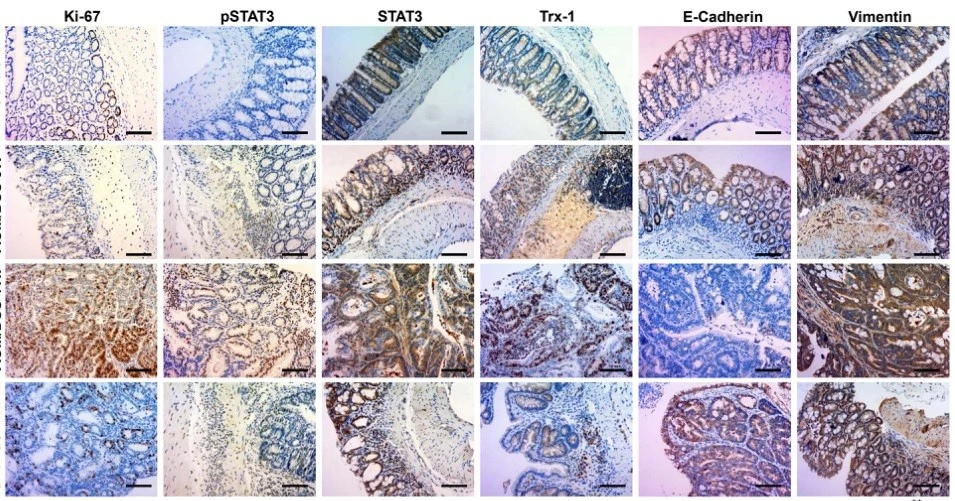
Trx-1 Inhibitor PX-12 Inhibits Progression of Colitis-Associated Tumorigenesis in a Mouse Model of Colitis-Associated Colorectal Cancer (CAC)
Image from: https://pubmed.ncbi.nlm.nih.gov/37771783/
In conclusion, the results of this study suggest that nuclear translocation of Trx-1 plays a key role in the development of CRC through activation of the IL-6-STAT3 signaling pathway. In particular, the investigators have demonstrated that this translocation is required for il -6-induced EMT and CRC metastasis. In addition, investigators have determined that Trx-1 and STAT3 form a functional complex with nuclear filament protein α1, which translocates into the nucleus and thus promotes CRC progression.
Thus, the interaction between Trx-1 and STAT3 represents a novel key mechanism controlling IL-6 signaling and CRC development and metastasis. The results of this study provide important insights into the mechanism by which il -6 triggers STAT3 activation and identify nuclear translocation of Trx-1 as a potential therapeutic target for the treatment of CRC and CAC.