New drugs are not a straight path, and SilenceTherapeutics, an established UK nucleic acid drug company, has recently undergone a major strategic change.
At the end of February 2025, Silence announced that it would not start a Phase 3 clinical study of its core in-house program, Zerlasiran (SLN360), until it found a new partner for the program.
Zerlasiran was previously Silence's fastest progressing program, an siRNA therapy targeting lipoprotein(a) [Lp(a)] designed as a subcutaneous formulation to treat cardiovascular disease associated with high levels of Lp(a) by targeting degradation of the mRNA transcribed from the LPA gene in order to reduce the production of Lp(a). on November 2024 On November 18, Silence presented the latest Phase 2 clinical data for Zerlasiran at the American Heart Association (AHA) Annual Meeting: from baseline to Week 36, the Zerlasiran treatment groups (300 mg every 16 weeks, 300 mg every 24 weeks, or 450 mg every 24 weeks) placebo-corrected resulted in a mean reduction in patient Lp(a) concentrations over the corresponding time period of reductions of more than 80%.
There are currently no lipid-lowering therapies on the market approved specifically for Lp(a), but Zerlasiran already has several nucleic acid drug competitors in late-stage clinical development, such as Amgen's siRNA therapy Olpasiran, Novartis/Ionis's ASO therapy Pelacarsen, and Eli Lilly/Dicerna's (acquired by Novo Nordisk) According to the data of pharma.bcpmdata.com (former pharma fusion cloud data), there are some small nucleic acid pharmaceutical companies in China that have laid out this target: Hengrui Medicine, Hejia, Hyunjin, Jingin, etc. In addition, there are also small molecule enterprises that have laid out this target. In addition, there are also small molecule enterprises.
The Silence strategic adjustment comes just two months after the company terminated the cooperation. The previous collaboration between the two companies began in March 2021, with the aim of co-developing siRNA drugs against three undisclosed targets using Silence's proprietary mRNAi GOLD™ platform. The collaboration was terminated in December 2024, however.
Although Silence received positive feedback from regulators on Zerlasiran's Phase 3 clinical trial design in the fourth quarter of 2024 and advanced Zerlasiran's Phase 3 clinical trial preparation, it may be difficult for Silence to move forward with a Phase 3 clinical study at this time - it is, after all, very costly, and Silence is facing a couple of Silence is also facing competition from several large companies.
Silence has recently been actively seeking a partner for Zerlasiran. This change in strategy has also eased the company's cash flow situation, which is expected to last until 2027.
Previously, Silence was also "bounced" and poached its partner CSO.
Silence has also suffered from "returns" from other partners in recent years.In July 2019, Silence entered into a collaboration with Mallinckrodt to develop and commercialize RNAi drugs targeting silencing of the complement cascade in complement-mediated diseases. In this collaboration, Silence received an upfront payment of $20 million, as well as a $5 million equity investment, and Mallinckrodt received an exclusive worldwide license to SLN501, a preclinical program targeting C3, as well as future options on two additional preclinical, undisclosed target complement programs, which Mallinckrodt has exercised in July 2020 option.
In March 2023, however, Silence regained exclusive worldwide rights to the two undisclosed target complement programs. At the same time the company poached Chief Scientific Officer Dr. Steven Romano from Mallinckrodt to serve as Silence's Chief Medical Officer and Head of Research and Development, having initially joined Silence as a non-executive director in July 2019 at the time of the companies' signing of the collaboration agreement.Dr. Romano had previously worked at Pfizer for 16 years and Lilly for for four years.
One year later, in March 2024, Mallinckrodt notified Silence that it would not pursue further development of SLN501, a program targeting C3, following the completion of the Phase 1 clinical trial.The collaboration was terminated.
Steven Romano, Ph.D., is now Executive Vice President and Chief Research and Development Officer of Silence.
AstraZeneca collaboration
Based on the latest annual report disclosure, it appears that Silence's current public major partner is only AstraZeneca.
In March 2020, Silence entered into a collaboration agreement with AstraZeneca to discover, develop and commercialize siRNA therapeutics for the treatment of cardiovascular, renal, metabolic and respiratory diseases. The companies will collaborate to enable delivery of siRNA molecules to the liver, heart, lungs and other tissues. The collaboration initially covers five targets, with AstraZeneca having the option to extend the collaboration to five additional targets.
Under the agreement, AstraZeneca made a $60 million upfront payment to Silence and a $20 million equity investment in Silence. For each target, Silence is eligible to receive up to $400 million in milestones, as well as tiered royalties.
In 2023 and 2024, Silence received an option fee of $10 million and a milestone payment of $10 million, respectively, from this collaboration.
Silence Therapeutics and AstraZeneca's earliest public track record of collaboration dates back to 2007, when the two companies established a partnership in respiratory diseases, and in 2010, the collaboration was expanded to include a number of areas, including oncology.
Focus shifts to rare diseases
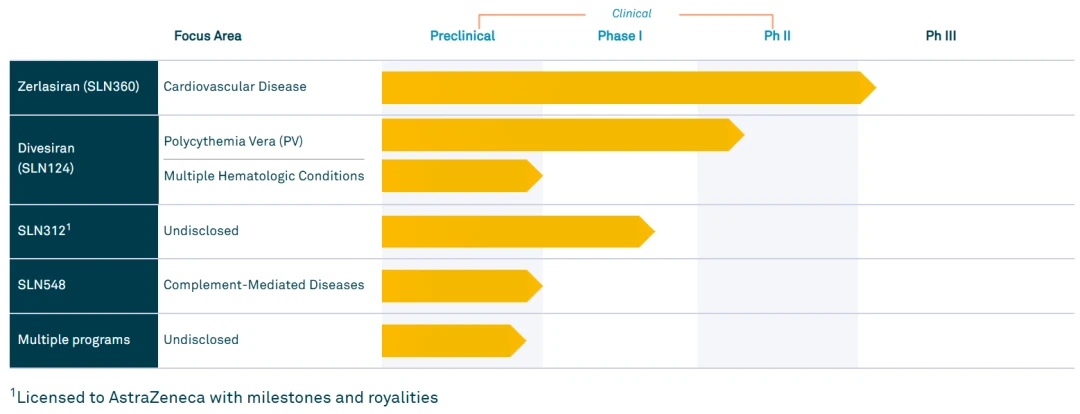
Following the suspension of its cardiovascular program Zerlasiran, Silence will prioritize its investment in its rare disease program Divesiran (SLN124), an siRNA therapy targeting TMPRSS6 designed to be injected subcutaneously for the treatment of true erythrocytosis (PV), with the potential to be a PV-first-in-class siRNA therapy.PV is a rare myeloproliferative neoplasm characterized by an excess of blood cells and platelets, often resulting in an elevated HCT (erythrocyte corpuscular pressurization).An elevated HCT of more than 45% has been associated with a 4-fold increase in mortality from cardiovascular or thrombotic events. The disease affects approximately 150,000 people in the United States and approximately 3.5 million people worldwide. The current standard of care consists of repeated bloodletting therapies to reduce HCT and/or the use of cytopenic agents to reduce red blood cell production. There are no approved therapies that specifically target red blood cells and HCT.
The TMPRSS6 gene is a negative regulator of ferroportin, the major hormone that controls iron homeostasis in the body. By silencing the TMPRSS6 gene in patients with PV, Divesiran aims to increase the production and release of iron-modulating hormones in hepatocytes, thereby limiting the entry of iron into the bone marrow, and thus reducing the overproduction of red blood cells.
In December 2024, Silence presented positive interim Phase 1 results from a Phase 1/2 clinical trial of Divesiran for the treatment of patients with PV at the American Society of Hematology (ASH) Annual Meeting. Interim results showed that in a series of PV patients, low-frequency Divesiran treatment significantly reduced the need for phlebotomy while lowering HCT levels. In addition, the drug has been well tolerated to date with no dose-limiting toxicities. Meanwhile, Silence also announced that the Phase 2 portion of the clinical trial for Divesiran has completed first patient dosing and patient enrollment is expected to be completed by the end of 2025.
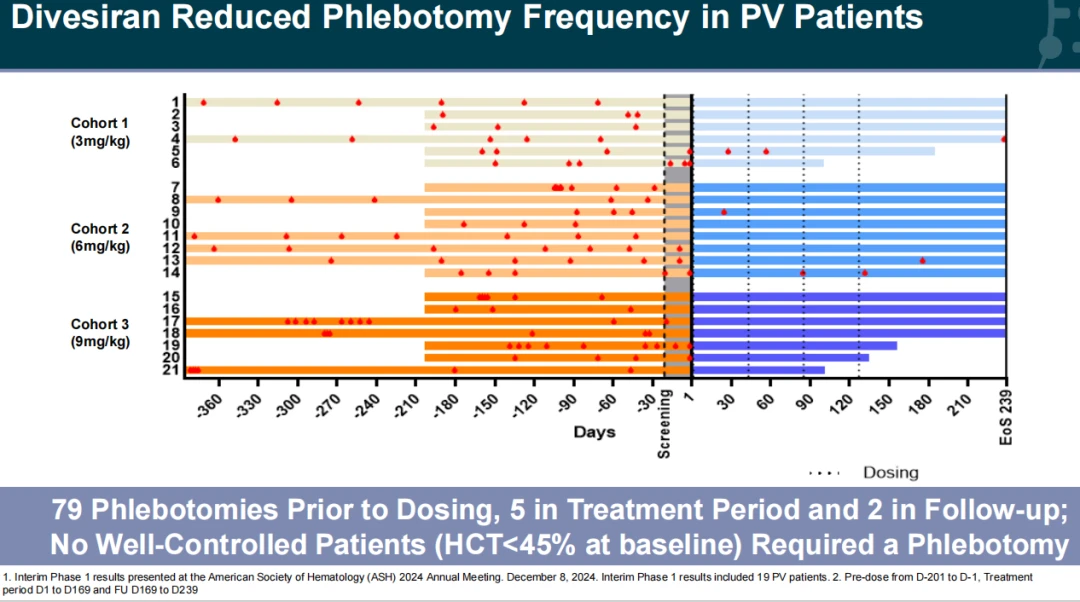

The FDA has granted Divesiran Fast Track and Orphan Drug status designation for the treatment of PV, according to Moentropic Pharmaceuticals data. The European Union has also granted the drug orphan drug designation in December 2024 for the treatment of PV.
Image source: moentropic pharmaceutical data, www.pharnexcloud.com
But Divesiran also faces competitors, albeit with different mechanisms of action: Takeda/Protagonist's Rusfertide (PTG-300) is an iron-mimetic peptide, which recently underwent a Phase 3 clinical study with positive preliminary results.
Other pipeline for Silence's mRNAiGOLD™ platform: SLN548, Silence's wholly-owned complement-mediated disease siRNA candidate, is scheduled for a Phase 1 study in the second half of 2025; a Phase 1 study of SLN312 (licensed to AstraZeneca with an undisclosed target indication) is underway; and, following the termination of the collaboration by Henson Pharmaceuticals, the previously utilized Following the termination of the collaboration with Henson Pharmaceuticals, the global rights to the three preclinical siRNA programs for undisclosed targets previously developed using Silence's mRNAiGOLD™ platform were retained by Silence, and further development programs are currently being evaluated.
Silence's Early History
SilenceTherapeutics was first established in 1994, when the company acquired Atugen AG, a German company specializing in siRNA, in July 2005, changed its name to its current name in 2007, and merged with Intradigm Corporation (co-founded by Dr. Lu Yang, founder of Sanborn Pharmaceuticals), a leading RNA company, in 2010 to become a leading RNA company. In 2010, the company merged with Intradigm Corporation (co-founded by Dr. Lu Yang, founder of Sanborn Pharmaceuticals) to become a leading RNAi therapeutics company. Silence's technology was reportedly used in four of the nine siRNA drug candidates in clinical development worldwide at the time.
Silence's current mRNAiGOLD™ platform (GalNAcOligonucleotideDiscovery) takes the form of GalNAc-siRNA. Silence is known to have filed a patent lawsuit against nucleic acid drug leader Alnylam in 2017, and the two companies settled the lawsuit in 2018.
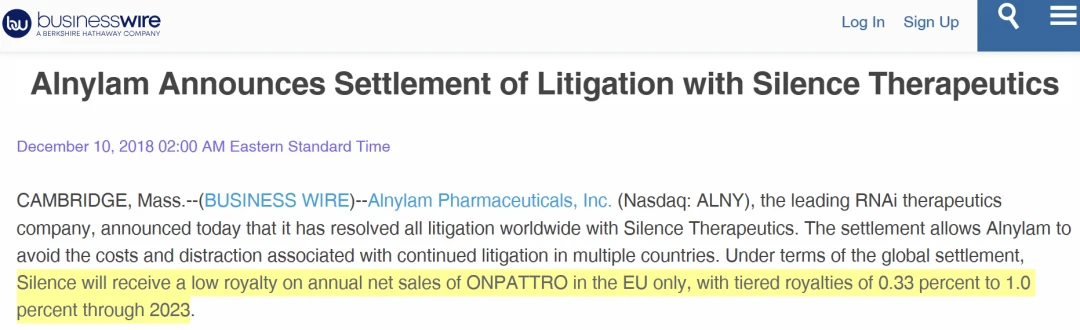
Photo credit: Business Wire
Silence has been mainly earning collaboration revenue through various external collaborations, and has not yet commercialized a single internally developed drug since its inception. Silence's early collaborators are known to include AstraZeneca, Sumitomo Pharma Japan, Pfizer, Novartis, Dainippon Sumitomo Pharma, Mallinckrodt Pharmaceuticals, Mirna Therapeutics, MiReven Pty Ltd, miRagen Therapeutics, InteRNA Technologies, and more.
Attachment: 2024 Financial Highlights
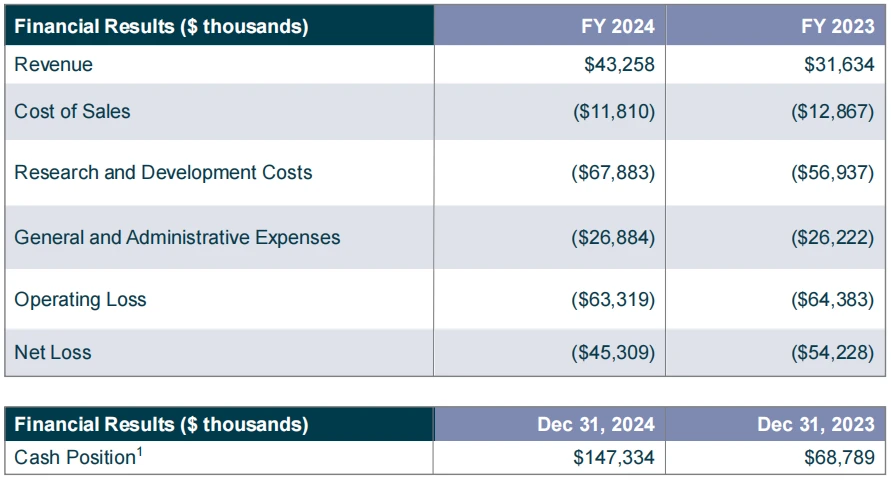
At the end of December 2024, Silence held cash, cash equivalents and short-term investments totaling $147.3 million.In FY2024, Silence had total revenues of $43.26 million, of which $43.1 million was collaboration revenues (compared to $30.9 million in the same period of the prior year); annual R&D expenses were $67.9 million (compared to $56.9 million in the same period of the prior year) , primarily due to additional clinical studies and an increase in contract manufacturing activities for Silence's proprietary programs; annual G&A expenses of $26.9 million ($26.2 million in the same period of the prior year); and annual net loss of $45.3 million, or $0.33 per basic and diluted net loss per share, compared to a net loss of $54.2 million, or $0.49 per basic and diluted net loss per share, in fiscal year 2023. net loss of $0.49.
References: mo entropy pharma data pharma.bcpmdata.com (formerly Pharma Fusion Cloud Data); corporate annual reports, slideshows; https://silence-therapeutics.com/investors/press-releases/press-releases-details/ 2025/Silence-Therapeutics-Reports-Full-Year-2024-Financial-Results-and-Provides-Business-Update/default.aspx.
https://silence- therapeutics.com/investors/press-releases/press-releases-details/2024/Silence-Therapeutics-Presents-Late-Breaking-Phase-2- Zerlasiran-Data-at-2024-American-Heart-Association-AHA-Annual-Meeting/default.aspx; and other relevant public information (body images are from corporate officials unless otherwise noted).