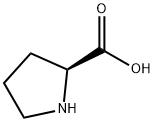


| Product Name: | L-Proline |
| Synonyms: | L-Proline ,L-2-Pyrrolidinecarboxylic acid;L-PROLINE, NATURAL;L-PROLINE, SYNTHETIC;L-(-)-PROLINE ((S)-(-)-PROLINE);L-PROLINE (13C5, 99%);L-PROLINE (13C5, 99%;L-PROLINE (D7, 97-98%);L(-)-Proline 0 |
| CAS: | 147-85-3 |
| MF: | C5H9NO2 |
| MW: | 115.13 |
| EINECS: | 205-702-2 |
L-Proline Chemical Properties
| Melting point | 228 °C (dec.) (lit.) |
| alpha | -85.5 º (c=4, H2O) |
| Boiling point | 215.41°C (rough estimate) |
| density | 1.35 |
| vapor pressure | 0Pa at 25℃ |
| FEMA | 3319 | L-PROLINE |
| refractive index | -85 ° (C=4, H2O) |
| storage temp. | 2-8°C |
| solubility | H2O: 50 mg/mL |
| form | powder |
| pka | 1.95, 10.64(at 25℃) |
| color | White |
| Odor | at 100.00 %. odorless |
| PH | 6.0-7.0 (25℃, 1M in H2O) |
| Odor Type | odorless |
| optical activity | [α]20/D 85.0±1.0°, c = 5% in H2O |
| Water Solubility | soluble |
| Sensitive | Hygroscopic |
| λmax | λ: 260 nm Amax: 0.05 λ: 280 nm Amax: 0.05 |
| JECFA Number | 1425 |
| Merck | 14,7780 |
| BRN | 80810 |
| Stability: | Stable. Incompatible with strong oxidizing agents. |
| InChIKey | ONIBWKKTOPOVIA-UHFFFAOYSA-N |
| LogP | -2.54 at 20℃ |
L-Proline Usage And Synthesis
| Chemical Properties | L-Proline, an amino acid, is colorless to white crystal or crystalline powder that has a slight, characteristic odor with a slightly sweet taste. It is soluble in water, insoluble in ethanol, diethyl ether and n-butanol, yellow in case of hydrated ninhydrin test solution, glacial acetic acid Red after acidification; pH=6.3, decomposition point is 220-222°C; specific optical rotation [α]20D-85° (0.5-2.0mg/ml, H2O), [α]20D-60.4° (0.5-2.0mg /ml, 5mol/LHCl). It is synthesized from L-glutamine and L-glutamate via L-ornithine in intestine, and from L-ornithine in liver. It is widely used as an ingredient in infusion and infant formula. |
| Uses |
L-Proline is used as asymmetric catalysts in organic synthesis and asymmetric aldol cyclization. It is involved in the Michael addition of dimethyl malonate to alfa-beta-unsaturated aldehydes. It is a precursor of hydroxyproline in collagen. It is an active component of collagen and involved in the proper functioning of joints and tendons. It finds uses in pharmaceutical, biotechnological applications due to its osmoprotectant property. Further, it is used with ninhydrin in the chromatography. L-Proline is an amino acid and precursor (with vitamin C) for collagen, the building block of the structure of tendons, ligaments, arteries, veins and muscles. It is important in wound healing. |
| Preparation | Synthesis of L-proline: Using glutamic acid as a raw material, it is esterified with absolute ethanol under the catalysis of sulfuric acid, and triethanolamine is added to free the aminosulfate to obtain glutamic acid-δ-ethyl ester. The glutamic acid-δ-ethyl ester is then reduced with a metal reducing agent potassium borohydride to obtain crude proline, which is finally separated and purified to obtain crude L-proline. |
| Definition | ChEBI: L-proline is pyrrolidine in which the pro-S hydrogen at position 2 is substituted by a carboxylic acid group. L-Proline is the only one of the twenty DNA-encoded amino acids which has a secondary amino group alpha to the carboxyl group. It is an essential component of collagen and is important for proper functioning of joints and tendons. It also helps maintain and strengthen heart muscles. It has a role as a micronutrient, a nutraceutical, an algal metabolite, a Saccharomyces cerevisiae metabolite, an Escherichia coli metabolite, a mouse metabolite and a member of compatible osmolytes. It is a glutamine family amino acid, a proteinogenic amino acid, a proline and a L-alpha-amino acid. It is a conjugate base of a L-prolinium. It is a conjugate acid of a L-prolinate. It is an enantiomer of a D-proline. It is a tautomer of a L-proline zwitterion. |
Hot Tags: CAS NO.147-85-3 L-Proline, China, manufacturers, suppliers, factory, custom, wholesale