Rapid advances in the study of the gut-brain axis have helped us to understand the "other layer" of mechanisms underlying many diseases, including a variety of neurodegenerative diseases and neurodevelopmental disorders, and in recent years it has been found that the gut microflora of patients with OD is significantly altered, and that signaling molecules from the gastrointestinal tract can influence specific brain functions and related behaviors [3,4], including behaviors related to eating and food choice preferences [3,4]. , behaviors related to eating and food choice preferences are also included. Moreover, the activities of the gut microenvironment and the central nervous system are affected by both stress and dieting.
Accordingly, Professor Wei Xiong of the Department of Life Sciences and Medicine at the University of Science and Technology of China, Director Jue Chen of the Department of Clinical Psychology at the Shanghai Mental Health Center, and Dr. Min Li of Anhui Medical University jointly conducted a study to reveal the gut-brain-axis mechanism of OD, in which the combination of dieting and stress leads to a reduction of Lactobacillus and Ruminal Streptococcus bacteria in the intestinal tract, and a decrease in the level of the metabolite kynurenine, which causes the intestinal vagal nerve-soleus nucleus-thalamic paraventricular nucleus circuit to be of hyperexcitability, which drove overfeeding behavior, and supplementation with the probiotic Bacillus pumilus perforatum ameliorated OD symptoms. The findings were published in the journal Cell-Metabolism.
Inspired by the developmental process of human OD patients, the researchers constructed a mouse model of staged dieting and plantar electric shocks to generate stress to the point of OD. Compared to healthy control mice, the OD mice replicated the key characteristics of human OD patients, showing a greater preference for tasty and calorie-rich Oreo cookies, running to Oreos faster, and a significant increase in total calorie intake compared to regular food.
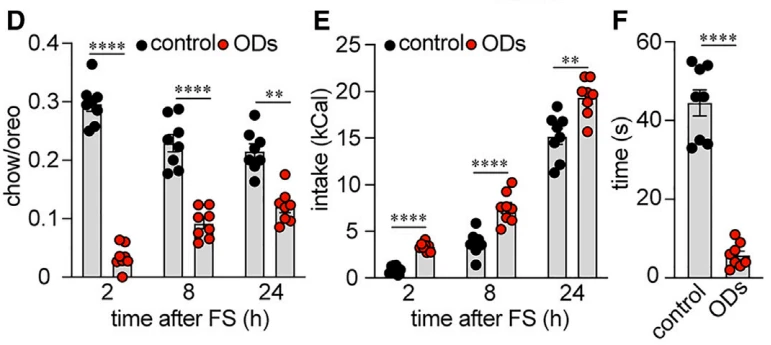
Control (black) and OD mice (red) ingested regular food/Oreo ratio (D), total calories (E) and time spent running to Oreos (F)
Notably, dieting or stress stress alone did not induce OD in mice; both must be met simultaneously.
The non-OD model mice, in which most of the gut microbes were eliminated after treatment with broad-spectrum quadruple antibiotics, also showed some degree of overfeeding behavior and were relieved after receiving fecal transplants from healthy mice. From this, the researchers suspected that gut microbes may play an important role.
Using 16S rRNA sequencing, the researchers found a significant decrease in the abundance of Lactobacillaceae and Ruminalococcaceae bacteria in the intestines of OD mice, two genera that contain a wide range of probiotic bacteria, and a corresponding decrease in the level of synthesis of a metabolite, kynurenic acid.
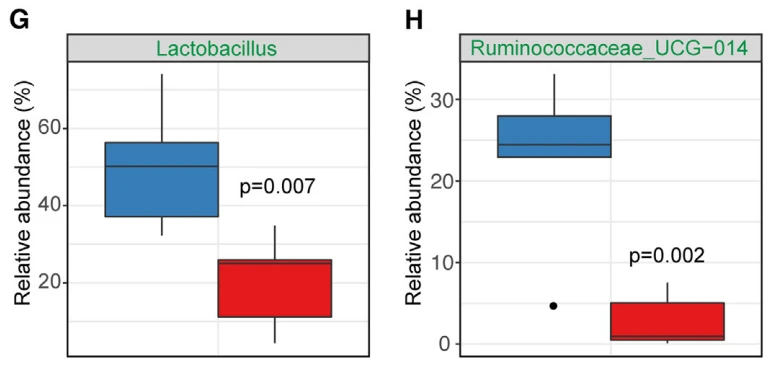
Differences in relative abundance of Lactobacillus spp. (G) and Ruminalococcus spp. (H) in control (blue) and OD mice (red)
Meanwhile, using a variety of techniques, including optogenetics, the researchers found that the OD mice had hyperactivation of the paraventricular nucleus of the thalamus (PVT) in the brain, which is a key brain region for addiction and energy harvesting, and this time, the researchers confirmed that it is central to mediating OD.
Further experiments revealed that intestinal vagal nerve endings express inhibitory kynurenine receptors, and that dieting and stress led to changes in gut microbiology and decreased kynurenine synthesis in mice, which drove hyperactivation of the intestinal vagus nerve-lone nucleus of the tract-PVT pathway, and the mice developed OD.
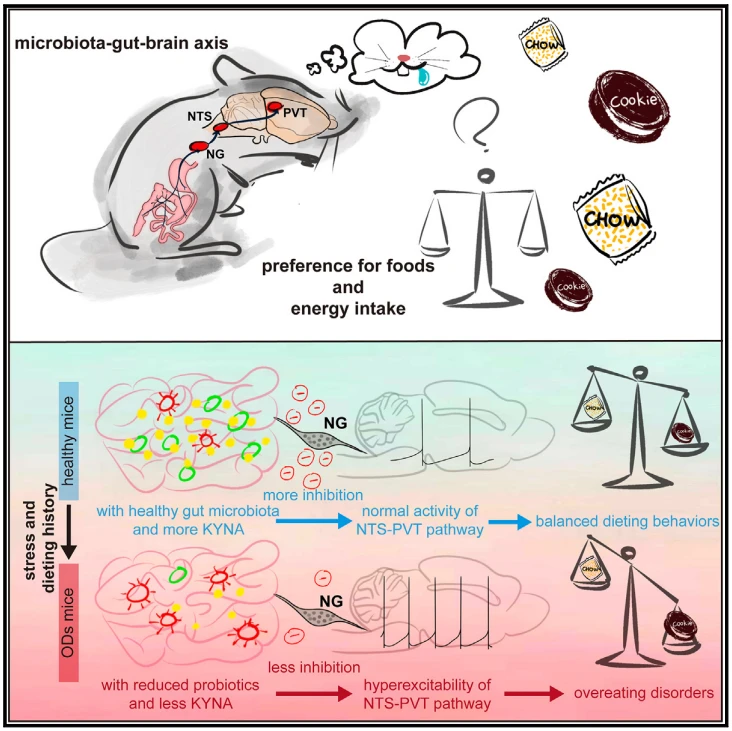
Schematic diagram of the mechanism
In 11 female patients with a clinical diagnosis of bulimia nervosa (BN), there was a significant separation of the gut microbiome compared to controls of the same age, sex and BMI with healthy eating habits, and at the genus level, the patients had significant reductions in bacteria of the genus Saprobacterium, with reductions in Saprobacterium przewalskii being the main reason for this change, and the patients also had the same decrease in kynurenine levels as the mice.
Based on these results, the researchers attempted to transplant the OD mice with B. perfringens and, as they expected, the OD mice's preference for high-calorie, tasty foods and overfeeding behaviors were corrected after transplantation, with a significant increase in canine uric acid levels.
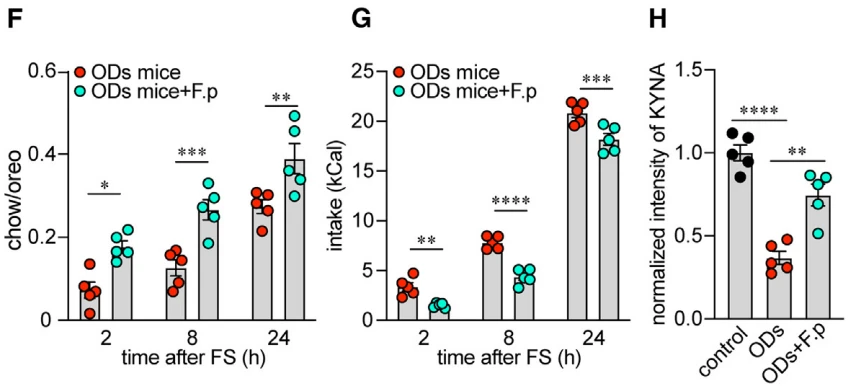
Normalized intake of regular food/Oreo ratio (F), total calories (G), and canine uric acid levels (H) in OD mice (red) and OD mice supplemented with Bacillus pumilus (green)
Taken together, this study reveals that stress- and dieting-induced OD is caused by a reduction in specific gut microbes and their metabolite canine uric acid, which mediates excessive activation of the intestinal vagus nerve-solitary fasciculus nucleus-PVT, and that supplementation with Mycobacterium abscessus could significantly ameliorate OD-associated food-choice-preferred overfeeding behaviors, offering a potential therapeutic strategy for OD.
The researchers also propose that proper food selection is critical for maintaining health, and that the animal's brain may be more inclined to choose a balanced diet when diets are relatively plentiful, and to favor high-calorie foods when food is scarce and stress is increased, as a way for the animal to be more flexible in responding to the pressures of natural selection. The present study further adds to the importance of the gut-brain axis as an adaptive regulator, controlling the brain's desire for different types of food by sensing environmental changes.