The development of many types of cancer is often thought to be linked to alterations in large molecular structures called nuclear pore complexes (NPCs, nuclear pore complexes), which become embedded in the nuclear membrane, a membrane barrier structure that separates the nucleus from the cytoplasm, the fluid that fills the rest of the cell. The nuclear pore complex is a protein composed of nuclear pore proteins, which regulate the transport of molecules across the nuclear membrane, including enzymes that synthesize DNA, among other things, and it is currently unclear to researchers whether the nuclear pore complex plays a role in the development of human glioblastoma, the most common type of cancer originating in the brain.
In a study entitled "Nuclear transport surveillance of p53 by nuclear pores in glioblastoma" published in the international journal Cell Reports, scientists from Kanazawa University and other institutions in Japan have found that the nuclear pore complex plays a role in the development of human glioblastoma, the most common type of cancer originating in the brain. In a recent study published in the international journal Cell Reports entitled "Nuclear transport surveillance of p53 by nuclear pores in glioblastoma," scientists from Kanazawa University and other institutions in Japan have discovered a link between the function of the nuclear pore complex and human glioblastoma, specifically, they have elucidated the inactivation of a tumor suppressor protein called p53.
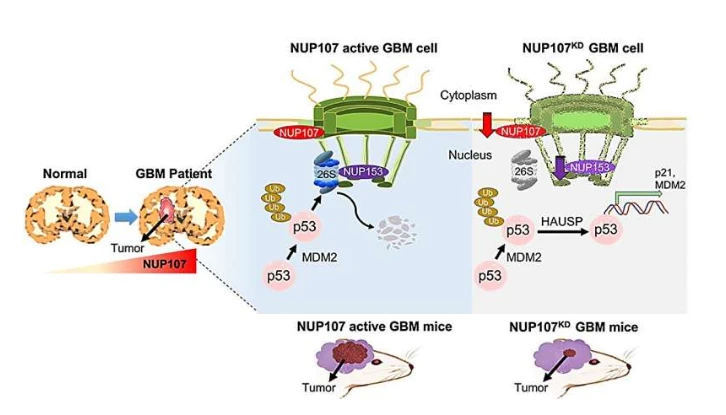
Human glioblastoma development may be associated with alterations in the nuclear pore complex in cells.
Image from: Cell Reports (2023). DOI:10.1016/j.celrep.2023.112882
The protein p53 is important for the prevention of human cancers, the corresponding gene TP53 encodes proteins that prevent genomic mutations and is the most frequently mutated gene in human cancers, and in-depth revelation of how the inactivation of p53 occurs is crucial to understanding how tumors in general and glioblastoma in particular occur. In this study, researcher Nakada and his concurrent first examined whether there was any overexpression of any nuclear pore complex proteins in glioblastoma, and as a result, they found that overexpression of a protein called NUP107 occurred, and further findings suggest that NUP107 is a potentially oncogenic protein in glioblastomas, and that its overexpression degrades the cancer-suppressive p53 protein In addition, another protein called MDM2 is also overexpressed along with NUP107 protein, and MDM2 also mediates the protein degradation of p53.
Further studies are needed to reveal the full molecular pathway, but the scientists hypothesized that increased levels of NUP107 protein in glioblastoma cells at the nuclear pore complex lead to the transport of structural regulators from the nucleus to the cytoplasm of the cell, which promotes the degradation of p53, a condition known as nuclear transport surveillance), and in experiments in which NUP107 protein was knocked out, p53 was reactivated, consistent with NUP107 providing structural stability of the glioblastoma nuclear pore complex.
The researchers confirmed that structural changes in the nuclear pore complex may contribute to the pathogenesis of glioblastoma. In conclusion, the results of this paper establish the role of the nuclear pore complex in transport surveillance and provide new insights and ideas for unraveling the inactivation of p53 in glioblastoma.