The nitric oxide synthase family converts arginine to L citrulline and nitric oxide and consists of three isoforms encoded by three separate genes, nos1, nos2 and nos3. These isoforms are also named according to the tissues in which they were originally found.NOS1 or neuronal-type NOS (NNOS) is isolated from neurons.NOS2 is isolated from monocytes and is known as macrophage NOS or inducible NOS (INOS) due to induction by pro-inflammatory cytokines.NOS3 is isolated from endothelial cells (ECs) and is defined as endothelial-type nitric oxide synthase (ENOS).
Recently, researchers from Heinrich Heine University published an article entitled "Red blood cell eNOS: a major player in regulating cardiovascular health." in Br J Pharmacol. The study reveals that erythrocyte endothelial-type nitric oxide synthase is a major factor in regulating cardiovascular health.
Traditionally, red blood cells (RBCs) have been viewed as simple carriers of gases and nutrients in the body. An important non-canonical function of RBCs in the cardiovascular system is the regulation of nitric oxide (NO) metabolism. The results showed that under hypoxic conditions, erythrocytes scavenge NO, translocate NO metabolites, and produce NO, thereby inducing hypoxic vasodilation. Erythrocytes also express endothelial-type nitric oxide synthase (ENOS).
However, its physiological significance has been controversial for many years. In this paper, we present a review of experimental studies of RBC eNOS signaling in vivo. These data suggest that RBC eNOS signaling regulates intracellular NO production and NOheme levels, as well as extracellular paracrine NO metabolite signaling, which contributes to the regulation of peripheral vascular resistance, blood pressure, and cardioprotection. In addition, this paper explores the potential intracellular molecular mechanisms of RBC eNOS and their significance in cardiovascular health and disease.
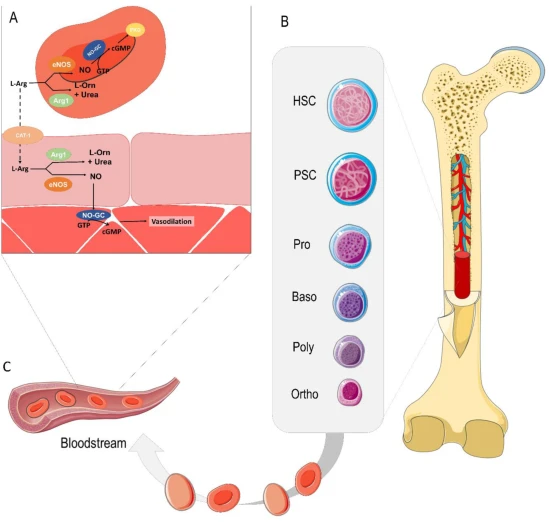
Growing evidence suggests a role for eNOS upstream and downstream signaling in the differentiation of mature erythrocytes and red lineage cells
Image from: https://pubmed.ncbi.nlm.nih.gov/37658519/
In summary, further research is needed to fully understand the complex cellular functions and regulatory mechanisms of the Arg1/eNOS/NO-GC pathway in health and disease. By addressing these knowledge gaps, researchers can advance the understanding of the complex interactions between eNOS signaling, NO bioavailability, and physiological processes in blood and other cells/tissues, which may ultimately contribute to improved therapeutic and clinical outcomes.