In a major breakthrough new study, researchers from Google Research in the United States, the Monell Chemical Senses Center and the University of Reading in the United Kingdom, among other research institutions, have built a tool that can predict the odor characteristics of molecules based on their structure alone. It can identify molecules that look different but smell the same, as well as molecules that look very similar but smell completely different. The findings are published in the September 1, 2023 issue of Science under the title "A principal odor map unifies diverse tasks in olfactory perception".
Prof. Jane Parker of the University of Reading in the UK says, "There are wavelengths for visual studies and frequencies for auditory studies, both of which can be measured and assessed with instruments. But what about smell? We currently have no way to measure or accurately predict the odor of a molecule based on its structure. One could do so based on current knowledge of molecular structure, but one would eventually run into countless exceptions where odor and structure do not match. This is precisely the challenge faced by previous olfactory models. The magic of this new machine learning-generated model is that it correctly predicts the molecular odor in these exceptions."
The new study uses machine learning to build an "odor map" that could be valuable to the work of synthetic chemists in the food and flavor industries. It may also open the way for the development of more sustainable flavors and fragrances.
Prof. Parker said, "As a flavor chemist, I have been involved in olfactory research for many years, relying mainly on my nose to describe aromas. This odor map applies not only to known odorants, but also to odorants with very similar structures. It can describe a large number of unrelated molecules with different molecular characteristics. For scientists in the food and flavor fields, this opens up an untapped source of thousands, if not millions, of potential odorants."
In this new study, the University of Reading's role was to assess the purity of the samples used to test the AI. "We verified the purity of the compounds used to test the predictions of the AI models. Gas chromatography allows us to separate trace impurities from the target molecules, so as they elute from the instrument one by one, we can smell all the individual molecules and determine whether the odor of any trace compounds overwhelms (or masks) the odor of the target molecules."
"Of the 50 samples tested, we did find some that contained significant amounts of impurities. In one instance, the impurity that we could smell was a trace residue of the reagent used to synthesize the target molecule and caused the sample to give off a distinctive buttery odor that overpowered the odorant we were really interested in. In this case, we were able to explain why the panel of experts described the odor as creamy, but this did not match the predictions of the AI model, whereas our description of this pure compound matched the predictions of the AI model."
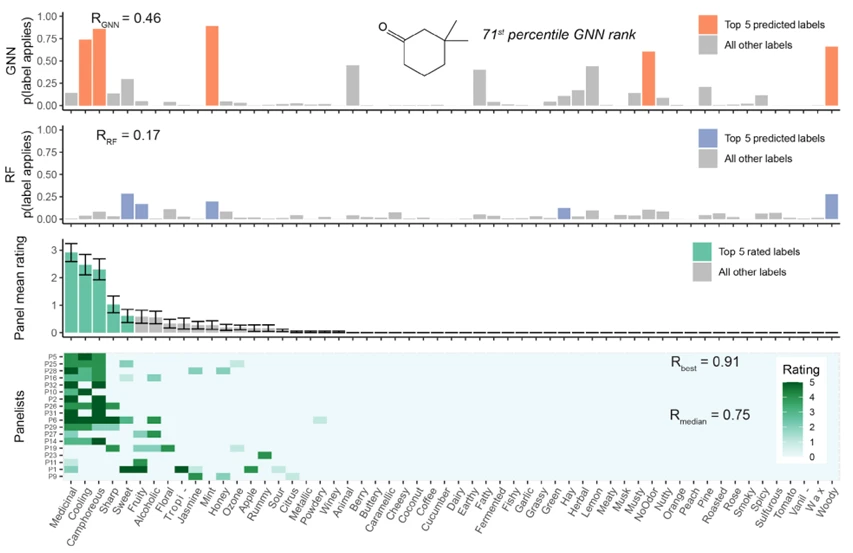
Image from Science, 2023, doi:10.1126/science.ade4401.
Once the AI was trained with the data, its ability to predict the odor of novel compounds was excellent. If it worked properly, it should match the average odor ratings of a panel of human experts, which it did.
Dr. Parker said, "As a tool for synthetic chemistry, this would be invaluable. We could use it to find new aromas. It opens up the possibility of screening large numbers of molecules for aromas, just as the pharmaceutical industry screens for new drugs."