Wang Ertao's research group at the Center of Excellence in Molecular Plant Science, Chinese Academy of Sciences, in collaboration with Zhai Jixian's research group at the Southern University of Science and Technology, published a research paper in Nature Plants entitled Single-nucleus transcriptomes reveal spatiotemporal symbiotic perception and early response in Medicago. This study was the first to resolve gene expression changes in specific cell types at the single-cell level in the root system of Tribulus terrestris (Medicago truncatula) during 24 hours of tubercle factor treatment, and revealed that epidermal and cortical cells underwent a significant reprogramming of gene expression within 30 minutes after tubercle factor treatment (these changes gradually recovered after 6 hours). This study found that MtFER had a similar expression pattern with MtLYK3 in the single-cell transcriptional profile of rhizobial symbiosis signaling response, further demonstrating that MtFER phosphorylated by MtLYK3 may be involved in symbiotic nitrogen fixation by regulating root hair development, coordinated immunity, and the expression of symbiotic key genes.
Legumes live in symbiosis with rhizobia, which can convert nitrogen into nitrogen-containing compounds that can be directly utilized by plants, thus drastically reducing the nitrogen demand of legumes. The establishment of symbiotic nitrogen fixation relies on mutual recognition between plants and rhizobia. Under nitrogen deficiency, the legume root system releases flavonoids into the inter-root, which induces rhizobia to secrete nodulation factors. The legume root system induces root hair curling, invagination line formation, and cortical cell division upon sensing the signal of the nodulation factor, inducing the morphogenesis of rhizomes. The establishment of a symbiotic relationship between legumes and rhizobia requires precise spatiotemporal and spatial-specific responses of different cell types in the legume root system to the tumorigenic factor signal. The team, in order to resolve the dynamic changes in the transcriptome during the recognition and transduction of this complex signal, constructed a single-cell transcriptional profile of tribulus alfalfa roots covering 0.5 h, 6 h, and 24 h after treatment with tumorigenic factors, using the FlsnRNA-seq technology developed by Zhai Jixian's team (Fig. 1). Examination of the single-cell transcriptome profiles based on this time series revealed that significant reprogramming of gene expression occurred at 0.5 h after treatment in all cell types, and this was particularly pronounced in epidermal and cortical cells. By identifying specifically up-regulated expressed genes in different cell types at different time points, the study further analyzed the spatiotemporal-specific response events that occur early in symbiotic signaling. For example, the expression of plant defense-related genes increased dramatically in almost all cell types within 0.5 h after treatment and then decreased, suggesting that the plant immune response to the symbiotic process is finely and dynamically regulated. The study identified similar expression patterns of MtFER and MtLYK3 genes in response to tumorigenic factors in single-cell transcriptional profiles, located in the same co-expression module enriched with known tumorigenic genes. Combining multiple research tools, the study further revealed that MtFER phosphorylated by MtLYK3 may participate in the symbiotic nitrogen fixation process in legumes by coordinating the expression of developmental, immune, and symbiotic key genes to ensure the normal invasion of Rhizobium (as shown in the figure).
A review article entitled FER meets the Nod factor pathway, which was published in the same issue of Nature Plants, introduced the above results and looked forward to the next research direction.
The single-cell gene map of tribulus clover roots established in this study is integrated in the data resource website (https://zhailab.bio.sustech.edu.cn/sc_medicago) for relevant researchers to use, providing important data support for subsequent related research in the field of symbiotic nitrogen fixation.
The research work was supported by the National Key Research and Development Program of China, the National Natural Science Foundation of China, the Guangdong Innovation and Entrepreneurship Team Project, the Shenzhen Science and Technology Innovation Commission, the Chinese Academy of Sciences Stable Support for Young Teams in the Field of Basic Research Program, and the Shenzhen Natural Science Foundation. Researchers from the University for Science and Technology of China (USTC) participated in part of the study.
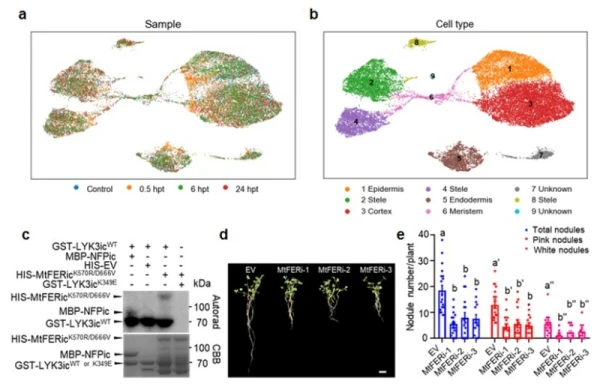
Involvement of MtFER in the regulation of root and rhizoma development using single-cell nuclear sequencing