Even killer T cells (specialized immune cells) that work around the clock to seek out and destroy cancer cells can become exhausted, and if scientists can understand why killer T cells become exhausted, they may be able to create more resilient cancer-fighting cells. In a recent study published in the international journal Nature, titled "Beta-1 Adrenergic Receptor links sympathetic nerves to T cell exhaustion," scientists from the Salk Institute and other institutions have shown that T cells can become more resilient to cancer. In the study entitled "Beta-1 Adrenergic Receptor links sympathetic nerves to T cell exhaustion", scientists from the Salk Institute and other institutions have found an association between T cell exhaustion and the body's sympathetic stress response ("fight-or-flight") by examining a variety of cancer types in mouse and human tissue samples. organism to control blood pressure and heart rate), thereby producing killer T cells that can more effectively fight off tumors.
In the article, the researchers establish a novel link between the sympathetic stress response and how the immune system responds to cancer, in addition to demonstrating that combining beta blockers with current immunotherapies may improve cancer treatment by boosting the function of killer T cells. There is no doubt that immunotherapy has revolutionized the treatment of cancer patients, but there are still many patients who are poorly treated, and the discovery that our nervous system can inhibit the function of cancer-destroying immune cells may open up entirely new avenues for thinking about how to restore the function of T-cells in tumors," said researcher Professor Susan Kaech. The sympathetic nervous system is primarily responsible for mediating the body's stress response, known as the "fight or flight response. However, researchers do not know how the body's nerves regulate the immune response against infection or cancer.
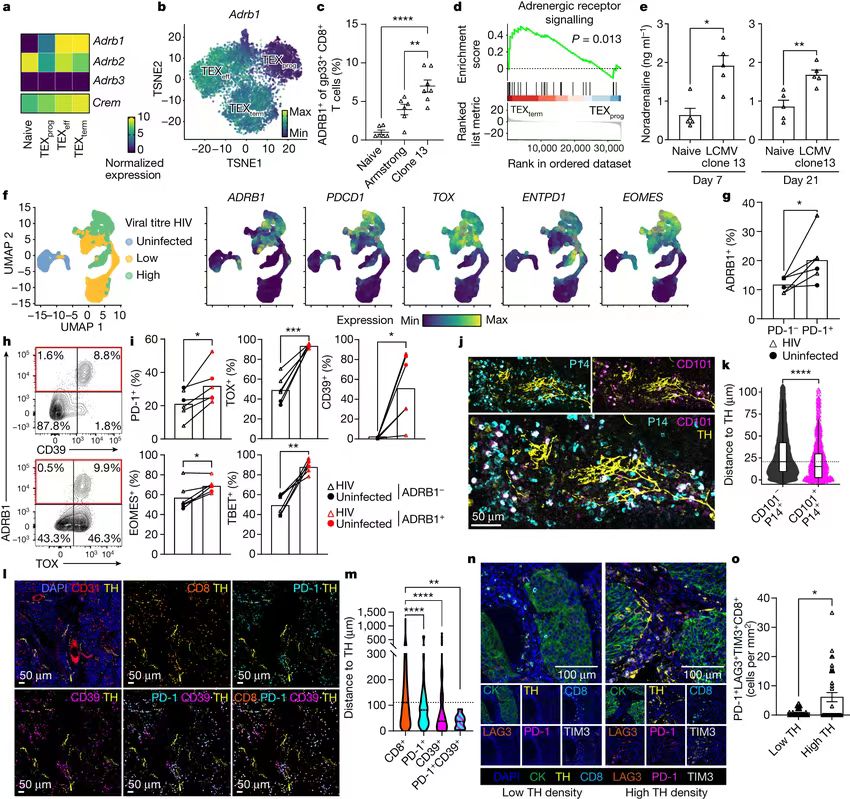
In this study, the researchers focused on the sympathetic nerves that innervate the body's organs and produce the messenger hormone norepinephrine, a stress hormone, and then analyzed when and how killer T-cells are affected by the sympathetic nerves using a variety of models of cancer and chronic disease in tissue samples from mice and humans. It was found that sympathetic nerves produce norepinephrine, which binds to killer T cells by utilizing a receptor called ADRB1, and that depleted killer T cells express more ADRB1 receptors than their functional counterparts, allowing the T cells to listen to the norepinephrine released by the nerves.
Reducing stress on T cells may lead to better treatment for cancer patients.
Image from: Nature (2023). DOI:10.1038/s41586-023-06568-6
To test whether the depletion of killer T cells could be prevented, the researchers tested two ways of blocking the interaction of norepinephrine with ADRB1, either by removing ADRB1 altogether or by using a beta blocker to impair ADRB1's function, which in turn would produce more functional killer T cells that would be better at destroying cancer cells. The researchers found that depleted T-cells do not "listen" to nerves from a distance, but gather around them in tissues, and surprisingly, the ADRB1 receptor provides T-cells with key instructions to migrate to the vicinity of the nerves, which in turn inhibits their function and makes them worse at fighting cancer. According to the researchers, tumor innervation is an understudied area of tumor immunology, and current research has found that nerves promote the process of T-cell depletion in tumors, and that over time, T cells also become exhausted and less powerful in the battle against tumors; if researchers can unravel the details behind nerve suppression of the body's immune response to cancer, and how depleted T cells how they move toward nerve tissue, perhaps they'll begin to therapeutically target this process.
The researchers hope to expand their understanding of the depleted T-cell environment to better understand why stress makes us heavier; we may be able to find a new pathway so that beta-blockers can be utilized to create more resilient killer T-cells that can resist depletion and better help fight off cancer, says researcher Globig. Since beta-blockers are now widely used in the clinic, researchers also hope to implement and propose novel anti-cancer strategies in lung cancer patients as soon as possible, and by collaborating with clinicians, researchers hope to study more tissue samples from human cancer patients to enrich the findings and provide further evidence of the effectiveness of beta-blockers in cancer therapies.
In summary, in this study, the researchers unveiled a new mechanism that restores the body's ability to fight tumors by blocking CD8+ T cells.