Recently, the Deep Sea Virus Research Team (DVRT), led by researcher Jian Huawow of the School of Life Science and Technology, Shanghai Jiaotong University, published a research paper titled "A systematic analysis of marine lysogens and proviruses" in Nature Communications, an international authoritative journal. A systematic analysis of marine lysogens and proviruses". Dr. Yi Yi was the first author of the paper, Prof. Jian Huawu was the corresponding author, and Prof. Xiao Xiang provided important support for the research. The research was also supported by the International Center for Deep Life Research (IC-DLI) team.
Viruses are the most abundant living organisms on Earth, and more than 90% of the world's viruses are found in the oceans and play important ecological functions. Unlike potent viruses, which only have a lysis cycle, mild viruses usually integrate their genetic material into the host genome (these hosts are called lysogenic microorganisms) and have both lysogenic and lysogenic life cycles. Previous studies of marine viruses have favored virulent viruses, and less attention has been paid to mild viruses. In recent years, multiple lines of evidence have suggested that mild viruses and lysogenic phenomena are prevalent in the marine environment. However, these evidences come from the analysis of small sample sizes, and a systematic assessment of the diversity and distribution patterns of marine mild viruses is still lacking, which greatly limits our overall knowledge of marine viruses. In this work, the researchers constructed the Marine Prokaryotic Microbial Genome Dataset (MPGD) and the Marine Mild Virus Genome Dataset (MTVGD), which contain 12,080 marine prokaryotic and 12,918 mild viral genomes, respectively, and cover the world's major oceanic regions (the Pacific Ocean, the Atlantic Ocean, and the Indian Ocean, etc.), the longitudinal depths (0-11094 m) and the two major environmental types of water column/sediment (Figure 1).
Based on these two datasets, the researchers found that lysogenic microorganisms are widely distributed in the global oceans with a total coverage of 40.4%. Lysogeny is widespread in a large number of marine microbial taxa, with bacteria having significantly higher lysogeny rates than archaea. Lysogenic coverage increased with increasing water depth in the aquatic environment, and could reach 52.8% in deep-sea (depth ≥1000 m) waters; whereas, it was basically stable in the marine sediment environment, maintaining between 46.1-48.7%. Systematic analyses showed that the differentiation between marine lysogenic and non-lysogenic microorganisms is extensive and significant, and that they have significantly different genomic and life-history traits: lysogenic microorganisms tend to display larger genome sizes, lower protein-coding densities, higher GC contents, and faster potential growth rates.
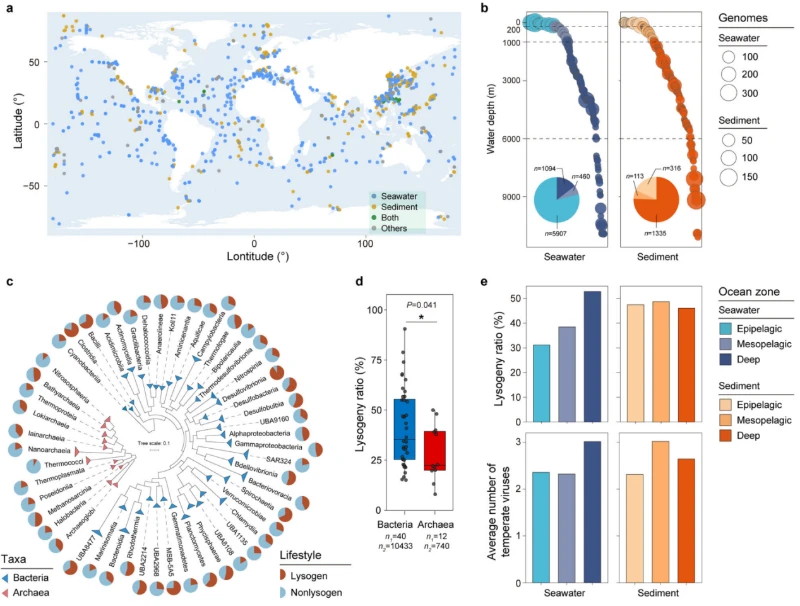
Figure 1. Overview of the construction of the Marine Prokaryotic Genome Dataset (MPGD) and the Moderate Viral Genome Dataset (MTVGD) and the distribution of marine lysogenic microorganisms.
The researchers identified potentially important tween virus taxa (tVCs) in the oceans through the tween virus-host interaction network, including 369 tVCs with cross-genera infestation ability, which provides important data support for the isolation and identification of tween viruses in the future (Figure 2). Further, the researchers have revealed the potential impact of tVCs on the genome evolution, metabolic remodeling and ecological functions of marine microorganisms through the identification of auxiliary metabolic genes, integration site analysis and virus-host fitness calculation. In order to better understand the functions of marine mildew viruses, the researchers have also demonstrated that marine mildew viruses are active and can significantly affect the expression of genes related to assimilatory sulfate reduction, type III secretion system, motility and so on, using a representative deep-sea virus-host system through gene knockdown, cut-off frequency detection, transcriptome sequencing and other experiments.
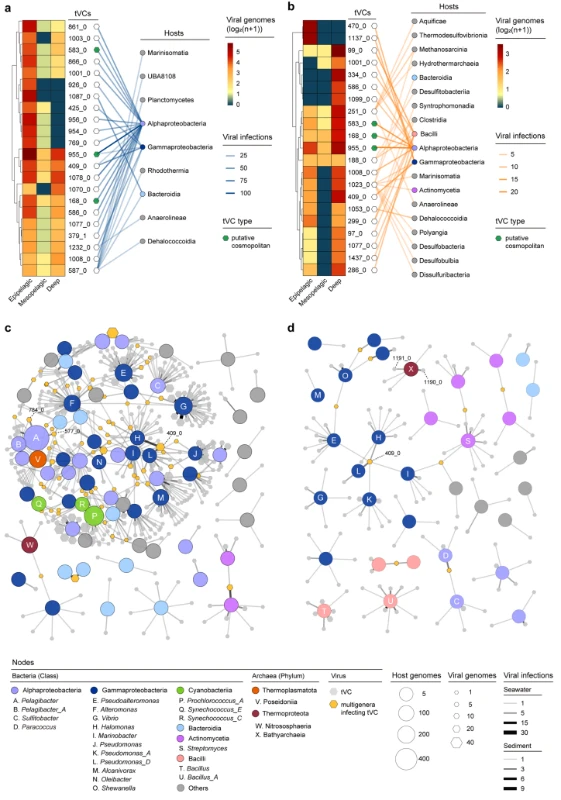
Figure 2. Distribution of marine mildew viruses and networks of interactions with prokaryotic microbial hosts
This work provides an important basic dataset for the study of marine viruses, significantly contributes to our overall knowledge of marine lysogenic microorganisms and mild viruses, reveals the potential ecological functions of mild viruses in marine biogeochemical cycles, and fills in the weak links in the knowledge system of marine viruses.
This study was supported by the National Natural Science Foundation of China (42176095, 41921006), the National Key Research and Development Program of China (2021YFF0501302), the Deep Blue Program of Shanghai Jiaotong University (SL2021PT201), and the Natural Science Foundation of Sanya Yazhou Bay Science and Technology City, a joint project of the Science and Technology Program of Hainan Province (2021JJLH0057) .