Researchers from the University of Cologne, Germany, published a paper in the journal Nature Aging titled: In planta expression of human polyQ-expanded huntingtin fragment reveals mechanisms to prevent disease-related protein aggregation.
Plants have an extra organelle, the chloroplast, compared to animals, which means that plants have more mechanisms for protein homeostasis. This study found that chloroplast protein homeostasis components prevent aggregation of disease-causing fragments of human Huntingtin expression, revealing a potential avenue for therapeutic intervention in human proteinopathies.
Although plants express hundreds of proteins containing polyQ regions, no pathology caused by these proteins has been reported to date. The wild type of the human HTT and ATXN3 proteins also have relatively long polyQ repeats, whereas the Arabidopsis proteome has no more than 24 polyQ stretches. Interestingly, specific polyQ proteins act as sensors, integrating internal and external cues that allow Arabidopsis to adapt to changing environments. One example is the transcription factor ELF3, which contains a Q7 stretch that allows the plant to respond to high temperatures through its aggregation. At 22 °C, ELF3 remains soluble and binds to genes that repress flowering. At temperatures above 27 °C, ELF3 forms aggregates that relieve transcriptional repression and promote flowering. Thus, under stress conditions, ELF3 can form aggregates in Arabidopsis even with a relatively short Q7 motif.
Since the longest polyQ amplification in the Arabidopsis protein is 24 repeats (Q24), the team expressed human HTT exon 1 containing Q28 and Q69 to investigate whether the plant could cope with polyQ-amplified proteins.
Under normal conditions, neither Q28 nor Q69 lead to the formation or deleterious effects of aggregates in Arabidopsis. However, similar to Arabidopsis ELF3 (Q7), Q28 and Q69 aggregate into aggregates under heat stress. Under nonstress conditions, Arabidopsis effectively prevents their aggregation by introducing polyQ-amplified proteins into chloroplasts and degrading them. In contrast, disrupting chloroplast protein homeostasis, either pharmacologically or genetically, triggers cytoplasmic aggregation of Q69 as well as endogenous polyQ proteins. The team found that Q28 and Q69 interacted with various chloroplast proteins, such as SPP. notably, ectopic expression of SPP reduced aggregation of polyQ-amplified proteins in both human cells and nematode models.
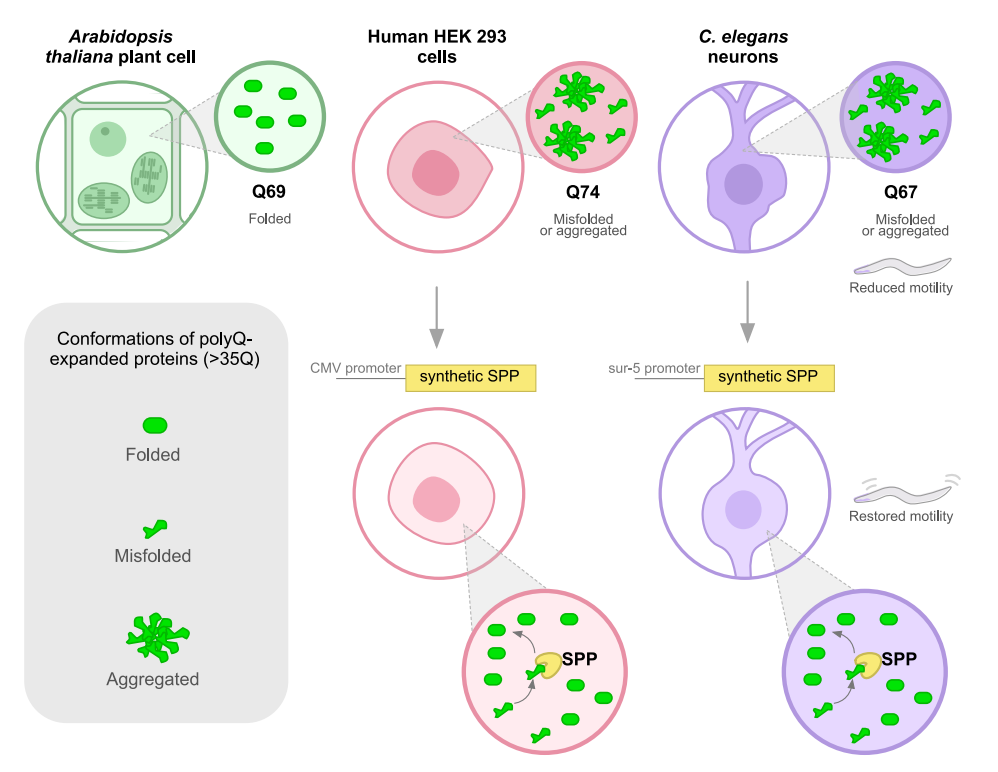
These findings open new avenues for the development of synthetic plant-based proteins for disease treatment that may be useful in treating polyQ amplification-associated proteinopathies in humans.