Immunotherapy has achieved great clinical success, but most patients fail to derive sustained clinical benefit from treatment. Cytotoxic T cells (CTLs) are key effector cells of the antitumor immune response, and they specifically recognize tumor cells through the interaction of the T cell receptor (TCR) with the peptide-major histocompatibility complex (MHC).CTLs release cytotoxic particles containing perforin and granzymes to induce apoptosis in target cells. Thus, cancer cells typically develop multiple mechanisms to avoid CTL-mediated recognition and killing. Among the known mechanisms are the downregulation of antigen presentation pathways and the upregulation of immunosuppressive molecules such as PD-L1 and SERPINB9. In addition, CTLs release cytokines such as TNFα and IFNγ to kill tumor cells. However, the molecular mechanisms of how tumor cells tolerate cytokine-mediated killing are unclear.
On July 27, 2023, Pan Deng's team at Tsinghua University School of Medicine, Zeng Zexian's team at the Center for Quantitative Biology (CQB) at Peking University, and the Peking University-Tsinghua Joint Center for Life Sciences, in collaboration with Wang Fubing's team at Wuhan University's Zhongnan Hospital, published a paper in the journal Cell Metabolism entitled: Tumor aerobic glycolysis confers Tumor aerobic glycolysis confers immune evasion through modulating sensitivity to T cell-mediated bystander killing via TNFα.
The study found that inhibition of tumor glycolysis and glucose transporter 1 (Glut1) enhances cytotoxic T cell (CTL) killing of tumor cells.
Mechanistically, Glut1 inactivation leads to an increase in tumor oxidative phosphorylation levels (OXPHOS), resulting in the production of excess reactive oxides (ROS), which promotes TNFα-mediated cell death. A variety of mouse tumor cells could be made more sensitive to antitumor immunity by the Glut1-specific inhibitor BAY-876. In addition, inhibition of Glut1 had relatively little effect on CTL function due to the high expression of another glucose transporter protein, Glut3, in CTLs. Thus, targeting Glut1 provides a new therapeutic idea for tumor immunotherapy.
The team first performed a genome-wide CRISPR-Cas9 screen for genes resistant to CTL-mediated killing in the mouse lung cancer cell line LLC and pancreatic cancer cell line Panc02. The screen revealed a significant decrease in sgRNA abundance of key genes targeting glycolysis, such as Slc2a1 (Glut1), Gpi1, Pkm, and Ldha, revealing the critical role of the tumor cell glycolytic pathway in regulating tumor resistance to CTL killing. By integrating multiple sets of human single-cell data and immunofluorescence experiments, it was found that Glut1 was more highly expressed in tumor cells, whereas immune cells selectively over-expressed Glut3 for glucose uptake. Therefore, the research team chose Glut1 as a potential target to specifically target the glycolytic pathway in tumor cells for further study.
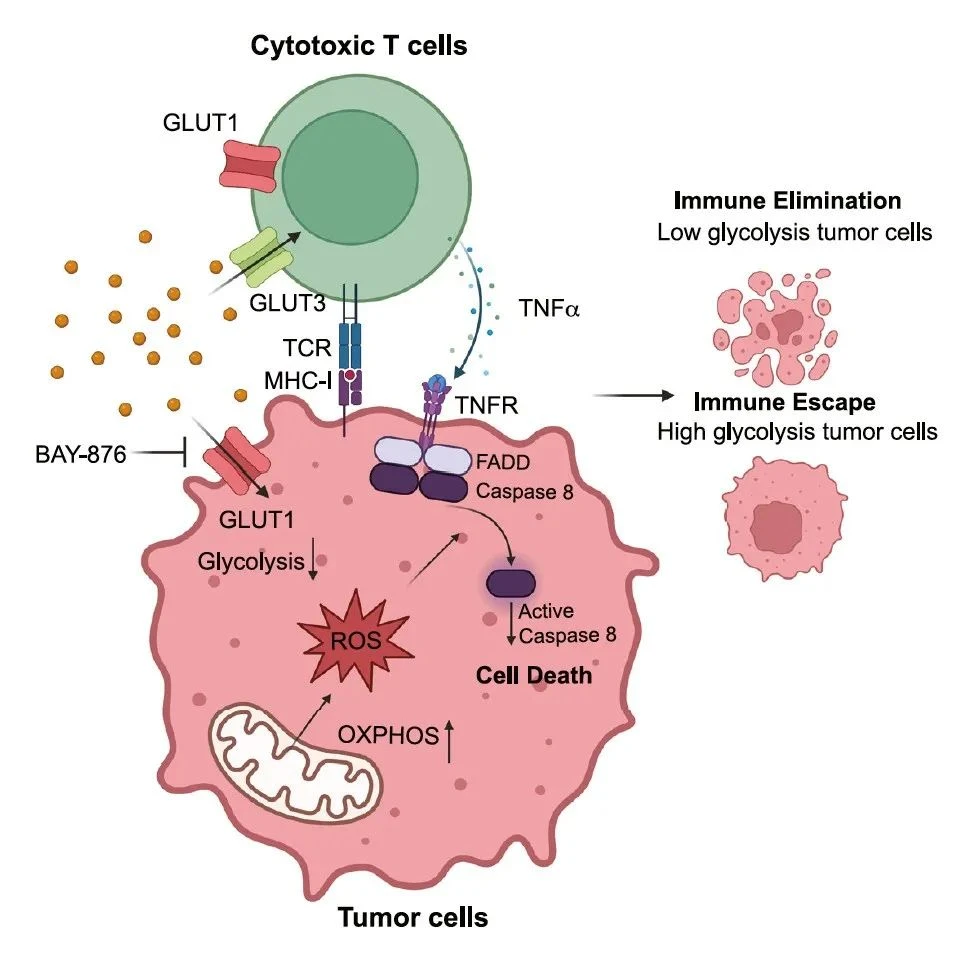
The team found that the phenotype of sensitivity to CTL killing resulting from Glut1 knockdown is not dependent on direct contact between tumor cells and T cells, implying that Glut1 is involved in regulating tumor cell tolerance to CTL-released cytokine killing. Through a series of biochemical and cellular experiments, the team demonstrated that Glut1 deficiency resulted in a significant rise in tumor cell death induced by TNFα. Mechanistically, Glut1 inhibition led to a significant increase in mitochondrial oxidative phosphorylation (OXPHOS) levels and the generation of large amounts of reactive oxygen species (ROS), the accumulation of which in the cell led to the down-regulation of c-Flip levels, which then exacerbated TNFα-induced apoptosis.
Finally, in a variety of mouse tumor models, the team found that inhibiting Glut1 had no effect on tumor growth in immunodeficient mice but inhibited tumor growth in immunocompetent mice, suggesting that the tumor inhibitory effect of targeting Glut1 is dependent on the host's adaptive immune system. Importantly, when TNFa receptor knockout tumor cells were used, the effect of Glut1 inhibition leading to slowed tumor growth correspondingly disappeared, again suggesting that Glut1 inhibition is closely linked to the tumor TNFa pathway. The team further analyzed clinical trial datasets and the TCGA database of patients treated with immune checkpoint blockade (ICB) and found that low expression of the glycolytic/Glut1 signature was associated with a better response to ICB.
Taken together, this study reports a novel mechanism of tumor cell glycolysis involved in regulating CTL secretion of TNFα-mediated killing, and identifies Glut1 as a preferred glycolytic target of tumor cells, providing new insights to improve the response rate of existing therapies and develop novel immunotherapies.
Lijian Wu, a doctoral student at the Department of Basic Medicine, Tsinghua University School of Medicine, is the first author of the paper. Deng Pan of Tsinghua University School of Medicine, Zeng Zexian of Center for Quantitative Biology, Peking University, and Wang Fubing of Zhongnan Hospital, Wuhan University, are the co-corresponding authors.