A research paper entitled: The default and directed pathways of hepatoblast differentiation involve distinct epigenomic mechanisms has been published in Developmental Cell by Xu Chengran's group at the School of Basic Medical Sciences, Peking University, Peking University-Tsinghua Joint Center for Life Sciences, and the National Key Laboratory for Female Fertility Promotion. The default and directed pathways of hepatoblast differentiation involve distinct epigenomic mechanisms.
The study reveals the distinct epigenomic mechanisms of hepatoblast differentiation to parenchymal cells and cholangiocytes during liver development.
Cell fate decisions are regulated by a range of genetic and epigenetic cascades, including gene transcription, chromatin accessibility, and histone modifications. Although multi-omics analyses have been used to define cellular identity during development, the precision of using multi-omics approaches to reveal the developmental pathways of cellular differentiation in vivo and the interrelationships between the different approaches have not been effectively investigated due to the lack of a simple and effective system. The liver is an important metabolic organ, and its major cell types, hepatic parenchymal cells and cholangiocytes, originate from bipotential hepatoblasts during development.
In the previous work of Xu Chengeran's group, a new "default-regulation" model of hepatoblast differentiation was proposed, i.e., the development of hepatoblasts into parenchymal cells is a default process of cell fate, while the differentiation into cholangiocytes is highly regulated. Using this simple and easy-to-use in vivo liver cell differentiation system, the group investigated the association of different epigenetic modifications with cell differentiation and developmental pathways, as well as the regulatory mechanisms.
The group selected a series of time points in the development of mouse hepatoblasts to liver parenchymal cells and cholangiocytes, and analyzed the dynamic epigenetic features of liver lineage cells at different developmental periods using multi-omics techniques such as RNA-seq, ATAC-seq and histone modification-related ChIP-seq. The results showed that the dynamic changes in transcriptome, chromatin accessibility and promoter-associated histone modifications H3K4me3 and H3K27me3 could effectively characterize the "default-regulated" pathway of hepatoblast differentiation, while enhancer-associated histone modifications H3K4me1 and H3K27ac could not effectively characterize this pathway. pathway. Genetic studies demonstrated that promoter-associated H3K27me3-modifying enzymes Ezh2 and Jmjd3 play opposite regulatory roles in hepatoblast to cholangioblast differentiation and have no significant effect on hepatoblast to parenchymal cell differentiation, whereas the active enhancer-associated histone acetyltransferase p300 modulates parenchymal and cholangioblast maturation after hepatoblast differentiation. Thus, promoter- and enhancer-associated epigenetic regulation in hepatoblast development divide their roles to regulate the differentiation process and maturation process of the cells, respectively.
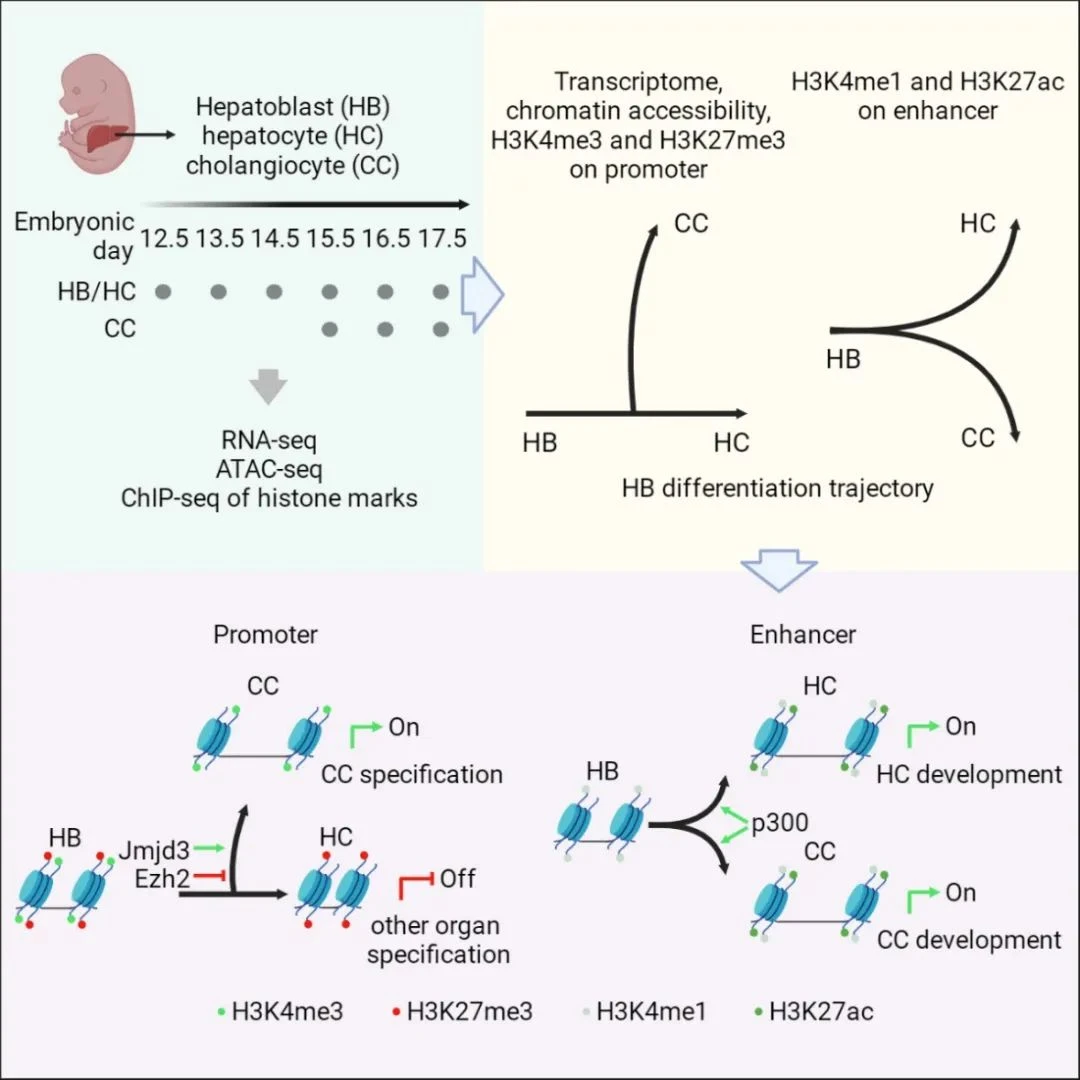
This study not only establishes a paradigm for the use of multi-omics to resolve cell fate transitions and development, but also provides important developmental biology information for optimizing liver cell directed differentiation in vitro.
Chengran Xu, professor of Peking University School of Basic Medical Sciences and researcher of the Joint Center for Life Sciences, is the corresponding author of the paper; Li Yang, postdoctoral fellow of Peking University School of Basic Medical Sciences, and Xin Wang, doctoral student of the School of Life Sciences, are the co-first authors; Xinxin Yu and Bichen Zhou, postdoctoral fellows of the School of Basic Medical Sciences of Peking University, and Prof. Joyce and Lu Yang, professors of Peking University School of Life Sciences, the Joint Center for Life Sciences, and the McGowan Institute for Brain Science of IDG, have study.