Ovarian cancer is very dangerous because it is usually only detected when it spreads outside the ovaries, and the symptoms of the disease are also attributed to other diseases; Scientists believe that aging increases the spread of ovarian cancer and other cancers, but the molecular mechanisms behind it are currently unclear to researchers. Recently, in a research report published in the international journal Cellular and Molecular Life Sciences titled "The sencent ovarian matrix cancer colonization by ovarian cancer cells", scientists from institutions such as the Indian Academy of Sciences found that ovarian cancer cells are more prone to spread in aging or aging tissues, Because these tissues secrete a special extracellular matrix that attracts spreading cancer.
In the article, researchers used a chemotherapy induced aging model to study this phenomenon. They first extracted tissue from the inner wall of the body cavity from a mouse model, and then exposed half of the tissue to chemotherapy used for cancer treatment, promoting aging, i.e. the state where cells stop replicating but do not die. Researcher Dr. Ramray Bhat suggests that you may refer to it as cellular or tissue aging. Subsequently, researchers exposed young and aging mouse tissues and human tissue-like cell slices to ovarian cancer cells. They used delayed imaging technology to label normal and aging cells with different fluorescent markers, so that they could be studied under a microscope for a long time.
In the article, researchers used a chemotherapy induced aging model to study this phenomenon. They first extracted tissue from the inner wall of the body cavity from a mouse model, and then exposed half of the tissue to chemotherapy used for cancer treatment, promoting aging, i.e. the state where cells stop replicating but do not die. Researcher Dr. Ramray Bhat suggests that you may refer to it as cellular or tissue aging. Subsequently, researchers exposed young and aging mouse tissues and human tissue-like cell slices to ovarian cancer cells. They used delayed imaging technology to label normal and aging cells with different fluorescent markers, so that they could be studied under a microscope for a long time.
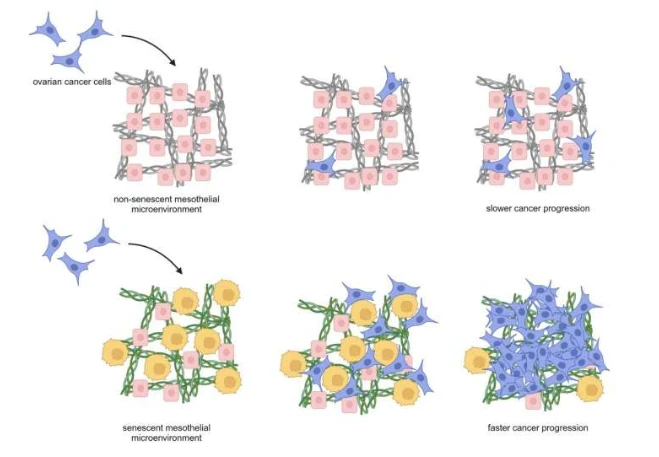
Aging cells may enhance the spread of ovarian cancer
Image source: Cellular and Molecular Life Sciences (2023) DOI: 10.1007/s00018-023-05017-x
Image source: Cellular and Molecular Life Sciences (2023) DOI: 10.1007/s00018-023-05017-x
Researchers suggest that imaging tissues is slightly more difficult compared to cell lines, as there is only one specific type of cell growing in the cell line; They found that cancer cells choose to colonize aging tissues, and they are also closer to aging normal cells in cell slices. In order to elucidate what mechanism attracts cancer cells to aging cells, researchers first want to know if they can be attracted by signaling molecules secreted by aging cells, which are undergoing long-distance diffusion. They established a computer model to explore the interaction between cancer cells and aging cells.
To the surprise of researchers, it is not the spreading molecules that attract cancer cells. The proteins secreted by aging cells can serve as extracellular matrix (ECM) to precipitate (the basis for cell adsorption and growth), which can bring cancer cells there and promote their better attachment to aging cells and rapid spread. In addition, researchers are conducting experiments in human cell lines to replicate the predicted results of computer simulations. They have noticed that cancer cells can strongly adhere to the extracellular matrix around aging cells and ultimately eliminate aging cells; Moreover, compared to the extracellular matrix of aging cells, the extracellular matrix of aging cells contains higher levels of proteins such as fibronectin, laminin, and hyaluronic acid, which may promote stronger binding of cancer cells.
In summary, the results of this study indicate that the age-related stromal phenotype in the peritoneal barrier may enhance the colonization of invading ovarian cancer cells, leading to a disease-related burden of cancer metastasis.
To the surprise of researchers, it is not the spreading molecules that attract cancer cells. The proteins secreted by aging cells can serve as extracellular matrix (ECM) to precipitate (the basis for cell adsorption and growth), which can bring cancer cells there and promote their better attachment to aging cells and rapid spread. In addition, researchers are conducting experiments in human cell lines to replicate the predicted results of computer simulations. They have noticed that cancer cells can strongly adhere to the extracellular matrix around aging cells and ultimately eliminate aging cells; Moreover, compared to the extracellular matrix of aging cells, the extracellular matrix of aging cells contains higher levels of proteins such as fibronectin, laminin, and hyaluronic acid, which may promote stronger binding of cancer cells.
In summary, the results of this study indicate that the age-related stromal phenotype in the peritoneal barrier may enhance the colonization of invading ovarian cancer cells, leading to a disease-related burden of cancer metastasis.