H. pylori is the main risk factor for gastric cancer and has been listed as a Class I carcinogen. Helicobacter pylori infection can promote gastritis, atrophy, and intestinal metaplasia (IM). Among Helicobacter pylori infected individuals, only 1% -3% ultimately develop GC, indicating the involvement of other triggers. New evidence suggests that there is a significant presence of non Helicobacter pylori microbiota in the gastric mucosa, and their dysregulation may play a role in the development of gastric cancer. However, the identification and characterization of non Helicobacter pylori driving bacteria associated with gastric cancer still need to be explored.
Recently, Professor Kaili Fu and his team from the Institute of Digestive Diseases at the Li Ka shing Institute of Health Sciences, The Chinese University of Hong Kong, Hong Kong, have characterized the gastric microbiome of Helicobacter pylori negative patients at different stages of gastric tumor occurrence, from superficial gastritis, atrophic gastritis, IM to GC, with the aim of exploring the non Helicobacter pylori gastric microbiome, And it was revealed that Amanita is a pathogen that promotes gastric tumor development through direct interaction with gastric epithelial cells on the TMPC-ANXA2-MAPK axis.
The results showed that Haemophilus parasuis easily colonized in the stomach of mice and triggered an acute inflammatory response, leading to upregulation of pro-inflammatory cytokines including Ccl20 and Ccl8, and subsequently entering the chronic stage, resulting in intensified and persistent gastritis. Long term infection with Streptococcus can cause progressive gastric lesions. The increase of Alcian blue positive cells and GSII positive mucinous neck cells, as well as the decrease of gastric intrinsic factor (GIF) positive leader cells, demonstrate that Streptococcus can induce degeneration and transformation.
Infection with Streptococcus suis during the precancerous stage can also lead to an increase in gastric pH and changes in gastric microbiota, enrichment of pathogenic oral symbiotic bacteria (Prevotella and Aggregatibacter), and probiotics B Pseudolongum is depleted. In MNU model, angiostreptococci will aggravate the transformation of dysplasia and increase the incidence rate of gastric tumors, and angiostreptococcal infection will lead to increased cell proliferation in gastric mucosa and tumors. The expression of tight junction markers CLDN18, OCLN, and ZO-1 decreases over time, and infection with Haemophilus parasuis can impair gastric barrier function.
Recently, Professor Kaili Fu and his team from the Institute of Digestive Diseases at the Li Ka shing Institute of Health Sciences, The Chinese University of Hong Kong, Hong Kong, have characterized the gastric microbiome of Helicobacter pylori negative patients at different stages of gastric tumor occurrence, from superficial gastritis, atrophic gastritis, IM to GC, with the aim of exploring the non Helicobacter pylori gastric microbiome, And it was revealed that Amanita is a pathogen that promotes gastric tumor development through direct interaction with gastric epithelial cells on the TMPC-ANXA2-MAPK axis.
The results showed that Haemophilus parasuis easily colonized in the stomach of mice and triggered an acute inflammatory response, leading to upregulation of pro-inflammatory cytokines including Ccl20 and Ccl8, and subsequently entering the chronic stage, resulting in intensified and persistent gastritis. Long term infection with Streptococcus can cause progressive gastric lesions. The increase of Alcian blue positive cells and GSII positive mucinous neck cells, as well as the decrease of gastric intrinsic factor (GIF) positive leader cells, demonstrate that Streptococcus can induce degeneration and transformation.
Infection with Streptococcus suis during the precancerous stage can also lead to an increase in gastric pH and changes in gastric microbiota, enrichment of pathogenic oral symbiotic bacteria (Prevotella and Aggregatibacter), and probiotics B Pseudolongum is depleted. In MNU model, angiostreptococci will aggravate the transformation of dysplasia and increase the incidence rate of gastric tumors, and angiostreptococcal infection will lead to increased cell proliferation in gastric mucosa and tumors. The expression of tight junction markers CLDN18, OCLN, and ZO-1 decreases over time, and infection with Haemophilus parasuis can impair gastric barrier function.
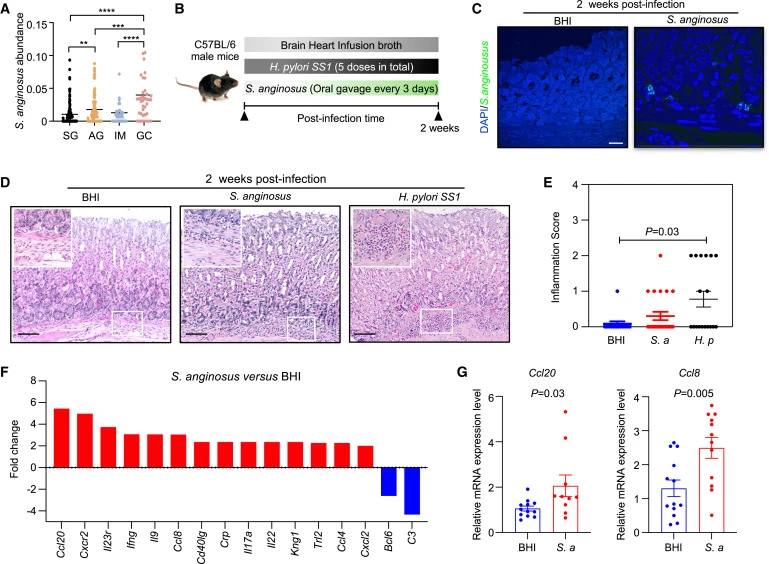
Vascular Streptococcus colonizes gastric mucosa and promotes acute inflammation
In summary, this experiment identified Streptococcus suis as a non Helicobacter pylori promoting gastric tumor development and elucidated the toxic surface factor TMPC of Haemophilus parahaemolyticus binding to ANXA2 on gastric epithelial cells, inducing bacterial attachment, invasion, and downstream activation of oncogenic MAPK signaling. Therefore, this provides evidence for Streptococcus suis to become a pathogenic pathogen in the development stage of gastric cancer.