Recently, researchers from the Tokyo Metropolitan Institute of Gerontology and Waseda University published a research paper entitled " Moderate protein intake percentage in mice for maintaining metabolic health during approach to old age " in the journal Geriatrics. The research paper.
The study shows that the optimal percentage of protein in the diet to maintain a healthy body is 25-35%, with lower triglyceride levels in the liver, blood glucose levels and lipid levels in the blood.
In the study, researchers analyzed the diets of young (6 months old) and middle-aged (16 months old) mice, which were fed for two consecutive months with a consistent total calorie but different protein proportions, with a total calorie count of 4.2 kcal/g, and a fixed fat of 25% based on the Japanese average.
Based on the protein percentage, the mice were divided into groups P5 (5% protein, 70% carbohydrate, 25% fat), P15 (15% protein, 60% carbohydrate, 25% fat), P25 (25% protein, 50% carbohydrate, 25% fat), P35 (35% protein, 40% carbohydrate, 25% fat) and P45 (45% protein, 30% carbohydrate, and 25% fat). Of these, the P15 group was closest to the Japanese nutritional balance.
After 2 months, the researchers found that middle-aged mice weighed significantly more than young mice, with the P5 group being the lowest; middle-aged mice ate more than young mice, with the P5 group eating the most and the P45 group eating the least; and middle-aged mice had a significantly higher intake of protein, fat, and carbohydrates than young mice.
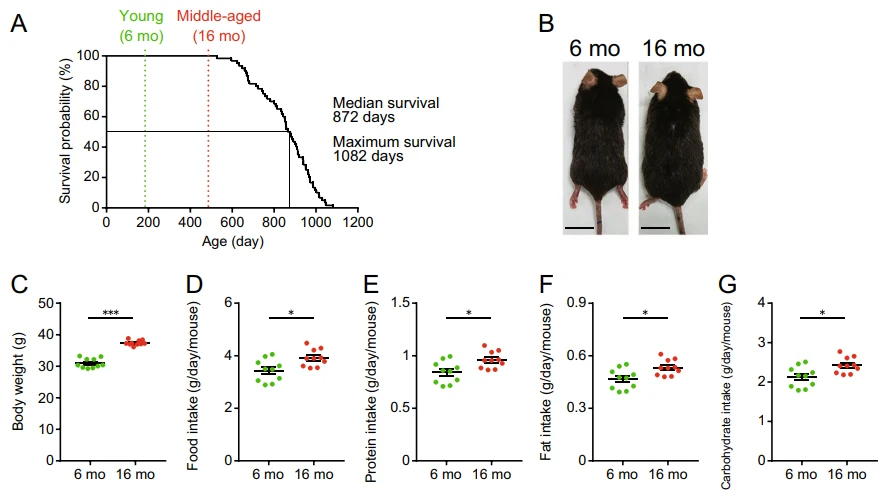
Changes in body weight, food intake and more in young and middle-aged mice
Next, the researchers examined fat accumulation in the livers of young and middle-aged mice, quantifying triglycerides and total cholesterol in the liver.
The analysis revealed that many fat droplets were present in the livers of mice in the P5 group, with higher levels of triglycerides and total cholesterol. In addition, middle-aged mice in the P5 and P15 groups had higher triglyceride levels than young mice. Fat accumulation in the liver is characteristic of malnutrition, which occurs when insufficient amounts of protein are consumed.
Importantly, in the P35 group, there was no accumulation of triglycerides in either the young or middle-aged mice.
In addition, in terms of blood glucose levels, the P25 and P35 groups had low blood glucose levels, but the P45 group had fairly high blood glucose levels. In terms of total cholesterol levels, the P15 group was the highest and the P5, P35 and P45 groups were the lowest.
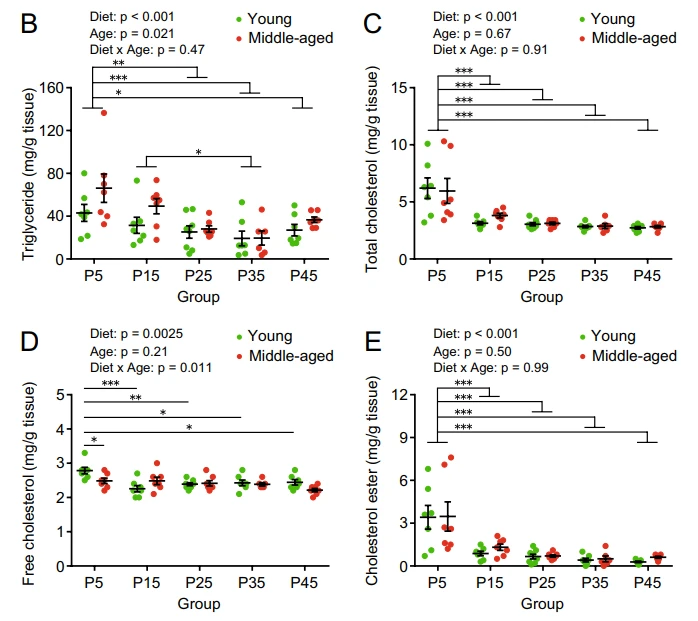
Liver lipid content in mice fed different protein diets
The results showed that triglyceride levels in the liver, blood glucose levels and lipid levels in the blood were lower when fed a diet with a protein percentage of 25-35% compared to the P15 group, which was closest to the Japanese nutritional balance. This means that a diet with a protein percentage of 25-35% is the healthiest for both young and middle-aged people.
The researchers say it's too early to apply the results of this experiment to humans, but the results in the mice provide a reference for healthy human diets.
As a next step, the researchers plan to analyze the optimal protein, fat, and carbohydrate balance for each life stage to prevent and improve sarcopenia, frailty, and dementia for a long and healthy life.
In summary, a diet with 25-35% protein is the healthiest in both youth and middle age, and the results of the study provide a reference for healthy human diets.