Many times we are studying how to eat to lose weight with the best results, such as the ketogenic diet, light fasting method and so on. But the importance of exercise workouts in the weight loss business cannot be overstated, so when is the best time to exercise for weight loss, I believe many of my buddies have the same problem. Recently, a number of studies have analyzed and reported on this issue, and they have come to a similar conclusion: the weight loss effect of exercise in the morning is the best.
First, in a recent study entitled "The diurnal pattern of moderate-to-vigorous physical activity and obesity: a cross-sectional analysis", researchers at the Hong Kong Polytechnic University in Hong Kong, China, reported that the morning exercise is the most effective for weight loss. researchers at The Hong Kong Polytechnic University in Hong Kong, China, explored the association between exercise duration and obesity.
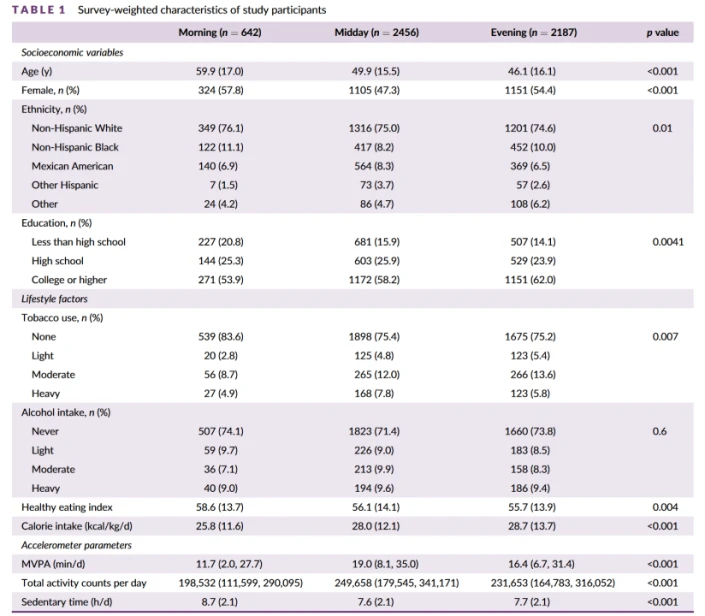
The study collected data from 5,285 participants from the U.S. Centers for Disease Control and Prevention (CDC) and divided them into 3 categories based on the time of day they performed moderate to high intensity physical activity: morning ( n = 642); midday (n = 2456); and evening (n = 2187 ; Fig. 1). Their peak periods of physical activity were 7:00-9:00 a.m., 11:00-13:00 p.m., and 17:00-20:00 p.m. Participants were asked to wear an accelerometer sensor on their right hip for 7 consecutive days during waking hours to measure physical activity and energy expenditure. Using the data collected by the accelerometers, physical activity was categorized as sedentary less active, light moderate intensity physical activity, and moderate to high intensity physical activity. Sedentary less active acceleration was less than 100 cpm; light intensity physical activity was 100 ~ 1951 cpm, and moderate to high intensity physical activity ( MVPA ) was greater than or equal to 1952 cpm.The study results were observed in terms of BMI (BMI greater than 30 was considered obese) and waist circumference ( WC ).
doi/10.1002/oby.23851
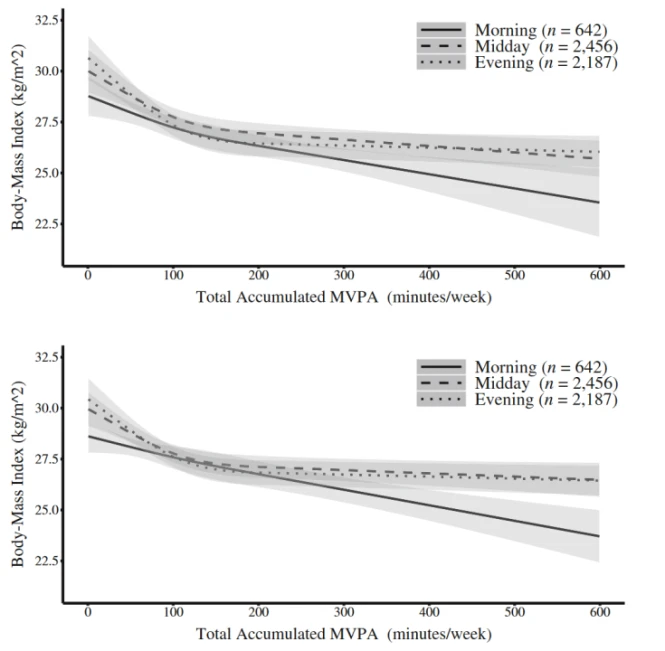
The data showed that while participants in the morning group accumulated less physical activity and had more sedentary behaviors than participants in the noon and evening groups. After controlling for age, gender, race, education, tobacco use, alcohol consumption, sedentary behavior, and number of MVPA, the morning group had lower BMI and WC compared to the other two groups. The mean values of BMI were 27.4, 28.4, and 28.2 kg/m2 and the mean values of WC were 95.9, 97.9, and 97.3 cm for the morning, midday, and evening, respectively.Further control for dietary quality and caloric intake did not alter the strength of the associations: the BMIs for the morning, midday, and evening groups were 27.5, 28.3, and 28.3 kg / m2 , respectively, and the WCs were 96.0, 97.8, respectively, 97.5 cm.
That is, there was a strong linear association between moderate to high intensity physical activity in the morning and obesity, whereas it was weakly associated with obesity when performed in the midday and evening, and further adjustment for dietary factors did not change this association. It suggests that participants who performed moderate-intensity physical activity from 7-9 am had lower BMI and WC, i.e., the weight loss effect was more significant, even if the sedentary time was longer. This also sends us a message that exercising in the morning increases metabolism throughout the day, which may be most effective for people who have to work sedentary jobs.
doi/10.1002/oby.23851
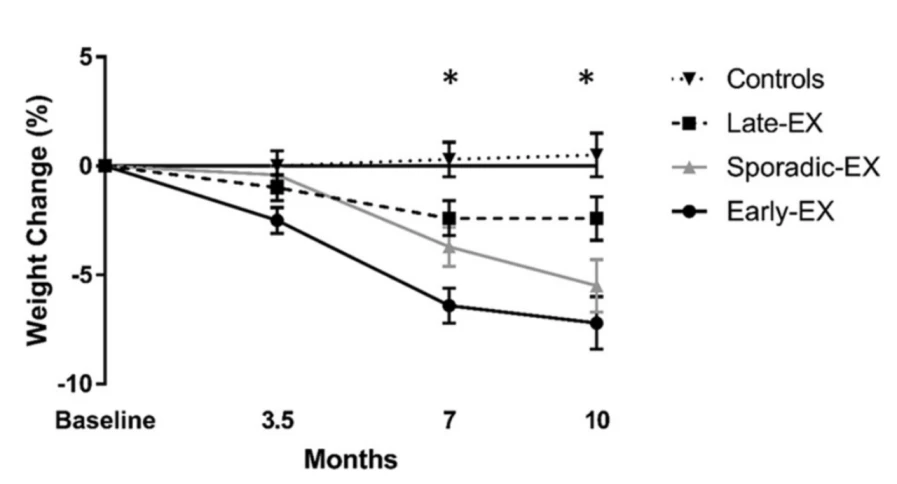
Another study published in the International Journal of Obesity entitled "The effects of exercise session timing on weight loss and components of energy balance: midwest exercise trial 2" reached similar conclusions. The effects of exercise session timing on weight loss and components of energy balance: midwest exercise trial 2". The study recruited participants who were obese (BMI 25.0-39.9 kg/m2) and asked them to complete 200 exercise sessions during a 10-month (40-week) exercise intervention. Early training was from 7:00-11:59 p.m., late training was between 3:00-7:00 p.m., and irregular training was exercise at any time. Workouts consisted primarily of treadmill walking/jogging 5 days per week.
The results showed that at month 10, all of the training groups lost weight, and the weight of the non-training group remained essentially unchanged. Among the early exercise group ( -7 . 2 ± 1 . 2 %. p < 0.001) and the irregular exercise group ( -5 .5 ± 1 . 2 %. p < 0.001) had significantly greater weight loss than the no-exercise group ( +0 . 5 ± 1 . 0 %, p < 0.001), and the weight loss was significantly greater in the early exercise group than in the late exercise group ( -2.1 ± 1 . 0 %, p < 0.001), i.e., weight loss was more pronounced in early exercise.
10.1038/s41366-019-0409-x
There has been much evidence of the positive benefits of morning exercise for weight loss, and we found more evidence in a review in EXERCISE AND SPORT SCIENCES REVIEWS entitled "Consistent Morning Exercise May Be Beneficial For Individuals with Obesity" in EXERCISE AND SPORT SCIENCES REVIEWS. The article suggests that among overweight/obese adults, consistent exercise time, especially consistent morning exercise, promotes more frequent exercise and more effective weight management. Not only that, but exercising in the morning has positive implications for increasing metabolism and fat oxidation throughout the day.
In short, now that you've decided to spread your legs and get ready to exercise, maximize your efficiency and get up early to do it!