Jie Hong, Haoyan Chen and Ruixin Liu from Shanghai Jiao Tong University published a research paper titled "Disruption of CerS6-mediated sphingolipid metabolism by FTO deficiency aggravates ulcerative colitis" online in Gut. The study found that FTO deficiency aggravates ulcerative colitis by disrupting CerS6-mediated sphingolipid metabolism. The study found FTO downregulation in both internal and external cohorts of UC patients. DSS treatment resulted in dysregulation of intestinal flora, increased infiltration of pro-inflammatory macrophages, and enhanced differentiation of Th17 cells in Ftoflox/ flox;Villin-cre mice.
FTO deficiency resulted in increased m6 A modification of CerS6, the gene encoding ceramide synthetase, and decreased mRNA stability, leading to downregulation of CerS6 and accumulation of S1P in IECs. Subsequently, secretion of S1P by IECs triggered secretion of serum amyloid A protein 1/3 by pro-inflammatory macrophages, which ultimately induced Th17 cell differentiation. In addition, through bioinformatics analysis and experimental validation, the authors found that UC patients with lower FTO expression may have a better response to vedolizumab treatment. In conclusion, FTO downregulation promotes UC by decreasing CerS6 expression, leading to increased S1P accumulation in IECs and exacerbating colitis through an m6A-dependent mechanism.Lower FTO expression in UC patients may enhance their response to vedolizumab treatment.
Inflammatory bowel disease (IBD) refers to a group of chronic inflammatory diseases of unknown cause, including ulcerative colitis (UC) and Crohn's disease (CD).Patients with UC have a higher risk of developing colon cancerThe development of UC is influenced by a variety of factors, including an individual's genetic susceptibility, environmental factors, and epigenetic regulation. Recent studies have emphasized the important role of epigenetic regulation in the pathogenesis of UC.
m6 A is a widely distributed and abundant epigenetic modification of mRNAs that plays an important role in a variety of biological processes, including the heat shock response, cellular differentiation, and RNA metabolism. m6 A modification of mRNAs is catalyzed by the methyltransferase complex, which consists of three major transcription factors: methyltransferase-like 3 (METTL3), METTL14, and Wilms ' tumor 1- associated protein (WTAP). This modification is removed by two demethylating enzymes: fat mass-related and obesity-associated protein (FTO) and AlkB homologue 5 (ALKBH5). Various studies have shown that the m6 A modification is involved in the pathogenesis of UC. Specifically, knockdown of METTL14 in T cells leads to dysregulation of Treg cells and spontaneous colitis. In addition, Foxp3-mediated deletion of METTL3 in Treg cells increased Th1 and Th17 responses However, the role of other m6 A modification members in UC progression is unknown.
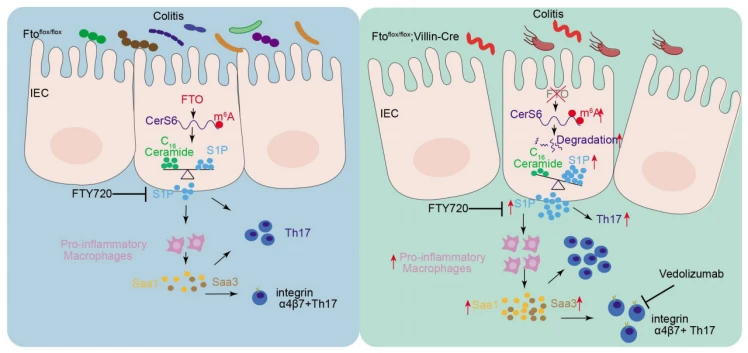
Mechanism model diagram (Figure from Gut)
Ceramide synthetase 6 (CerS6) is highly expressed in the gut and immune system and is an enzyme that preferentially produces C16 -ceramides CerS6-deficient mice in different disease models exhibit different pathological patterns. On the one hand, lack of CerS6 exacerbates experimental autoimmune encephalomyelitis (EAE) in mice, and on the other hand, lack of CerS6 reduces macrophage infiltration in a model of dietary obesity. Sphingolipid metabolism has been shown to play a role in colitis, and the bioactive lipid sphingosine-1-phosphate (S1P) is emerging as a new therapeutic target.
In general, S1P levels are regulated by the activity of two enzymes (Sphk1 and Sphk2), which catalyze sphingomyelin phosphorylation, or by controlling the amount of sphingomyelin In the ceramide synthase family (CerS1-6), it has been reported that Cers2 and Cers6 regulate sphingomyelin levels in the brain, senescent gastric smooth muscle cells, and in dextran sulfate sodium (DSS)-induced inflammatory colonic levels of sphingomyelin. However, whether m6 A modification affects ceramide and S1P homeostasis is unknown.
This study examined the involvement of m6 A modification in UC patients and identified a protective role for FTO, which has important biological, mechanistic, and clinical implications for UC. The authors investigated the role of FTO-mediated m6 A modification in the epigenetic stabilization of CerS6, an essential enzyme involved in sphingolipid metabolism, emphasizing the critical role of m6 A ecto-transcriptome modifications in UC and sphingolipid metabolism. This study has practical implications for the clinical management of UC patients and has the potential to provide new and innovative approaches for clinical trials. Assessment of FTO expression levels and sphingolipid metabolism levels is essential for the effective management of UC patients using biologics and S1PR modulators.