In a new study, researchers from the Van Andel Institute in the United States and their collaborators report that a metabolic byproduct that is more prevalent during fasting may enhance the ability of immune cells to fight infection and disease. The finding could pave the way for future personalized dietary recommendations to enhance treatment of infections, cancer and other diseases. The findings were published online July 28, 2023, in the journal Immunity under the title "Ketolysis drives CD8+ T cell effector function through effects on histone acetylation ".
Dr. Russell Jones, corresponding author of the paper and professor at the Van Andel Institute, said, "This study helps us better understand how nutrition affects the immune system. This is an exciting first step, and we look forward to one day translating this knowledge into dietary recommendations for improving immune function."
These findings focus on ketone bodies, which are produced by the liver on a regular basis, but increase when glucose, the main source of energy for cells, is in short supply. This can happen during exertion processes such as exercise, when cells rapidly burn up fuel, or during fasting, when there is little food to break down into glucose.
To make up for this deficiency, the liver ramps up production of ketone bodies to fuel the brain and other organs. This new study shows that ketone bodies also provide energy for immune cells, a surprising finding that reveals a new link between diet and immune response.
Like other cells in the body, T cells - the soldiers of the immune system - take in nutrients such as glucose from our diets to produce the energy they need to do their job, and Jones and colleagues demonstrated that T cells prefer ketone bodies to glucose as a fuel source. They also found that ketone bodies improve T-cell function by reprogramming them to better neutralize threats. Conversely, losing the ability to process ketone bodies leads to defective T cell function, hindering their ability to fight infection.
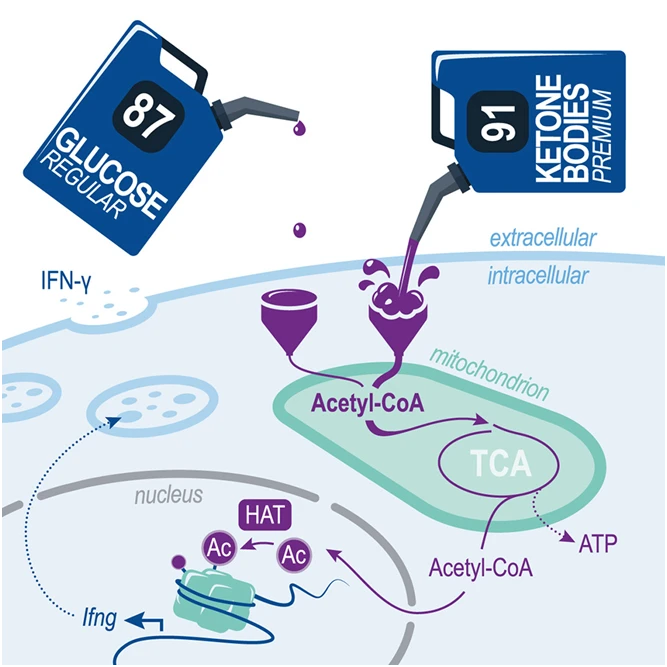
Image From Immunity, 2023, doi:10.1016/j.immuni.2023.07.002
These authors hypothesize that ketone bodies may be an evolutionary fail-safe that boosts the immune system when nutritional resources are limited, such as when appetite is suppressed during illness.
Dr. Peter Crawford, co-author of the paper and associate dean for research at the University of Minnesota Medical School, said, "This study highlights how different nutrient fuels feed different cellular functions. It also promotes future interest in considering the diversity of nutrient fuel utilization patterns of different immune cell types in the context of different infectious diseases or cancers."
While this new study suggests that increasing ketone bodies through a fasting or intermittent fasting regimen may enhance T-cell function in some cases, other previous studies have suggested that fasting may suppress immune function. Rather than contradicting each other, these studies reveal the intricate interplay between diet and the immune system, emphasizing the need for further research into this complex relationship.
Going forward, Jones and colleagues will explore how fasting and ketone supplementation affect immune function, with a focus on the cancer-fighting ability of T cells.