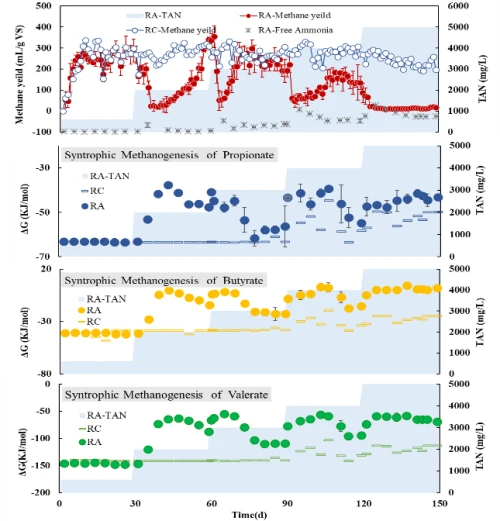
Ammonia inhibition often occurs during anaerobic fermentation of nitrogen-rich organic wastes, such as livestock manure and kitchen waste, leading to a decrease in methane production performance. In order to analyze the mechanism of ammonia inhibition, the Biomass Biochemical Conversion Research Laboratory of Guangzhou Energy Research Institute, Chinese Academy of Sciences, revealed the mechanism of ammonia inhibition in terms of gas production performance, Gibbs free energy of key methanogenic reactions, energy and material flow, microbial community succession and microbial electron transfer activity during anaerobic fermentation with stepwise increase of ammonia concentration. It was found that with the increase of ammonia concentration, methane production decreased, volatile fatty acids accumulated in the fermentation system, the Gibbs free energy variation of propionic acid and butyric acid degradation methanation reactions increased, and the energy flow from the fermentation feedstock to the methane decreased significantly (Figure 1).
In addition, the relative abundance of acid-producing bacteria was significantly higher than that of methanogenic bacteria; the significant increase in the gene abundance of ATP synthase as well as the increase in the abundance of macromolecule transport-related genes indicated that the electrochemical gradient ATP production pathway was weakened at high ammonia concentrations and the ATP production pathway was enhanced by phosphorylation of the bacterial substrate level (Fig. 2); and the abundance of genes for the transfer of electrons associated with the process of acid to methanogenesis was significantly decreased, limiting the efficiency of the electron intercalation among microorganisms. efficiency, which was the main reason for the accumulation of volatile fatty acids and lower methane production. Based on the above results, it was hypothesized that high ammonia concentration mainly inhibited the microbial electron transfer efficiency during the methanation of organic waste. Therefore, supplementation of electrons into the fermentation system has the potential to alleviate ammonia inhibition and improve fermentation efficiency.
The research results were published in Chemical Engineering Journal under the title of Effect of ammonia on anaerobic digestion: focusing on energy flow and electron transfer. This work was supported by the Youth Innovation Promotion Committee of the Chinese Academy of Sciences and the National Natural Science Foundation of China.