Mice enter their twilight years at around two years of age, roughly equivalent to 80 in humans. When scientists introduce specific mutated genes into the mice and age them, the mice become forgetful and irritable, eventually displaying the same symptoms of Alzheimer's disease as many older people.
Now, a new study suggests that as Alzheimer's disease becomes more prevalent in mice and humans, the brain's immune cells - microglia - gradually shrink, and that a key gene variant associated with Alzheimer's disease - APOE4 - may mediate these changes. The findings are published in the January 9, 2024 issue of Immunity under the title "An exhausted-like microglial population accumulates in aged and APOE4 genotype Alzheimer's brains".
Professor Sohail Tavazoie of The Rockefeller University, co-corresponding author of the paper, said, "The immune cells in the brains of aged mice and those carrying the APOE4 gene variant were exhausted, and we found a similar phenomenon in the human dataset." These authors refer to the new exhausted immune cells as terminally inflammatory microglia (TIM).TIM have lost the ability to effectively remove plaque from the brain and therefore may contribute to Alzheimer's disease.
The new study also reveals how the Alzheimer's disease drug aducanumab interacts with immune cells in the brain. Alon Millet, co-first author of the paper and a graduate researcher in the Tavazoie lab, said, "When mice carrying a variant of the APOE4 gene were treated with aducanumab, we found that their TIMs regained some function."
Age and Inflammation
Humans carry one of three APOE gene variants: APOE2, APOE3, and APOE4. Previous research in the Tavazoie lab has shown that these variants play a key role in how the body responds to diseases ranging from cancer to COVID-19, but the link between Alzheimer's disease and APOE4 is particularly clear: carriers of APOE4 variants make up about 20 percent of the population and are considered one of the strongest genetic risks for Alzheimer's disease. 20% of the population and are considered one of the strongest genetic risk factors for Alzheimer's disease.
Tavazoie, Millet, and Jose Ledo spent four years developing Alzheimer's disease mouse models that express human APOE variants and then allowed them to age in order to better understand how APOE4 affects their brains when Alzheimer's disease occurs," says Tavazoie. "Breeding these mice systematically is a major task. It's an ongoing project made possible by Ledo and Millet's special expertise."
These authors then constructed a single-cell map of immune cells in the brains of these mice and identified a population of microglia filled with signs of stress and inflammation that had never been described before.
The brains of mice carrying the APOE4 gene variant were over-occupied with TIM, while mice carrying other APOE gene variants had relatively little TIM. Once they knew what to look for, these authors also began to find TIM in human brain tissue donated by patients carrying APOE4 gene variants.Their findings suggest that APOE4 may wear down immune cells in the brain, thereby increasing the risk of developing Alzheimer's disease.
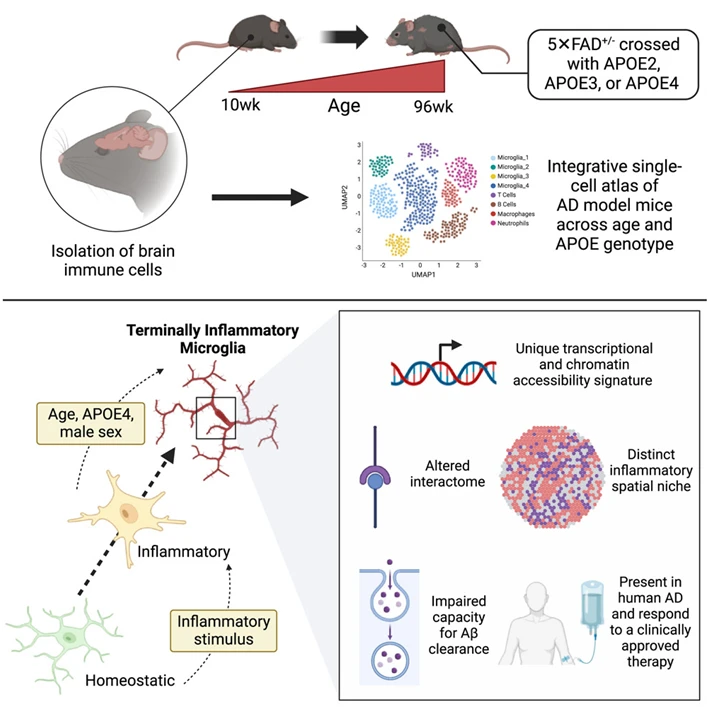
Image from Immunity, 2024, doi:10.1016/j.immuni.2023.12.001.
The authors also found that treating mice with the recently approved Alzheimer's disease drug adunumab improved their condition and restored impaired TIM. Interestingly, the drug's effect was more pronounced in mice harboring a variant of the APOE4 gene, said Millet, adding that, while these preliminary findings do not have immediate clinical applicability, "this may be the first hint that adunumab works differently for different genotypes. This could be the first hint that adunumab works differently for different genotypes. Clinicians should look into this".
Helping the immune system help itself
Some scientists speculate that a healthy immune system removes plaque before it builds up in the brain, and that Alzheimer's disease occurs when the immune system fails and plaque builds up. According to this theory, getting exhausted microglia back to work might provide the brain with the boost it needs to protect itself. If so, TIM would be a promising therapeutic target.
Millet says, "TIMs are soaked in this inflammatory environment for years until they can't cope anymore. If we can get them back to a healthy state, maybe the immune system will be able to keep Alzheimer's disease in check."
In this regard, these authors will now explore the signaling molecules that lead to the formation of TIM with a view to developing drugs that interfere with this process, keeping microglia healthy and reducing cognitive decline. In the long run, this could lead to a novel Alzheimer's disease therapy.
These authors will also look at whether TIM is present in other diseases.Millet speculates that while TIM may have gone unnoticed so far, these depleted immune cells may also be linked to other brain diseases, from tumors to Parkinson's disease. Inflammation causes TIM to accumulate, he says, "so what we're seeing may not be specific to Alzheimer's disease. Most microglia could eventually become TIMs if we give them enough time."