Vitamin C, also known as ascorbic acid, is a very important vitamin for our body and we can get it from foods like citrus, strawberries and tomatoes. Early studies have found that vitamin C is a powerful antioxidant that helps to scavenge free radicals and reduce cellular damage caused by oxidative stress. In addition, vitamin C is involved in a variety of biological processes, such as collagen synthesis and antihistamine release, which play an important role in skin health and immune system function.
Recently, a major cancer study jointly completed by Shanghai Second Military Medical University and other institutions has unveiled the potential role of vitamin C in liver cancer treatment. The results of the study were published in Nature Communications on January 4, 2024, with the paper titled "TET2-mediated tumor cGAS triggers endothelial STING activation to regulate
Liver cancer is one of the most common malignant tumors and the third leading cause of cancer-related deaths worldwide. Currently, immunotherapy based on immune checkpoint blockade, particularly antibodies against the programmed cell death-1 (PD-1)/programmed cell death ligand 1 (PD-L1) pathway, has achieved remarkable success in the treatment of a wide range of malignant tumors, including advanced liver cancer.
Abnormal tumor vasculature and the resulting hypoxic and immunosuppressive tumor microenvironment are key factors that impede the efficacy of immunotherapy, especially in highly angiogenic hepatocellular carcinomas. Antiangiogenic therapy not only normalizes the abnormal tumor vasculature and improves the infiltration of immune effector cells within the tumor, but also reverses the angiogenesis inducer-induced immunosuppressive microenvironment, providing a rationale for the combination of antiangiogenic therapy and immune checkpoint blockade. However, the vascular normalization time window of current anti-angiogenic therapy is narrow and transient, limiting its augmentation of immunotherapy. Therefore, effective strategies are urgently needed to stably induce tumor vascular normalization and enhance the efficacy of immunotherapy.
Liver cancer is one of the most common malignant tumors and the third leading cause of cancer-related deaths worldwide. Currently, immunotherapy based on immune checkpoint blockade, particularly antibodies against the programmed cell death-1 (PD-1)/programmed cell death ligand 1 (PD-L1) pathway, has achieved remarkable success in the treatment of a wide range of malignant tumors, including advanced liver cancer.
Abnormal tumor vasculature and the resulting hypoxic and immunosuppressive tumor microenvironment are key factors that impede the efficacy of immunotherapy, especially in highly angiogenic hepatocellular carcinomas. Antiangiogenic therapy not only normalizes the abnormal tumor vasculature and improves the infiltration of immune effector cells within the tumor, but also reverses the angiogenesis inducer-induced immunosuppressive microenvironment, providing a rationale for the combination of antiangiogenic therapy and immune checkpoint blockade. However, the vascular normalization time window of current anti-angiogenic therapy is narrow and transient, limiting its augmentation of immunotherapy. Therefore, effective strategies are urgently needed to stably induce tumor vascular normalization and enhance the efficacy of immunotherapy.
This study found that in vascular normalization and anti-tumor immune response, cGAS in tumors is not dependent on the STING pathway in tumors, but there is an interdependent relationship with host STING. The specific mechanism is that cGAS in tumor produces cGAMP, which is delivered to endothelial cells through LRRC8C channels and activates STING in endothelial cells, thus promoting lymphocyte infiltration. Further, the tumor suppressor TET2 synergizes with the IL-2/STAT5A signaling pathway to promote cGAS gene expression and cGAMP secretion in tumors. And vitamin C, as a TET2 activator, induced TET activation, which in turn activated the tumor cGAS-cGAMP-endothelial STING pathway and promoted lymphocyte translocation. This finding not only provides important clues for revealing the immunoregulatory mechanism in the tumor microenvironment, but also provides a theoretical basis for the future development of targeted therapeutic strategies based on this axis.
In addition, this study used a mouse tumor model to verify that activation of the TET2-STAT5A-cGAS-endothelial STING axis in tumors mediated vitamin C-induced vascular normalization and immune cell infiltration, and facilitated the therapeutic efficacy of vitamin C combined with anti-PD-L1 therapy. This finding reveals the mechanism of vitamin C in enhancing the immunotherapeutic effect and improving the therapeutic efficacy of anti-PD-L1 combination therapy, and provides a new theoretical basis for individualized treatment of hepatocellular carcinoma patients.
In addition, this study used a mouse tumor model to verify that activation of the TET2-STAT5A-cGAS-endothelial STING axis in tumors mediated vitamin C-induced vascular normalization and immune cell infiltration, and facilitated the therapeutic efficacy of vitamin C combined with anti-PD-L1 therapy. This finding reveals the mechanism of vitamin C in enhancing the immunotherapeutic effect and improving the therapeutic efficacy of anti-PD-L1 combination therapy, and provides a new theoretical basis for individualized treatment of hepatocellular carcinoma patients.
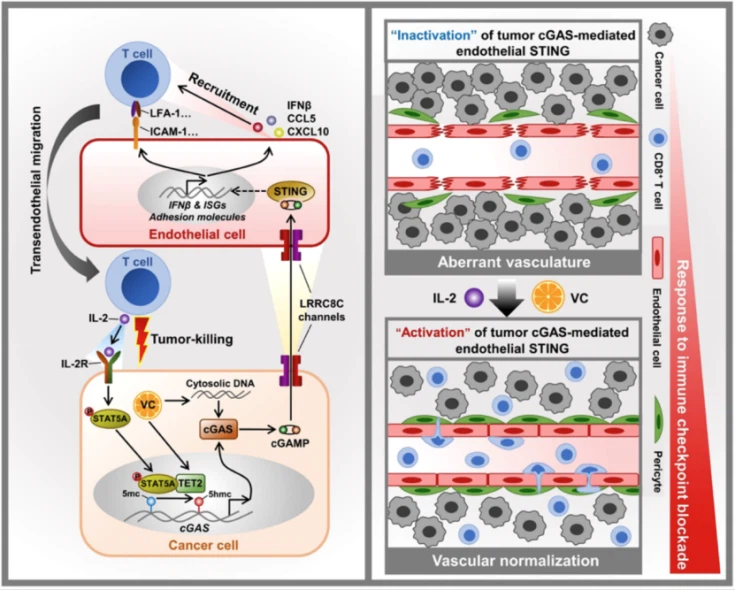
Activation of the TET2-STAT5A-cGAS-endothelial STING axis in tumors mediates vitamin C-induced vascular normalization and immune cell infiltration
Image source: https://doi.org/10.1038/s41467-023-43743-9
Image source: https://doi.org/10.1038/s41467-023-43743-9
This study deepens our understanding of vitamin C in the field of cancer therapy by revealing its potential role in liver cancer immunotherapy. In contrast to previous studies, this study not only focuses on the direct effects of vitamin C on liver cancer, but also highlights its role in promoting immunotherapy. Past studies have focused on the antioxidant and anti-inflammatory properties of vitamin C and its direct effects on tumor cell growth. However, the present study provides a more comprehensive perspective by digging deeper into the effects of vitamin C on the immune system and tumor microenvironment. This is expected to provide new ideas for future cancer treatment research, especially in integrating vitamin C in combination with immunotherapy.
Although this study provides new insights into the use of vitamin C in the immunotherapy of hepatocellular carcinoma, there are some limitations. First, the experiments of the study were mainly based on animal models, and more clinical trials are needed to confirm the applicability of these findings in humans. Second, although the study covered the multifaceted effects of vitamin C on the immune system and tumor microenvironment, more in-depth exploration on specific immune cell types and signaling pathways is still needed. Future studies could address these limitations by expanding the sample size, introducing more cancer types into the study population, and digging deeper into the molecular mechanisms. In addition, researchers can explore the effects of different dosages and modes of administration on therapeutic efficacy to optimize the use of vitamin C in immunotherapy.
Overall, through in-depth experimental studies and comprehensive data analysis, the research team revealed the critical role of vitamin C in liver cancer immunotherapy, providing new ideas for future cancer treatment. This study opens up a new field for the application of vitamin C, providing an important theoretical and experimental basis for overcoming immunosuppression and improving the effect of immunotherapy. Therefore, vitamin C is not only whitening and antioxidant, but also a powerful assistant in liver cancer immunotherapy!
Although this study provides new insights into the use of vitamin C in the immunotherapy of hepatocellular carcinoma, there are some limitations. First, the experiments of the study were mainly based on animal models, and more clinical trials are needed to confirm the applicability of these findings in humans. Second, although the study covered the multifaceted effects of vitamin C on the immune system and tumor microenvironment, more in-depth exploration on specific immune cell types and signaling pathways is still needed. Future studies could address these limitations by expanding the sample size, introducing more cancer types into the study population, and digging deeper into the molecular mechanisms. In addition, researchers can explore the effects of different dosages and modes of administration on therapeutic efficacy to optimize the use of vitamin C in immunotherapy.
Overall, through in-depth experimental studies and comprehensive data analysis, the research team revealed the critical role of vitamin C in liver cancer immunotherapy, providing new ideas for future cancer treatment. This study opens up a new field for the application of vitamin C, providing an important theoretical and experimental basis for overcoming immunosuppression and improving the effect of immunotherapy. Therefore, vitamin C is not only whitening and antioxidant, but also a powerful assistant in liver cancer immunotherapy!