Patients with Guillain-Barré syndrome (GBS) face a rare and heterogeneous peripheral nervous system disorder, usually triggered by a previous infection and resulting in myasthenia gravis. In Europe and the United States, there are about one to two cases per 100,000 people per year.
GBS usually begins with weakness and tingling in the legs, then spreads to the arms and upper body, making it difficult to walk or move. In severe cases, paralysis can affect the breathing muscles. Although GBS is recognized as an autoimmune disease, the underlying mechanisms remain largely unknown, making accurate diagnosis and effective treatment a challenge.
In a new study, a team of researchers led by Daniela Latorre, head of the NSF PRIMA group at the Institute of Microbiology at ETH Zurich, Switzerland, has examined the autoimmune factors that may contribute to GBS, thus shedding light on a key aspect of GBS pathophysiology. The findings were published online January 17, 2014 in Nature under the title "Autoreactive T cells target peripheral nerves in Guillain-Barré syndrome. ".
Autoreactive T cells target peripheral nerves
Using a sensitive experimental approach, Latorre's team found that in patients with GBS, immune system-specific cells called T cells invade nerve tissue and target the insulating layer that covers nerve fibers, called myelin.
Normally, T cells play an important role in the body's immune system, where they recognize and eliminate threats such as infections and abnormal cells. However, on rare occasions, they mistakenly attack the body's own tissues, leading to autoimmune diseases.
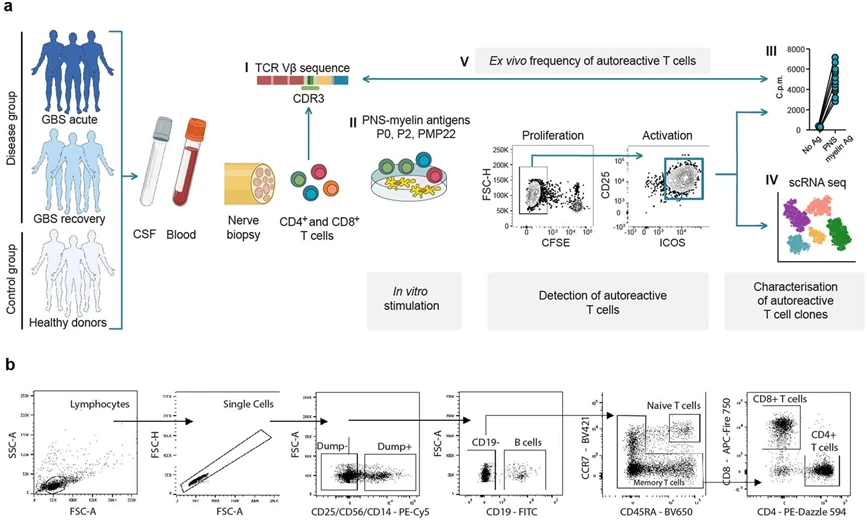
An experimental approach to studying autoreactive T cells in patients with GBS. Image from Nature, 2024, doi:10.1038/s41586-023-06916-6.
Latorre explains, "We found that these autoreactive T cells are unique to patients with a form of GBS characterized by nerve demyelination (nerve demyelination) and display specific disease-related features that distinguish these patients from healthy individuals." These findings mark the first evidence that autoreactive T cells cause disease in humans.
In addition, these authors found T cells that responded to both peripheral nerve autoantigens (myelin) and viral antigens in a subset of GBS patients following viral infection, supporting a direct link between disease progression and prior infection.
Current treatments are effective for many GBS patients but lack specificity, and about 20% of patients remain severely disabled or die. This new study provides scientists with a new perspective on GBS, opening the way for further research in larger patient populations and deciphering the immune mechanisms of different GBS variants. This new knowledge may lead to targeted therapies for specific GBS subtypes, potentially improving patient care.