In a new study, researchers from the University of Maryland School of Medicine and other research institutions have found for the first time that a hemoglobin-like protein, known as cytoglobin, plays an important role in the development of the heart. Specifically, it influences the correct left-right pattern of the heart and other asymmetrical organs. This discovery may ultimately lead to the development of new therapeutic interventions to alter the processes that lead to these defects. The findings were published online Dec. 14, 2023, in the journal Nature Communications in a paper titled "Cytoglobin regulates NO-dependent cilia motility and organ laterality during development."
These authors used CRISPR gene editing to knock out the cytoglobulin gene in zebrafish. Lack of cytoglobulin causes embryos to develop mirror-image hearts, in which the left-right pattern of the heart is reversed. In humans, cytoglobulins are involved in the production of nitric oxide, a compound that helps regulate healthy blood flow to organs.
Dr. Mark T. Gladwin, co-senior author of the paper and dean of the University of Maryland School of Medicine, has been studying the effects of nitric oxide on blood vessels for more than 20 years, including this new study.
Since the discovery of cytoglobulin two decades ago, it has been found to be expressed in virtually all human tissues, but the mechanism by which this protein functions has been largely unknown," Dr. Gladwin said. We know that cytoglobulin can play a role in regulating and maintaining nitric oxide levels, but our new findings suggest that it positively regulates nitric oxide production to ensure proper cilia function, and that its absence leads to major organ-biased abnormalities."
To conduct this new study, these authors knocked out the cytoglobin gene in zebrafish, which, to their surprise, led to huge defects in the structure and location of organs in the developing embryo. For example, the heart is located on the right side of the zebrafish instead of the left, and the heart loops to the left instead of the right.
Dr. Paola Corti, co-corresponding author of the paper and assistant professor of biochemistry and molecular biology at the University of Maryland School of Medicine, said, "We found that cytoglobulins play a crucial role in the structure and function of tiny hair-like structures called cilia, where the cilia determine the asymmetry of the organ and normal development."
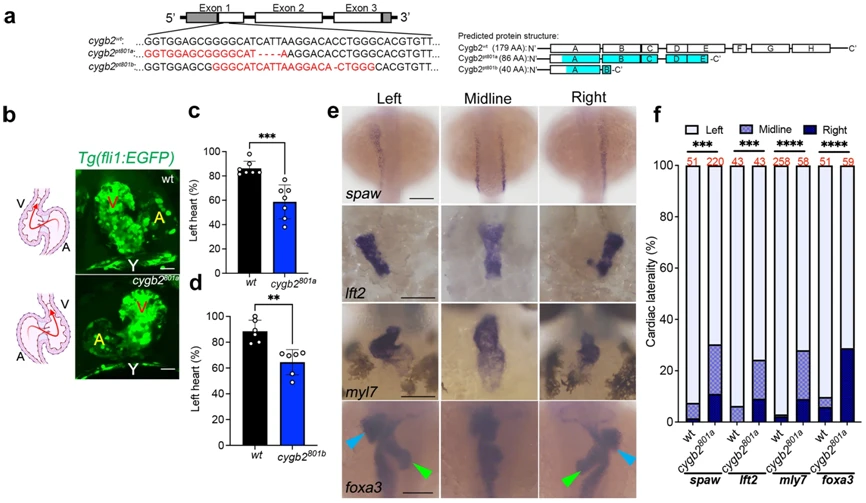
Cygb2 mutant phenotypes exhibit organ-biased defects. Image from Nature Communications, 2023, doi:10.1038/s41467-023-43544-0.
This is the first time that cytoglobulin - or any kind of globulin like hemoglobin - has been found to be involved in fetal development, and that its absence may be associated with birth defects. It is also the first time that cytoglobulin has been found to be involved in cilia function. The discovery may open the door to the development of drugs to treat rare birth defects that affect cilia movement.
About 1 in 10,000 to 1 in 30,000 people is born with Primary Ciliary Dykinesia (PCD), a rare disorder affecting the cilia that can cause breathing problems due to thickened mucus that clogs the airways," said Dr. Corti. Kartagener's syndrome), a form of PCD, is known to cause heart defects in zebrafish, where the heart is abnormally tilted and rotated to the right. There is no cure for this disease, only surgery to repair any heart defects and treatments to control symptoms."
While certain genes are known to cause about 70 percent of PCD cases, cytoglobulins may play a key role in the 30 percent of cases with no known genetic cause.
Dr. Elizabeth Rochon, first author of the paper and assistant professor of medicine at the University of Maryland School of Medicine, said, "We discovered the phenotype and linked it to cilia. In the presence of cytoglobulin, we could trace the function of the protein and how it leads to normal cilia function and organ development. In the absence of cytoglobulin, we observed these defects."