Immune memory is a hallmark of the body's adaptive immune system, and although natural killer cells (NK cells), which are innate immune cells that are important for the immediate defense system of the host organism, can also differentiate into memory NK cells, the molecular mechanisms behind the control of this process have not been fully elucidated by researchers. In a recent study published in the international journal Nature Communications entitled "Themis2 regulates natural killer cell memory function and formation," scientists from the University of Tsukuba and other institutions in Japan have shown that Themis2 regulates natural killer cell memory function and formation. In a recent study published in the international journal Nature Communications entitled "Themis2 regulates natural killer cell memory function and formation," scientists from the University of Tsukuba and other institutions in Japan identified a key molecule called Themis2 in NK cells, which play an important role in clearing the body of virally-infected cells, and which memorizes viral antigens and further regulates the differentiation of these NK cells into more potent immune memory NK cells, thereby enhancing their killing ability and overall function.
Viral infections often pose a serious threat to the health of an organism, and NK cells may serve as a primary defense against virus-infected cells. When a virus attacks an organism, the host organism's immune system retains a memory of the virus, which exists for a longer period of time in the body; however, scientists believe that NK cells are not capable of differentiating into immune-memory NK cells capable of robustly defending themselves against subsequent viral invasion and infection.
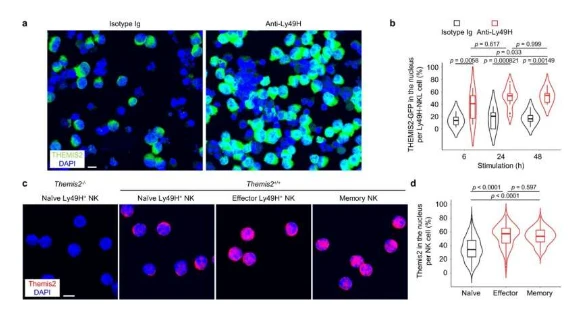
Scientists discover key molecule that regulates the immune memory of natural killer cells.
Image from: Nature Communications (2023). DOI:10.1038/s41467-023-42578-8
This latest study may just challenge this theory, as the researchers found that NK cells can indeed memorize viral antigens and differentiate into immune-memory NK cells with considerable killing capacity, however, the molecular mechanisms behind this process may still need to be fully elucidated by scientists. The researchers found that the Themis2 molecule, located in the cytoplasm of NK cells, plays a crucial role in regulating the differentiation and function of immune memory NK cells.
Specifically, NK cells deficient in Themis2 molecules were able to differentiate more efficiently into immune memory NK cells after cytomegalovirus infection compared to wild-type NK cells. In addition, immune memory NK cells lacking the Themis2 molecule were also effective in clearing cytomegalovirus-infected cells. These findings are expected to help researchers develop novel therapeutic strategies for the treatment of viral infections by targeting the Themis2 molecule to enhance the differentiation and function of immune memory NK cells.
Taken together, the results of this paper suggest that Themis2 molecules may be able to quantitatively and qualitatively regulate memory formation in NK cells.