In a new study, researchers from Virginia Commonwealth University wanted to understand the role of a specific gene called MDA-9/Syntenin-1/SDCBP in prostate cancer and how the gene communicates with surrounding cells and tissues in the tumor's microenvironment leading to metastasis of the tumor to the bone. They found that this gene is the mastermind behind the molecular domino effect that drives prostate cancer growth and metastasis. This finding has important clinical implications for the treatment of prostate cancer and other forms of the disease.
Bone metastases are common in all types of advanced cancers, especially in prostate and breast cancer patients. Once cancer enters the bones, it can cause a dramatic deterioration in bone health, often leading to fractures, breaks and other life-threatening complications.
Dr. Paul B. Fisher, co-corresponding author of the paper and director of the Institute for Molecular Medicine at Virginia Commonwealth University, said, "The final stages of cancer metastasis are always fatal; once a patient's cancer has metastasized to the bone, there are virtually no treatment options."
Extensive previous research by Fisher and his collaborators has found that the MDA-9 gene - a gene that is not specific to tumor cells and is present in all forms of tissue - is a major contributor to the spread of cancer; however, the biological "cause" remains unknown.
With this new study, the authors demonstrate for the first time that MDA-9 is largely responsible for initiating the cellular chain reaction that triggers prostate cancer metastasis and allows tumor cells to take over control of the bone itself.
Swadesh K. Das, Ph.D., co-corresponding author of the paper and associate professor in the Department of Human and Molecular Genetics at the Virginia Commonwealth University School of Medicine, said, "MDA-9 plays an A to Z role in tumors; it's essentially the gene that directly promotes tumor progression and metastasis."
Through this study, they found that MDA-9 activates a protein in tumor cells called PDGF-AA that regulates cell growth and division and releases it into the skeletal environment. PDGF-AA then binds to PDGFR, a receptor on the surface of bone marrow cells called bone marrow-mesenchymal stromal cells (BM-MSC).
They interact with MDA-9 and activate the Hippo signaling pathway responsible for cell regeneration. This releases a smaller migration-stimulating protein called a chemokine, which in this study means CXCL5. CXCL5 then attracts cancer cells to the bone tissue, which in turn interact to produce more CXCL5 and continue to attract more cancer cells to the environment, setting off a cyclical series of events that promotes the growth of cancer in the bone.
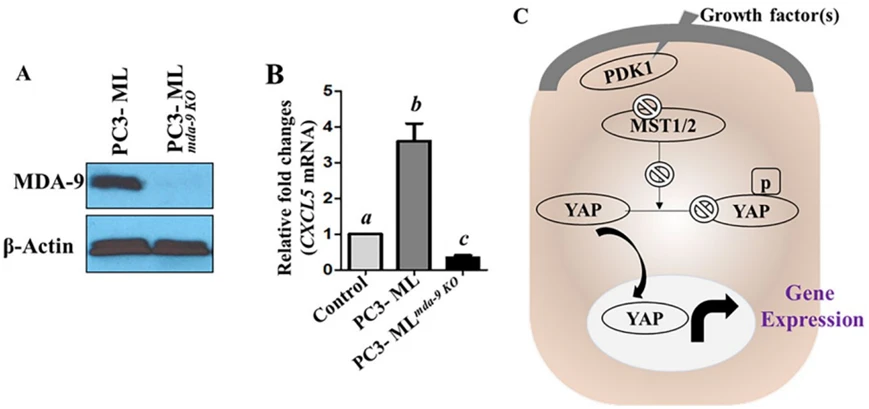
Image from PNAS, 2023, doi:10.1073/pnas.2307094120.
In addition, while inducing more tumor cells to enter bone tissue, CXCL5 also leads to bone degradation and fractures by promoting the proliferation of osteoclasts, a subpopulation of bone-destroying osteoblasts.
Das said, "This new study clearly shows the communication between prostate cancer cells and normal BM-MSCs in the tumor microenvironment and how this biological dialogue between them allows metastatic cells to spread into and proliferate in bone."
By eliminating MDA-9 from prostate cancer cells, these authors interfered with this biological dialogue that leads to tumor growth, thus stopping the spread of this disease. They also observed that removing MDA-9 from bone cells did not negatively affect the health of bone tissue.
In this new study, this interaction was observed in animal, human, and patient-derived prostate cancer cells, but these deceased researchers believe that these findings will have an impact on the many types of solid tumors in which MDA-9 is also present, including brain, breast, melanoma, lung, and pancreatic cancers.
Fisher said, "We're getting close to something that might make it into the clinic." He added that in collaboration with InVaMet Therapeutics, they have developed a novel inhibitor drug at Virginia Commonwealth University that has previously shown in separate studies that it is promising for targeting MDA-9 in cancer.Future research plans are to explore the use of MDA-9 inhibitors in clinical tumor samples and eventually in patients.