Researchers at the Max Planck Institute for the Biology of Aging in Germany published a research paper titled " Refeeding-associated AMPKγ1 complex activity is a hallmark of health and longevity" in the journal " Nature Aging".
The study shows that in young animals, the fasting-refeeding cycle triggers reverse oscillatory expression of the genes encoding the AMP-activated protein kinase (AMPK) regulatory subunits Prkag1 and Prkag2, whereas in older animals, aging attenuates this regulation, leading to reduced Prkag1 expression. In transgenic fish with sustained expression of Prkag1, a more youthful feeding and fasting response can be demonstrated in old age, improving metabolic health and extending lifespan.
Furthermore, in humans, Prkag1 expression declines with age and is associated with multimorbidity and multidimensional frailty risk. Thus, selective activation of Prkag1 may promote metabolic health and extend lifespan in humans.
AMPK, or AMP-dependent protein kinase, is a key molecule in the regulation of biological energy metabolism, and AMPK activation has previously been shown to mediate lifespan extension and the beneficial effects of dietary restriction in invertebrate model organisms.
In this study, the researchers analyzed the effects of fasting on killifish, a rapidly aging fish with a lifespan of 6-7 months, at different ages, and found through transcriptome analysis that the adipose tissue of older fish exhibited a transcriptional program similar to that of fasting, where energy metabolism was suppressed, protein production was reduced, and tissues were unable to be renewed regardless of whether they fed or fasted.
Adipose tissue is most responsive to changes in food intake and plays an important role in metabolism, while visceral adipose tissue in aged fish is insensitive to feeding, the researchers said.
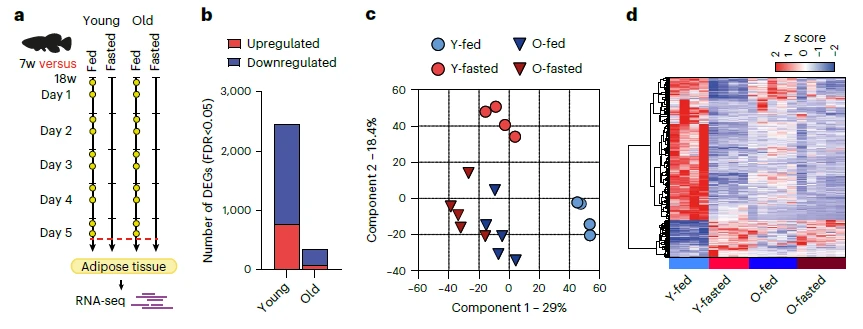
Aging alters the physiological response of adipose tissue to fasting
In contrast, for the adipose tissue of young fish, the fasting-refeeding cycle triggers reverse oscillatory expression of the genes encoding the AMP-activated protein kinase (AMPK)-regulated subunits Prkag1 and Prkag2. Prkag1 expression is suppressed by fasting and induced by refeeding, whereas aging attenuates this regulation, leading to reduced Prkag1 expression.
The researchers genetically modified aged fish to consistently express Prkag1 and found that the modified aged fish had their fasting state counteracted, exhibited younger feeding and fasting responses, improved metabolic health and extended lifespan.
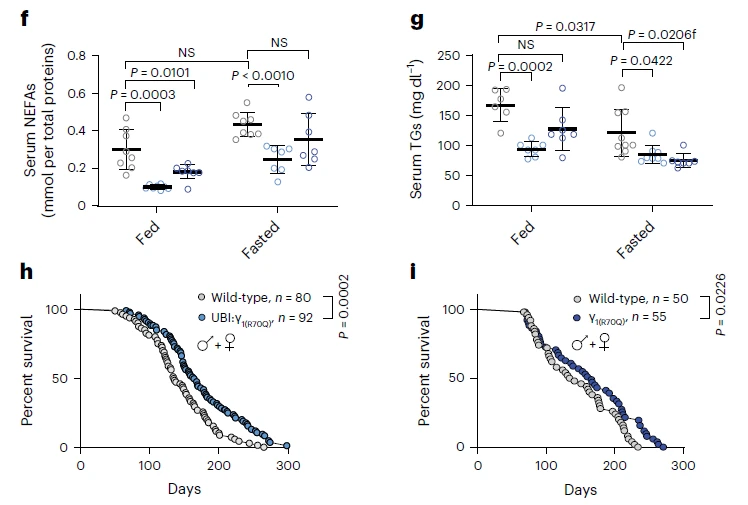
Sustained Activation of Prkag1 Promotes Metabolic Health and Longevity
Finally, the researchers analyzed the relevance of Prkag1 in human health and longevity, and transcriptome analysis of human subcutaneous adipose tissue after fasting found that, consistent with medaka, fasting upregulated Prkag2 and downregulated Prkag1 expression.
Furthermore, in humans, Prkag1 expression also declined with age and was associated with risk of multimorbidity and multidimensional frailty, with higher Prkag1 levels being associated with less frailty in humans in old age, suggesting that selective activation of Prkag1 may promote metabolic health and prolong lifespan in humans.
The researchers emphasize that, at this point, we don't know if Prkag1 in humans actually promotes healthier aging, and the next step will be to try to find molecules that can precisely activate the subunit and investigate whether they can be harnessed to positively affect aging.
Taken together, the results suggest that age-related metabolic quiescence can be prevented by selective stimulation of the Prkag1 complex, thereby promoting metabolic health and longevity in vertebrates.