Recently, a new clinical research result published in The Lancet Gastroenterology & Hepatology by Hu Corps team of West China Hospital of Sichuan University demonstrates the excellent performance of AI for esophageal cancer diagnosis: endoscopic examination assisted by AI system in real time can make the leakage rate of superficial esophageal squamous carcinoma and pre-cancerous lesions drop dramatically compared with conventional examination, which means that AI may bring a change in early diagnosis and early screening for esophageal cancer!
Like other digestive cancers, esophageal cancer does not have obvious clinical symptoms in the early stage, and when the patients are diagnosed with typical symptoms such as difficulty in swallowing, they are often in the middle or late stage, and the treatment choices are limited and the prognosis is quite unsatisfactory, which is also the key reason why the 5-year survival rate of esophageal cancer was hovering around 20% for a long time, and the way to break the situation is of course to realize early diagnosis and early treatment.
The number of new esophageal cancer cases in China accounts for more than half of the global cases, so the fight against esophageal cancer is also a key direction for clinical workers. With the popularization of gastrointestinal endoscopy technology in recent years, the proportion of esophageal cancer patients diagnosed at an early stage in China has risen to about 40% [2], but endoscopic diagnosis of early stage esophageal cancer is not simple, as the subtle endoscopic features of the cancerous lesions in the early stage, the differences in the recognition ability of doctors, and the visual fatigue may cause the cancerous lesions to be overlooked [3]. , all of which may lead to the cancer being missed.
From previous studies, the leakage rate of endoscopy for esophageal cancer and other upper gastrointestinal cancers is 4-17% [3], such a high leakage rate obviously needs to be further optimized, therefore, the West China Hospital team thought of the hot AI, since AI can accurately review the results of the imaging examination, so it is the same reason that it is used to help endoscopy and improve the detection rate.
Based on the conventional white light endoscopy and narrow-band spectral imaging endoscopy commonly used in clinical practice, the research team constructed an early esophageal squamous cancer AI system called "Eagle Eye" based on more than 38,000 endoscopic images from more than 8,000 patients (including esophageal squamous carcinoma, precancerous lesions, and benign esophageal lesions), which was fully trained and tested. After sufficient training and testing, "Eagle Eye" can diagnose endoscopic images in only 0.01 seconds (10 milliseconds), so it can help doctors identify suspicious lesions in endoscopy in real time.
Moreover, the Eagle Eye system can be directly integrated into current endoscopy systems by framing the suspected lesion area in the form of a polygon and displaying the type and probability of the suspected lesion on the upper left side of the endoscopy display, allowing doctors to switch between the original endoscopy video signal and the composite video signal with the AI diagnostic results with a simple press of a switch button. Doctors only need to simply press the switch button to switch between the original endoscopic video signal and the composite video signal with AI diagnostic results, which is simple and easy to operate and does not change daily habits, realizing real-time assistance in diagnosing early esophageal squamous carcinoma.
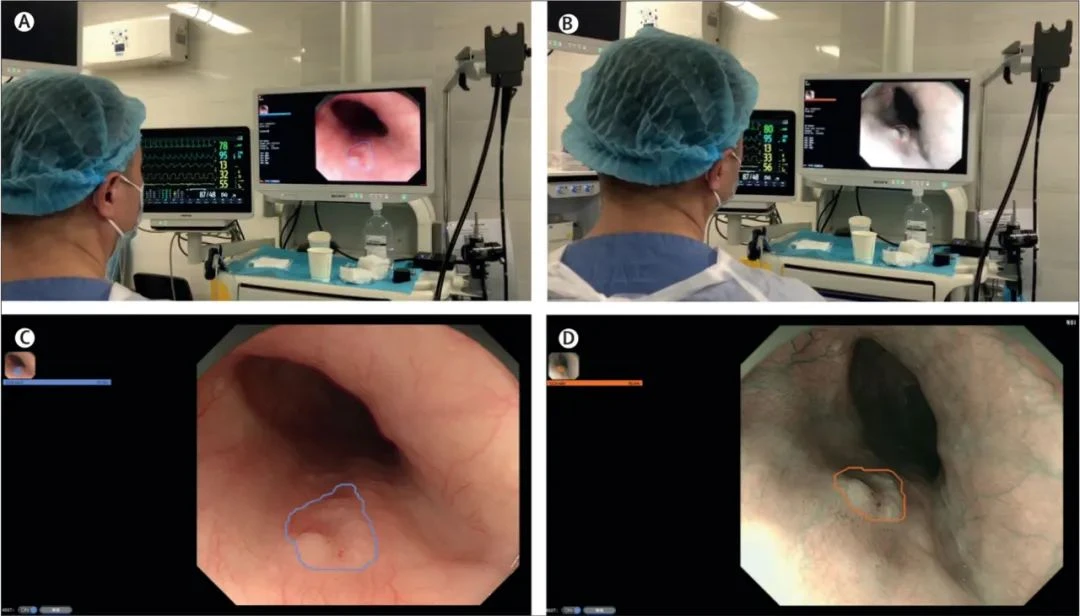
"Eagle Eye" system on-site operation map
The results of this study are a multi-center, tandem, randomized controlled trial of the effectiveness of real-time diagnostic assistance of the "Eagle Eye" system, which was carried out in 12 hospitals nationwide, and included a total of 11,982 subjects who underwent painless gastroscopy; it is understood that this is the first report of the world's first study evaluating real-time diagnosis of early esophageal squamous carcinoma by an AI system in real clinical practice, and it is also the largest sample size study in the world. It is understood that this is the first report in the world to evaluate the real-time assistance of AI system in diagnosing early esophageal squamous carcinoma in real clinical practice, and it is also the study with the largest sample size of AI-assisted diagnosis of early esophageal cancer in the world.
Subjects were divided into an "AI-prioritized group" that received the "Hawk-Eye" system-assisted endoscopy first, followed by routine endoscopy, and a "routine-prioritized group" that received the "Hawk-Eye" system-assisted endoscopy second, and the "routine-prioritized group" that received routine endoscopy in the opposite order. The endoscopists evaluated the performance of the Hawk-Eye system-assisted endoscopy and conventional endoscopy by performing two endoscopic examinations on the same day in the corresponding order, and by missing superficial esophageal squamous carcinomas and pre-cancerous lesions that were not detected during the first examination but were detected during the second examination.
The results of the study showed that 106 subjects in the AI-prioritized group had superficial esophageal squamous carcinoma and precancerous lesions detected in the first round of exams, whereas new lesions were detected in only 2 subjects in the subsequent routine exams, which resulted in a leakage rate of 1.9% (2/106), compared with 7.6% (6/79) in the routine-prioritized group by the same criterion, and a significantly higher proportion (1.8%) of the AI-assisted lesions were detected in the first exam (1.8%). The proportion was significantly higher (1.8%/1.3%, p=0.030) and the positive predictive value (PPV) was also relatively high (56.6%/44.0%).
The risk of missed detection of superficial esophageal squamous carcinoma and precancerous lesions decreased by 75% in the AI-prioritized group when calculated by the number of patients (RR=0.25, p=0.079) and by 63% when calculated by the number of lesions (RR=0.37, p=0.40), but none of them crossed the threshold of statistical significance, which may be related to the fact that most of the endoscopists were more senior, and the overall rate of missed detection was lower than expected (15%) ) related to this. In addition, there was no significant difference in the time spent on Eagle Eye system-assisted endoscopy versus conventional endoscopy, and it did not result in more bleeding events.
Overall, AI-assisted endoscopy performed well in this study, and the ease of use and real-time presentation of the results are very favorable to clinical practice. The Lancet Gastroenterology and Hepatology published a simultaneous review of the research results and AI, pointing out that, based on full consideration of the patient's condition and the implementation of high-level endoscopic testing, AI will become a key aid in the early diagnosis of and early detection and screening for esophageal cancer. AI will be a key enabler for early diagnosis and screening of esophageal cancer.