Parenting is a key environmental predictor of adolescent anxiety. However, not all individuals develop anxiety symptoms in poor parenting environments. The adolescent nervous system is highly sensitive to stressful environments. Evolutionary-neurodevelopmental Theory (ENDT) suggests that neurophysiological traits can explain individuals' differential responses to stressful situations. However, to date, the neural susceptibility to anxiety is unknown.
Li Xinying's research group at the Key Laboratory of Mental Health, Institute of Psychology, Chinese Academy of Sciences, in collaboration with Qin Shaozheng's team at the State Key Laboratory of Cognitive Neuroscience and Learning, Beijing Normal University, selected 100 homozygous and 78 heterozygous same-sex twins for a longitudinal study in the Beijing Twin Study (BeTwiSt) database over a period of three years to examine the integration of brain network can support the neural differential sensitivity of adolescent anxiety to the parenting environment and its genetic relationship. The findings are published online in Psychological Medicine.
The study found that: lower connectivity within the central executive network amplified the effect of maternal hostility on anxiety symptoms; and a high degree of inverse correlation between the pre-synaptic network and the default mode network amplified the effect of paternal hostility on anxiety symptoms (Figure 1).
The modulation patterns of the brain networks are consistent with differential susceptibility theory, whereby adolescents with neurological susceptibility have more anxiety in high hostile environments and less anxiety in low hostile environments. Combined with the brain-based bipartite ACE model, the study further found that the heritability of the intrinsic connectivity pattern of the central executive network was 21.18% and was associated with the susceptibility gene BDNF Val66Met.
In conclusion, this study is the first to examine the neural susceptibility and genetic contribution to anxiety in adolescents under the framework of "genetics-environment-brain function-psychobehavior". This study further deepens scientists' understanding of neural susceptibility in the developing brain, and provides new inspiration for early identification and intervention of high-risk groups.
The research was supported by the National Natural Science Foundation of China (NSFC) and the Institute of Psychology (IPS) under the "Unveiling the List of Commanders" program. Researchers from Huilongguan Hospital and Beijing University of Aeronautics and Astronautics participated in the study.
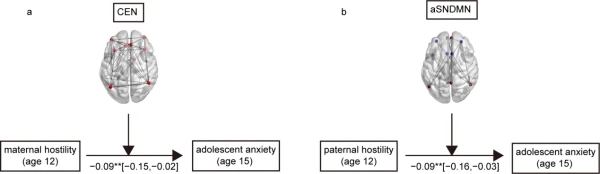
Figure 1. brain network integration moderates the relationship between parental hostility and adolescent anxiety