Cancer cells hijack normal biological processes to allow them to proliferate. For example, tumors stimulate the creation of new blood vessels, building themselves "highways" to deliver nutrients. Decades ago, scientists knew that cancer could infiltrate blood vessels, but it was only a few years ago that scientists at the Stanford University School of Medicine and their colleagues discovered that tumors not only take advantage of the "highway" system they have built in the body, but that they can also infiltrate it and use its "telecommunication system" to send signals. They can also penetrate it and use its "telecommunication system" to transmit signals.
In physiological terms, tumors not only grow blood vessels, they also plug themselves into the nervous system. Some brain cancers form effective electrical connections with nearby nerves and then use the electrical signals from those nerves for their own purposes.
In a new study, researchers from Stanford University and other research institutions certain brain tumors can even hijack the biological mechanisms of brain plasticity to drive their own growth. The discovery opens up a new field of medicine called cancer neuroscience. It offers new opportunities to target some of the deadliest cancers, including brain tumors, which are almost always fatal. They were intrigued by the cancer therapeutic potential of drugs approved by the U.S. Food and Drug Administration (FDA) for the treatment of other neurological disorders such as epilepsy. Several such drugs have been shown to interfere with the neural signals that promote the production of certain cancers. The findings were published online Nov. 1, 2023, in Nature under the title "Glioma synapses recruit mechanisms of adaptive plasticity.
Dr. Michelle Monje, corresponding author of the paper and Professor of Neurology and Neuroscience at Stanford University, said, "There has been a very exciting explosion of research on these interactions since we first published in 2015 that neuronal activity actually drives cancer growth in a variety of brain tumor types. This is clearly an important set of interactions that are critical to tumor biology that we have previously overlooked."
The Hidden Talents of Tumors
Why did scientists go so long without discovering cancer's ability to invade the nervous system? A focus on the differences between malignant and healthy tumor cells may offer an explanation.
Dr. Kathryn Taylor, the paper's first author and a postdoctoral fellow in neurology and neuroscience at Stanford University, said, "People tend to think of cancer as more of an infectious disease, a disease that is happening but has nothing to do with our bodies. However, in reality, especially in childhood tumors, it is a developmental disease."
Monje and his research team have found that small lapses in development underlie some of the most serious childhood tumors. Such is the case with a particularly frightening type of brain cancer - diffuse intrinsic pontine glioma (DIPG), a high-grade glioma that occurs in the brainstem, which controls vital body functions such as breathing and heartbeat. It is entangled with healthy cells, which means it cannot be surgically removed. the five-year survival rate for people with DIPG is just 1 percent.
In 2011, Monje discovered that DIPG originates from a group of healthy brain cells called oligodendrocyte precursor cells (OPC). Normally, OPC cells develop into brain cells that produce insulating myelin, a substance that wraps around nerves and speeds up the transmission of electrical signals. This "neuronal maintenance" task requires that these healthy brain cells remain in close communication with neighboring neurons, receiving and responding to their electrical and chemical signals.
Monje's team demonstrated that DIPG cancer cells respond to the same signals, but use them to fuel the growth of malignant tumors. "This cancer is invading the nervous system diffusely and extensively because it's advantageous to it," Monje says. It will integrate into the neural circuitry."
Hardwired into the brain
In 2019, Monje's team published a groundbreaking study showing that DIPG and similar cancers form working synapses with neurons. Synapses are small parts of the nervous system that allow electrical signals to pass through the gaps between cells. That study showed that through these connections and other means of electrical signaling, about half of the glioma cells in a given tumor have some type of electrical response to signals from healthy neurons.
Neighboring brain cells also signal each other through proteins that cross the gaps between cells and trigger complex intracellular responses. These responses include molecular signals that underlie the neuroplasticity needed for learning and memory. (The brain changes physically when we learn; these signals are part of that change).
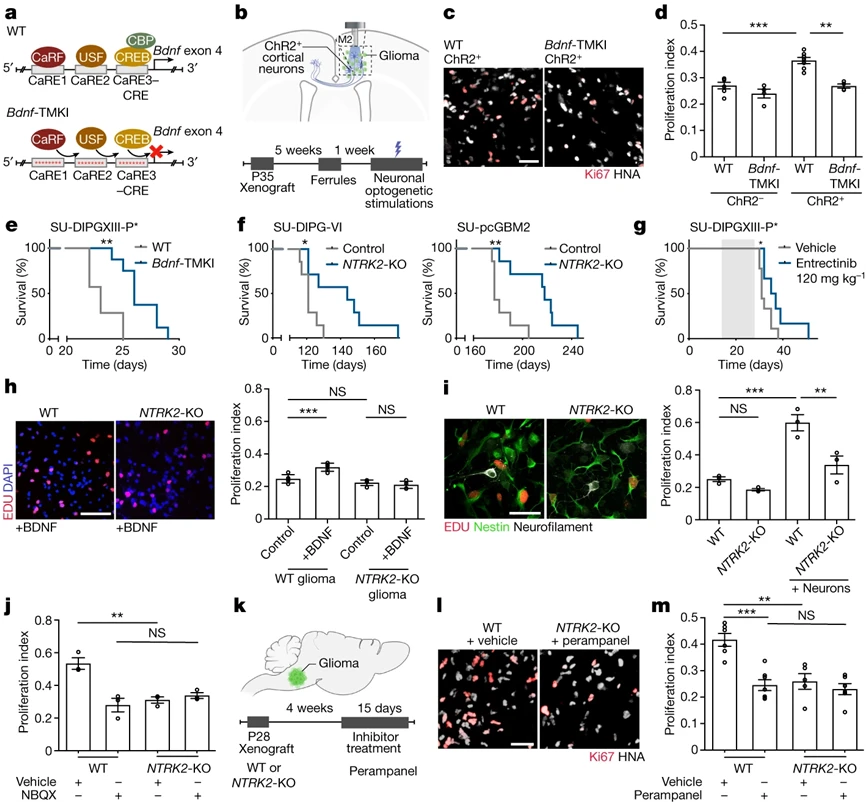
Neural activity-regulated BDNF promotes glioma progression. Image from Nature, 2023, doi:10.1038/s41586-023-06678-1.
This new study explores the response of tumors to brain-derived neurotrophic factor (BDNF), a protein that helps achieve brain plasticity. With BDNF, the brain is able to strengthen synaptic connections between cells, reinforcing the neural circuits we build during the learning process.
These authors found that gliomas use BDNF in the same way that healthy brain cells do: BDNF travels from neurons to tumor cells, triggering a chain reaction inside the tumor that ultimately helps it form more and stronger synapses.
In a key experiment in the Taylor-led study of BDNF, it was shown that when the cellular mechanisms triggered by BDNF were more strongly activated, tumor cells responded with stronger currents, which in turn promoted their growth. In other words, cancer uses the brain's learning mechanisms to grow.
Taylor says, "We looked at electrophysiologic recordings and saw this growth ...... I'll never forget it. It was incredible. What's amazing about this discovery is that these tumor cells not only make connections, but also respond dynamically to input from healthy brain cells. The tumor cells not only integrated into the neural network, but also increased their connections to it."
Previous research by Monje's team has shown that another mechanism of neuroplasticity is driven by a signaling molecule called neuroligin 3, which acts independently of BDNF and also increases neuron-to-glioma synapses.
Taylor acknowledges that it's troubling that tumors use brain activity to grow. She says, "The same brain electrical activity that helps us think, move, feel, touch, and see. Cancer uses that electrical activity to grow, invade and even happen."
Hope for a cure
But understanding these troubling interactions between tumors and the healthy nervous system offers new options for cancer treatment. In this new study, Taylor, Monje, and their team of researchers found that drugs targeting the BDNF receptor (which were developed for other cancers with mutations in this receptor) were surprisingly effective in slowing the growth of DIPG and other gliomas, which typically do not have genetic alterations in this receptor.
Other drugs, including certain painkillers, anti-seizure medications, and antihypertensive drugs, also have anti-cancer potential. A detailed understanding of how tumors use nerve signals to grow provides a huge boost to cancer treatment research, as scientists can match the drugs in the FDA-approved "medicine cabinet" of neuroactive drugs with their new knowledge of how cancer works.
Stopping the most serious gliomas, including DIPG, requires combining strategies from cancer neuroscience and other oncology specialties, Monje said. Perhaps doctors could start with a neurological drug treatment that slows tumor growth and then use immunotherapy -- such as specially designed CAR-T cell immunotherapy, which her team is also investigating to treat DIPG with CAR-T cells -- as a second line of attack. this strategy might give immunotherapy enough of a head start to allow it to squash fast-growing tumors.
Monje's team also plans to learn more about how electrical currents prompt tumor growth. She says, "As we discover the details of these voltage-sensitizing mechanisms, this will open up a whole new realm of potential therapeutic targets."
Cancer neuroscience also offers clues about how to treat tumors outside the brain. Nerves often send signals to stem cells that help regulate the development and repair of healthy organs, Monje says, adding, "The nervous system plays an extremely important role in cancers such as pancreatic, prostate, breast, colon, stomach, skin, and head and neck cancers-and the list is long." Monje added that there is also evidence that tumors that start outside the nervous system can hijack normal nerve signals once they invade the brain.
Future prospects
Monje was inspired to start studying DIPG more than 20 years ago, when the biology of the disease was completely unknown. Older methods of trying to treat this deadly tumor have ended their mission, she says.
It's a connective tumor; it connects the whole nervous system," she says. We have to cut it off. We know enough about the disease today to have a lot of really reasonable ways to fight it."