In a new study, researchers from the University of Illinois and Roche Switzerland report that they have found a way for antimicrobial drugs to penetrate the virtually impenetrable outer membrane of Pseudomonas aeruginosa. By bombarding Pseudomonas aeruginosa with hundreds of compounds and using machine learning to determine the physical and chemical properties of these molecules as they accumulate in its body, they discovered how to penetrate the outer membrane of this bacterium. They used this information to convert antimicrobial drugs that were previously inactive against Pseudomonas aeruginosa into drugs that are active against it. The findings were published online on November 22, 2023 in the journal Nature under the title "Porin-independent accumulation in Pseudomonas enables antibiotic discovery ".
Paul Hergenrother, corresponding author of the paper and professor of chemistry at the University of Illinois at Urbana-Champaign, said, "Pseudomonas remains the most difficult Gram-negative bacterial infection to treat, and treatment of Gram-negative infections in general is very challenging. The U.S. Food and Drug Administration (FDA) has not approved a new antibiotic drug for Gram-negative bacteria in more than 50 years."
Gram-negative and gram-positive bacteria have different cell wall compositions. Emily Geddes of the University of Illinois at Urbana-Champaign, first author of the paper, said Pseudomonas aeruginosa has a tightly packed outer membrane that is negatively charged. "This makes it difficult for other molecules to pass through by passive diffusion."
Pseudomonas aeruginosa also has other defenses, Geddes says, including highly specialized porins that enable it to bring in specific nutrients while keeping others out; and efflux pumps, which expel unwanted compounds from the body. pseudomonas aeruginosa has 12 efflux pumps, Geddes says. "This really confers a diversity of resistance mechanisms that some other bacterial species don't have." Our goal, she says, "is basically to test a series of compounds to see what types of molecules get into this bacterial cell and stay inside the cell, and hopefully learn some design principles from that."
Hergenrother said early research on Pseudomonas aeruginosa focused on antibiotics, testing which ones could kill or weaken the bacteria.
He says, "We took a different approach - testing a range of non-antibiotic compounds and tracking which ones accumulated in the body. We then used machine learning to understand the common chemical characteristics of these buildups."
This approach found, among other characteristics, that compounds with positively charged surfaces and compounds with a larger surface area of hydrogen bond donors were more likely to accumulate in P. aeruginosa, Geddes said, and that these compounds "can form a gap in the bacterium's outer membrane, destabilizing it and letting other substances through."
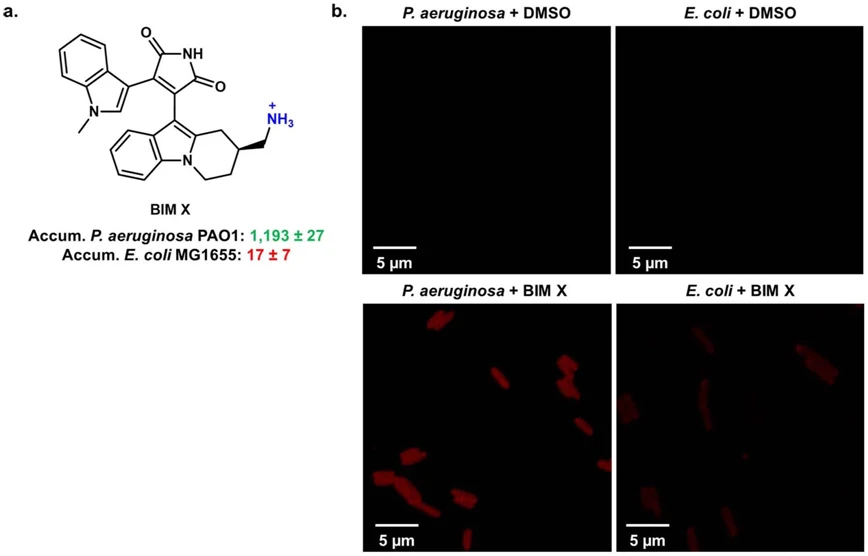
Image from Nature, 2023, doi:10.1038/s41586-023-06760-8.
Once they knew what characteristics a compound must have to penetrate Pseudomonas aeruginosa, these authors chose to test these rules by adapting an existing antibiotic drug, fusidic acid (FA), in which fusidic acid is used to treat gram-positive bacterial infections but has no activity against gram-negative bacteria. They modified the drug by constructing a derivative form of it, called an FA precursor drug (FA prodrug), which incorporates the features found in the machine learning exercise.
Geddes said the experiment was successful. She said, "As the positive charge increased and the surface area of the hydrogen bond donor increased, we saw a corresponding increase in the accumulation of the FA prodrug in Pseudomonas aeruginosa. With these changes, we found a 64-fold increase in activity."
Hergenrother said, "FA alone had no activity against Pseudomonas aeruginosa. Therefore, being able to construct this FA precursor drug is a strong demonstration of these rules."
Geddes says that this FA precursor drug by itself would probably not be a candidate for use against Pseudomonas infections. However, the principles learned in this new study will help design new compounds to fight these dangerous drug-resistant infections.