In a new study, researchers from Memorial Sloan Kettering Cancer Center (hereafter referred to as the MSK team) have revealed a previously unknown link between two important features of cancer - chromosomal instability and epigenetic alterations. This discovery not only opens up a fertile new field for basic science biology research, but also has implications for clinical treatment. The findings were published online on June 7, 2023, in the journal Nature under the title "Epigenetic dysregulation from chromosomal transit in micronuclei".
Chromosomal instability is associated with changes in the number of chromosomes carried by each cancer cell. Epigenetic alterations affect which genes are turned on or off in a cell, but do not modify their DNA code.
Chromosomes are tightly packed strands of DNA that carry our genetic information. Normally, we have 46 chromosomes per cell - half from our father and half from our mother. When a cell divides to produce its daughter cells, all of these chromosomes should be passed on to the new daughter cells, but in cancer, this process can go horribly wrong.
One of the big questions my lab is trying to answer is how chromosomal instability drives cancer evolution, progression, metastasis and drug resistance," said paper co-corresponding author Samuel Bakhoum, PhD, of Memorial Sloan Kettering Cancer Center. It's a feature of cancer, especially advanced cancers, which can make the normal process of cell division go haywire. Instead of 46 chromosomes, you might have a cell containing 69 chromosomes right next to a cell containing 80 chromosomes."
The prevailing view in this field is that cancer cells increase their chances of survival by reorganizing their genetic material as they divide. This process increases the chances of some random changes that allow the newly created daughter cells to resist immune system attacks and medical interventions.
Bakhoum says, "However, this new study suggests that this is only part of the story." That's because you can have two cancer cells, each with the same number of extra copies of a particular chromosome, but each with different genes turned on or off. This is due to additional epigenetic changes.
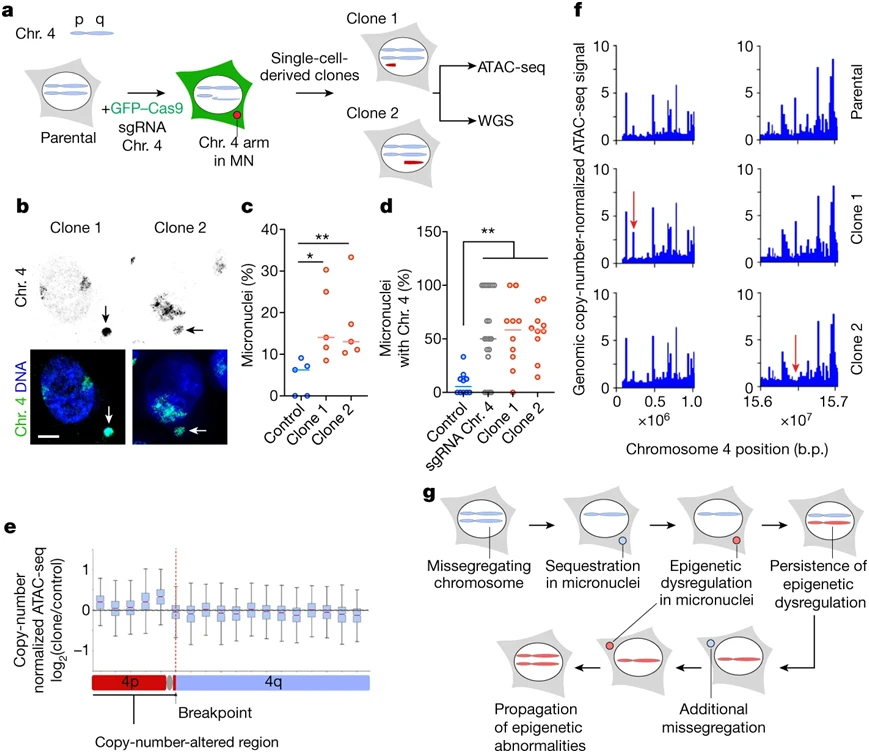
Chromosomal transport in micronuclei promotes inherited epigenetic abnormalities. Image from Nature, 2023, doi:10.1038/s41586-023-06084-7.
Dr. Bakhoum said, "Our study further shows that mutations in the genes encoding epigenetic modifying enzymes are not actually required for epigenetic abnormalities to occur. All that is required is the presence of persistent chromosomal instability. This is an unexpected finding, but really important. It also explains why we often find chromosomal instability and epigenetic abnormalities in advanced drug-resistant cancers, even when there is no evidence of the type of mutation that we would expect to cause epigenetic disruption."
Smaller, additional nuclei in cells - micronuclei (micronuclei) - are usually rare and are quickly eliminated by the cell's natural repair mechanisms. When many such micronuclei are observed in a cell, it is an indication that something has gone terribly wrong in the cell, as happens in cancer.
Like the main nucleus in a cell (also called the primary nucleus), these micronuclei contain a portion of the genetic material. This new study shows that the sequestration of chromosomes into micronuclei disrupts the assembly of chromatin, in which chromatin is packaged into chromosomes during cell division. This results in a persistent epigenetic dysregulation that continues after the micronucleus is reintegrated into the cell's nucleus.
The repeated formation and reintegration of micronuclei during the many cycles of cell division leads to an accumulation of epigenetic changes. These, in turn, lead to increasing differences between different cancer cells. The greater the differences between different cancer cells within the same tumor, the more likely it is that some cancer cells will become resistant to any treatment being administered, allowing them to survive and continue to grow uncontrollably.
To understand and quantitatively determine the epigenetic changes that occur within cells, these authors used a series of complex experiments to isolate micronuclei and probe the changes that occur in them compared to the nuclei in cells. This allowed them to observe changes in the pattern of histone modifications, which in turn altered access to genes. They also compared intact micronuclei with ruptured micronuclei and found that the degree of change was even greater in ruptured micronuclei. They also found that there were many more promoter regions in the micronucleus than in the nucleus.
In a key experiment, these authors forced a chromosome into the micronucleus and then allowed it to reintegrate into the nucleus. They compared this adventurous chromosome with a chromosome that remained in place. Dr. Yael David of Memorial Sloan Kettering Cancer Center, co-corresponding author of the paper, said, "Our model chromosome, which happens to be the Y chromosome, shows substantial changes in its epigenetic landscape and DNA accessibility. This is significant because the process by which a chromosome enters the micronucleus has a major impact on epigenetic changes in the nucleus, which we know plays a role in tumor progression and evolution. We now have confirmation that chromosomal instability and epigenetic changes are closely linked, and we can look deeper and ask exactly the right questions about how and why."
Meanwhile, researchers from Harvard University and the Dana-Farber Cancer Institute published another paper in the same issue of Nature titled "Heritable transcriptional defects from aberrations of nuclear architecture " that found supporting additional evidence to support the MSK team's findings.
Clinical Implications
The authors note that this new research not only reveals changes occurring within cancer cells, but also offers hope for treating patients.
The presence of chromosomal instability and micronuclei may be used as biomarkers to help determine which patients are more likely to be helped by epigenetically modified drugs, Dr. Bakhoum said.
In addition, these findings may pave the way for new treatments. One question is whether we should use these epigenetic modification therapies to treat chromosomally unstable cells," he said. This study shows that epigenetic changes can occur without the presence of genetic mutations."
Dr. Bakhoum added that, in addition, this new study suggests that ongoing research on drugs that directly target chromosomal instability may benefit from being combined with efforts to suppress epigenetic changes.