The SARS-CoV-2 virus that causes COVID-19 causes severe acute respiratory syndrome, perhaps in contrast to other coronaviruses known to cause mild seasonal colds that emerged in 2019, and raising the question of why one coronavirus affects humans more severely than another. In a recent study published in the international journal Nature entitled "TMPRSS2 is a functional receptor for human coronavirus HKU1," scientists from the Pasteur Institute and other institutions have provided a partial answer to this question through their research, and have identified the seasonal The scientists from the Institut Pasteur and other institutions have provided a partial answer to this question by identifying the channel through which the seasonal coronavirus HKU1 enters human cells.
HKU1 binds to a different receptor than SARS-CoV-2, which may partly explain the difference in severity between the two coronaviruses, and the receptor could be a useful way to help elucidate the spread and pathology of coronaviruses as part of the monitoring of their evolution. There are currently seven coronaviruses known to infect humans, four of which are generally considered to be mildly pathogenic, including HKU1, 229E, NL63, and OC43, and three of which are highly pathogenic, including SARS-CoV-1, Mers-CoV and SARS-CoV-2. Back in 2005, researchers first isolated HKU1 from an elderly man from Hong Kong who was suffering from severe pneumonia. Like SARS-CoV-2, HKU1 mainly infects the upper respiratory tract cells of the body, however, it rarely infects the bronchial tubes and alveoli in the lungs, and the HKU1 virus causes colds and other mild respiratory symptoms. Patients may also develop complications, including severe respiratory infections, especially in young children, the elderly, and immunocompromised individuals. It is estimated that 70% of children will become infected before the age of 6 years, and a total of 75%-95% of the global population has been exposed to HKU1, which is perhaps comparable to other seasonal human coronaviruses.
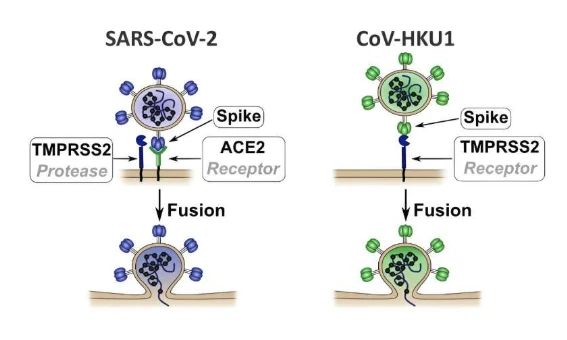
Scientists identify the specific receptor used by coronaviruses to enter human cells.
Image from: Nature (2023). DOI:10.1038/s41586-023-06761-7
At the cellular level, the spiking proteins of coronaviruses are cleaved or split in half when bound to a receptor, and this splitting phenomenon is essential for viral fusion, entry, and proliferation.Some coronaviruses (e.g., SARS-CoV-2 and NL63) are able to use the ACE2 receptor as a gateway to enter the cell, and so far HKU1 and OC43 are the only ones with unknown receptors for the coronaviruses. In this study, the researchers identified the TMPRSS2 enzyme class or can act as a receptor for HKU1 to enter the cell, and once binding occurs, TMPRSS2 induces fusion of HKU1 with the cell, which leads to viral infection.By using a combination of techniques to test this in vitro and in cell cultures, the researchers found that the TMPRSS2 receptor with the HKU1 spines with high affinity, which was not the case for SARS-CoV-2.
Researcher Olivier Schwartz said that once the viral receptor is identified, it will be possible to characterize the target cells more accurately, as well as to gain a deeper understanding of the viral entry, proliferation mechanisms, and pathophysiological features of the infection; the study in this paper also revealed multiple evolutionary strategies employed by coronaviruses, which are able to use TMPRSS2 to bind to the target cells or to induce viral and fusion with target cells and viral entry. These human pathogenic viruses can use different receptors to influence the severity of their pathogenicity, and the level of receptors varies in respiratory cells, which in turn affects cellular susceptibility to infection and viral dissemination; once the pathways of viral entry into the cell are known, it will be possible for researchers to combat infection more effectively through the development of targeted therapies and the assessment of virulence risk posed by any emerging coronaviruses in the future. infections.
At the same time, the researchers also developed and revealed a nanobody that inhibits HKU1 infection by binding to the TMPRSS2 receptor, and these agents are currently patented for their potential therapeutic activity. Taken together, the results herein reveal multiple evolutionary strategies for coronaviruses that may utilize TMPRSS2 to either bind directly to target cells or to guide spines for viral membrane fusion and entry into target cells.