The amount of time we spend exposed to daylight may affect what we eat and how we burn calories, which may help us understand the link between the seasons and our metabolism; imagine that you might be a little healthier in the summer because the sunny weather gives us plenty of vitamin D and the longer days promote this. However, in a recent study published in the international journal Cell Metabolism, entitled "Seasonal light hours modulate peripheral clocks and energy metabolism in mice", a group of researchers from the University of Copenhagen and other institutions reported that the sunny weather is associated with higher levels of vitamin D in mice. In the study, scientists from the University of Copenhagen and other institutions revealed a link between the seasons and the body's dietary habits, finding that a winter diet may be better for the body's metabolic health than a summer diet, at least in mice, and analyzed the effects of exposure to "winter daylight" and "summer daylight" on the body's metabolic health. The researchers also analyzed the metabolism and body weight of mice exposed to "winter daylight" and "summer daylight.
We found that even in non-seasonal animals, the difference in light between summer and winter causes differences in energy metabolism, in which case body weight, adiposity, and liver fat content are altered; this happened mainly in mice exposed to winter daylight, which showed relatively less weight gain and obesity, and whose dietary patterns over the 24-hour period were very different from the mice exposed to winter daylight. These mice had relatively less weight gain and obesity, and ate in a rhythmic manner over a 24-hour period, which may have some benefits for their metabolic health. This study is the first of its kind to analyze the effect of light exposure on the metabolism of mice, which are not considered seasonal animals like humans, but reproduce during certain seasons, before which they gain weight and thus conserve energy.
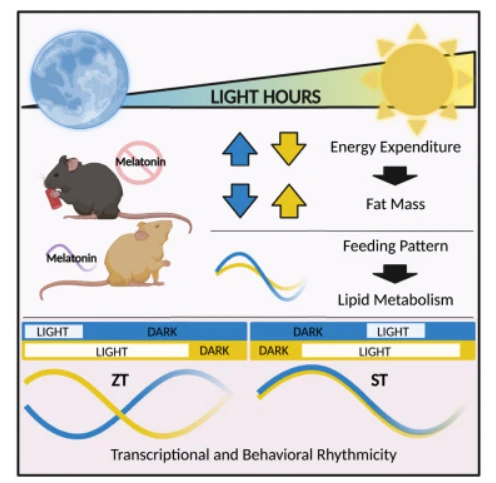
A winter diet may be more favorable to the metabolic health of the organism than a summer diet.
Image from: Cell Metabolism (2023). DOI:10.1016/j.cmet.2023.08.005
The researchers were inspired to launch the study by the huge differences in the amount of daylight hours experienced by people around the world. The researchers examined the effect of the time of day on the body's metabolism in terms of exercise, obesity, and diabetes, however, most of the studies that have investigated this association assumed that the length of the day and night is the same throughout the year. So the researchers wanted to find out how seasonal differences in light affect the body's metabolism. Most of the world's population lives in environments where there is a difference of at least two hours of light between summer and winter, says researcher Small. I'm from Australia, and when I first moved to Denmark I wasn't accustomed to the huge difference in light between the summer and the winter, and I was very interested in how this affects the body's circadian clock and metabolism, so we exposed lab mice to different light hours representing different seasons and measured metabolic health and circadian biomarkers in these animals. Because this study was conducted using mice as subjects, it is not possible to assume that the same thing applies to humans.
So does the difference in light duration affect the energy metabolism of the organism? Yes, it does, and the researchers believe that further studies in humans suggest that changing the amount of artificial light the organism is exposed to at night or the amount of time it is exposed to natural light during the year may be able to be used to improve the organism's metabolic health, and the researchers add that the new knowledge is very important for understanding how dietary patterns can be affected by light and the seasons, and that this may help us to understand why some people gain a lot of weight, or whether people gain a lot of weight at certain times of the year.
Differences in light between summer and winter may affect the body's hunger pathways and the amount of time it feels hungry during the day. Taken together, the data from this paper suggest that seasonal light may affect the body's energy metabolism by regulating the timing of eating.