Natural killer cell (NK cells) are the "occupational killers" of tumors and play a pivotal role in anti-tumor immunotherapy. However, the anti-tumor function of NK cells in the tumor microenvironment is seriously challenged. Most advanced tumors can escape the killing of NK cells. It is urgent to clarify the mechanism and find a new scheme to restore the function of NK cells.
The National Research Center for Micro scale Material Science of the University of Science and Technology of China and the research team of Professor Wei Haiming, Professor Zheng Xiaohu and Professor Tian Zhigang from the Department of Life Science and Medicine, in cooperation with the research team of Huang Guangming from the School of Chemistry and Materials Science of the University of Science and Technology of China and the director of Qian Yeben from the First Affiliated Hospital of Anhui Medical University, found that NK cells in the microenvironment of tumor tissue lost their facial mask protuberances and could not identify tumor cells, Loss of anti-tumor function. They also created a "single immune cell membrane mass spectrometry detection technology", revealing that the loss of sphingomyelin, the main component of NK cell membrane, is the main reason for the loss of surface protrusions of NK cells.
This research achievement was published in the journal Nature Immunology on March 23, 2023, under the title "Tumors evade immune cytotoxicity by altering the surface topology of NK cells". The study reveals a new mechanism of tumor immune escape, providing new ideas and targets for NK cell based tumor immunotherapy.
In this study, the topology morphology of NK cell membrane in the microenvironment of normal tissue and tumor tissue can be clearly seen by using transmission and scanning electron microscope technology. The surface of normal NK cell membrane is rich in protrusions, while the surface of NK cell membrane in the microenvironment of tumor tissue is unusually smooth, and the protrusions are obviously lost (Figure 1).
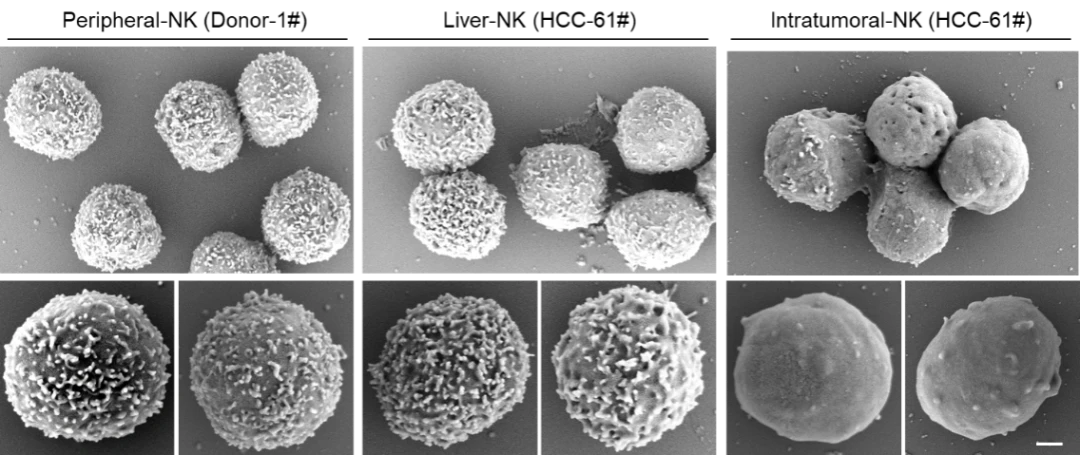
Figure 1: The surface of normal NK cells from peripheral blood and liver tissue showed abundant membrane bulges (left and middle), while the surface of NK cells from tumor tissue microenvironment was unusually smooth, and membrane bulges were lost (right).
Further exploration has found that normal NK cells use membrane protrusions to recognize and grasp tumor cells, and promote cell-cell interactions to form "immune synapses", exerting anti-tumor effects. This immune synapse is a special structure between NK cells and tumor cells. NK cells release granzyme to dissolve and kill tumor cells through the immune synapse. However, in patients with advanced tumor, the processes of NK cells in the microenvironment of tumor tissue are lost, which makes them unable to recognize tumor cells and form immune synapses, thus losing the ability to kill tumor cells (Figure 2).
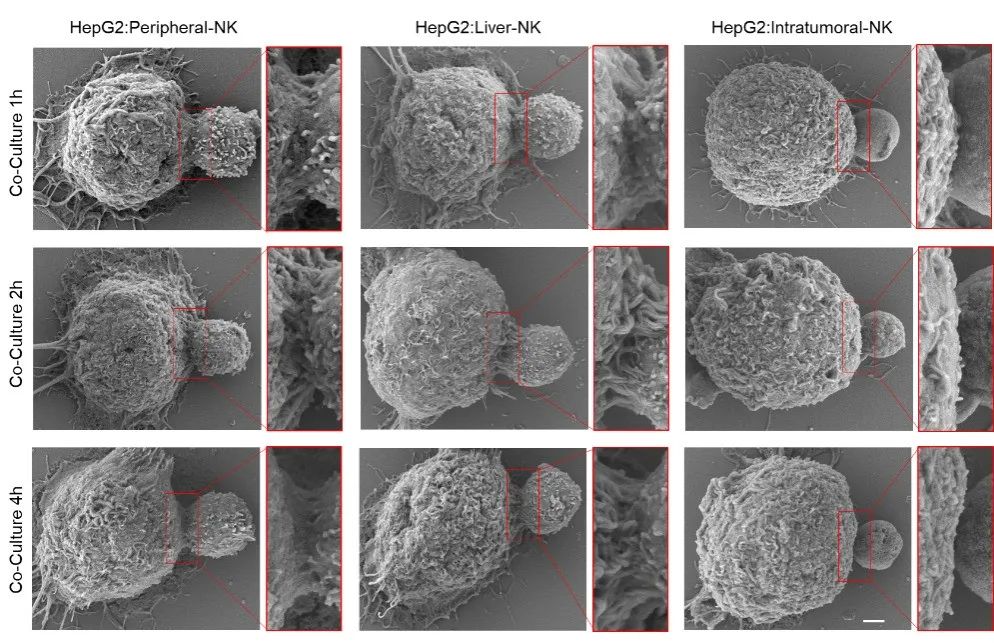
Figure 2: Normal NK cells from peripheral blood and liver tissue use membrane processes to form "immune synapses" with tumor cells (left and middle), while NK cells from microenvironment of tumor tissue lack membrane processes and fail to form them (right).
The research team also created the "single immune cell membrane mass spectrometry detection technology", found that the membrane composition of NK cells in the tumor microenvironment changed, mainly because the content of sphingomyelin was significantly reduced, and confirmed that the disorder of serine metabolism in the tumor microenvironment was the main cause of the decline of sphingomyelin. The use of targeted sphingophospholipase inhibitors can significantly increase the content of sphingomyelin in NK cell membrane of tumor microenvironment, restore the formation of neurites, and improve the recognition and killing ability of tumor cells. Targeted sphingomyelinase intervention combined with immunocheckpoint blockers has a synergistic anti-cancer effect.
This study interprets the new mechanism of functional chaos and immune escape of tumor derived NK cells from a new perspective of cell membrane topology, and also provides a new strategy for improving the immunotherapy of NK cells.