Colorectal cancer is the third most common cancer worldwide, with approximately 1.9 million new cases diagnosed and 900,000 deaths annually. Therefore, preventive medicine is a pressing clinical need. Aspirin (acetylsalicylic acid) has been shown to be one of the most promising drug candidates for the prevention of colorectal cancer.
Existing studies have shown that low-dose aspirin taken over several years in patients with cardiovascular disease reduces the risk of colorectal cancer. In addition, aspirin inhibits the progression of colorectal cancer.
Now, in a new study, Heiko Hermeking, Professor of Experimental and Molecular Pathology at the University of Munich, Germany, and her team have identified a signaling pathway in colorectal cancer that is inhibited by aspirin. Specifically, they found that aspirin induces the production of two tumor-suppressor microRNA molecules (miRNAs), miR-34a and miR-34b/c. To do this, aspirin binds to and activates the AMPK enzyme, which in turn alters the transcription factor NRF2, which then migrates to the nucleus and activates miR-34 gene expression. The results of the study were published online on October 28, 2023, in Cell Death & Disease under the title "Salicylate induces AMPK and inhibits c-MYC to activate a NRF2/ARE/miR-34a/b/c cascade resulting in suppression of colorectal cancer metastasis".
For this activation to be successful, aspirin would also have to inhibit the oncogene product c-MYC, otherwise NRF2 would be inhibited.
In summary, these findings suggest that the miR-34 gene is required to mediate the inhibitory effects of aspirin on colorectal cancer cells. Therefore, aspirin is unable to prevent migration, invasion and metastasis of colorectal cancer cells lacking miR-34. It was previously known that the miR-34 gene is induced and mediates its action by the transcription factor p53.
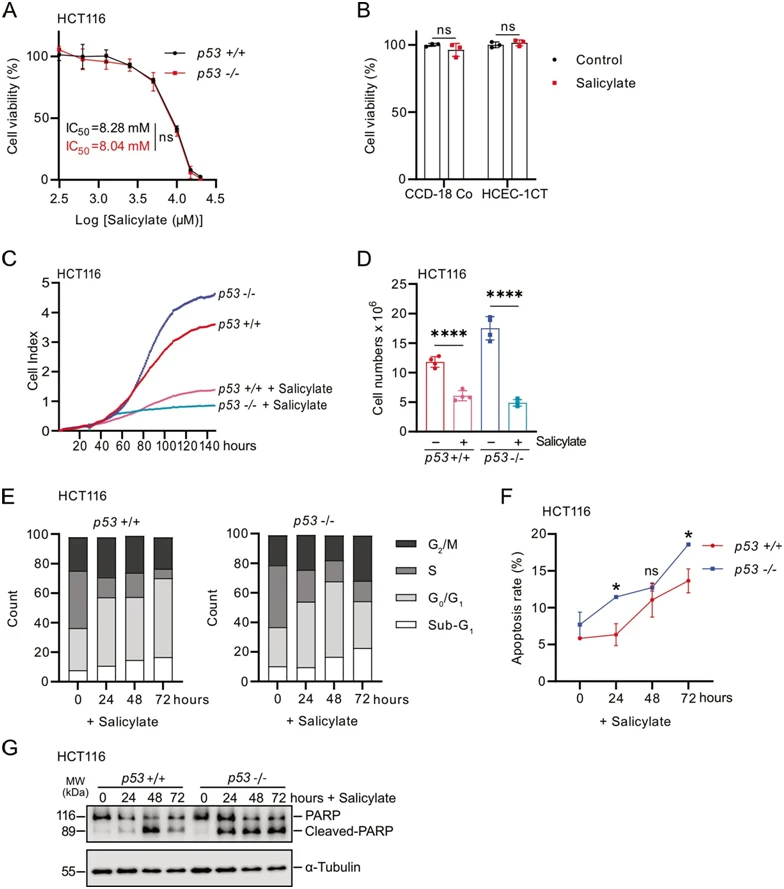
Aspirin inhibits colorectal cancer cell viability and proliferation, and this inhibition is independent of p53. Image from Cell Death & Disease, 2023, doi:10.1038/s41419-023-06226-9.
Hermeking said, "However, our findings suggest that the activation of the miR-34 gene by aspirin is independent of the p53 signaling pathway. This is important because the p53-encoding gene is the most common oncogene to undergo inactivation in colorectal cancer. Furthermore, in most other types of cancer, p53 is mostly inactivated by mutation or viral infection. Therefore, aspirin may be used to treat such cases in the future."