The development of the brain is like a carefully choreographed dance: neurons develop specific functions and move through the small range of the brain to reach the correct location, which, through the resulting chemical signals, equips the animal to think, feel, and survive.
In neurodevelopmental disorders (NDD), however, hundreds of mutations in the DNA may interrupt this process, but scientists still don't know how these mutations interrupt the precise pattern of neuronal differentiation or migration. In terms of experimental design, it is too risky to study these defects directly in embryos or newborns, and the use of other animal models may lead to less precise results.
In a new study published in Nature, Stanford neuroscientist Sergiu Paşca and his team combined assembly techniques with CRISPR gene editing to determine the role of neurodevelopmental disease genes in typical brain development and the disruption that ensues when they are absent1.
"We finally got a long list of genes that cause autism," says Paşca, "and the question is, how do we understand their function, especially in the context of the very complex human brain development."
Over the past decade, scientists have been able to transform stem cells into brain organoids, three-dimensional clusters of cells that can grow cell types and structures similar to those of the human brain.2 Six years ago, Paşca's team took this technique one step further by fusing two organoids, each of which represents a different area of the brain.3 This new model, known as an "assemblage," has allowed scientists to develop a new model of the human brain. This new model, called the "assemblage," allows scientists to artificially simulate the interactions that occur within the brain.
The new study focuses on interneurons, which carry key perceptual and motor signals in the brain. During development, these neurons migrate from one location in the forebrain to another and regulate the excessive firing of other neurons, a process that some believe is disrupted in neurodevelopmental disorders4.
Paşca's team made more than 1,000 organoids that mimic the migration of forebrain interneurons beginning in the subcortex and ending in the cortex. In each subcortical organoid, they used CRISPR gene editing to eliminate one of the 425 neurodevelopmental disorder genes screened by the researchers. They then fused the gene-edited subcortical organoids to the cortical organoids and generated the assemblies. By labeling the interneurons with molecules that emit green light, the researchers were able to track the generation of the interneuron and its migration between the cerebral cortex and the cortex.
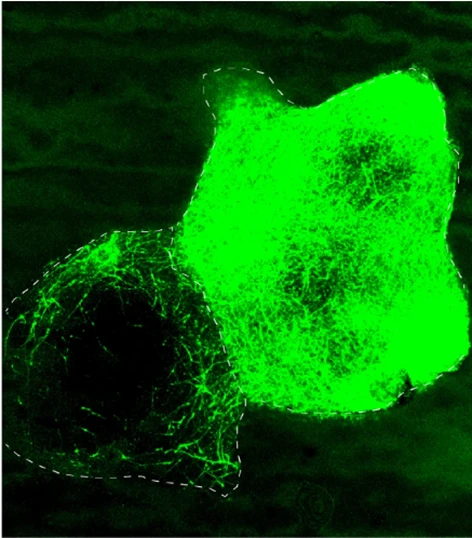
Interneurons (green) migrate throughout the assemblage in a manner similar to the way they migrate to the cortex during brain development (image source: Sergiu Paşca Laboratory)
Researchers found that 11% of neurodevelopmental disorder genes play an important role in interneuron function. In the absence of certain genes, interneurons cannot form at all. Eliminating other genes prevents interneurons from moving from subcortical-like organs to neighboring cortical-like organs. An in-depth study of the LNPK gene has shown that it disrupts the movement of intercalated neurons through subcellular structures, thus preventing the cells from traveling through the brain.
Paşca said, "We have now been able to access hundreds of genes and look at their role in human brain development in an integrated way, which could not be done before." He believes this approach could help identify new disease-causing genes. "Once we identify all the genes that interfere with the migration of interneurons, we may be able to find disease-causing genes that we didn't know about before because patients are so rare."
Yale geneticist Kristen Brennand, who was not involved in the study, said the research provides a more physiologically relevant context of the human brain than previous studies using neural progenitor cells. However, she emphasized the importance of repeating the study using more samples. Three different people can inherit the same risk gene, but one has autism, one has schizophrenia, and one is unaffected," she noted. Rare NDD genes don't work in isolation."
Paşca recognizes that interneuron migration may only lead to a fraction of neurodevelopmental disorder cases, but he believes that studying these key disease processes promises to lead to potential new drugs to treat or repair the defects. His team has already begun to dissect how these genes affect interneuron function.
"My lab is known for developing tools, but that was never really the goal," Paşca says, "My goal is to understand the biology behind serious mental illness."